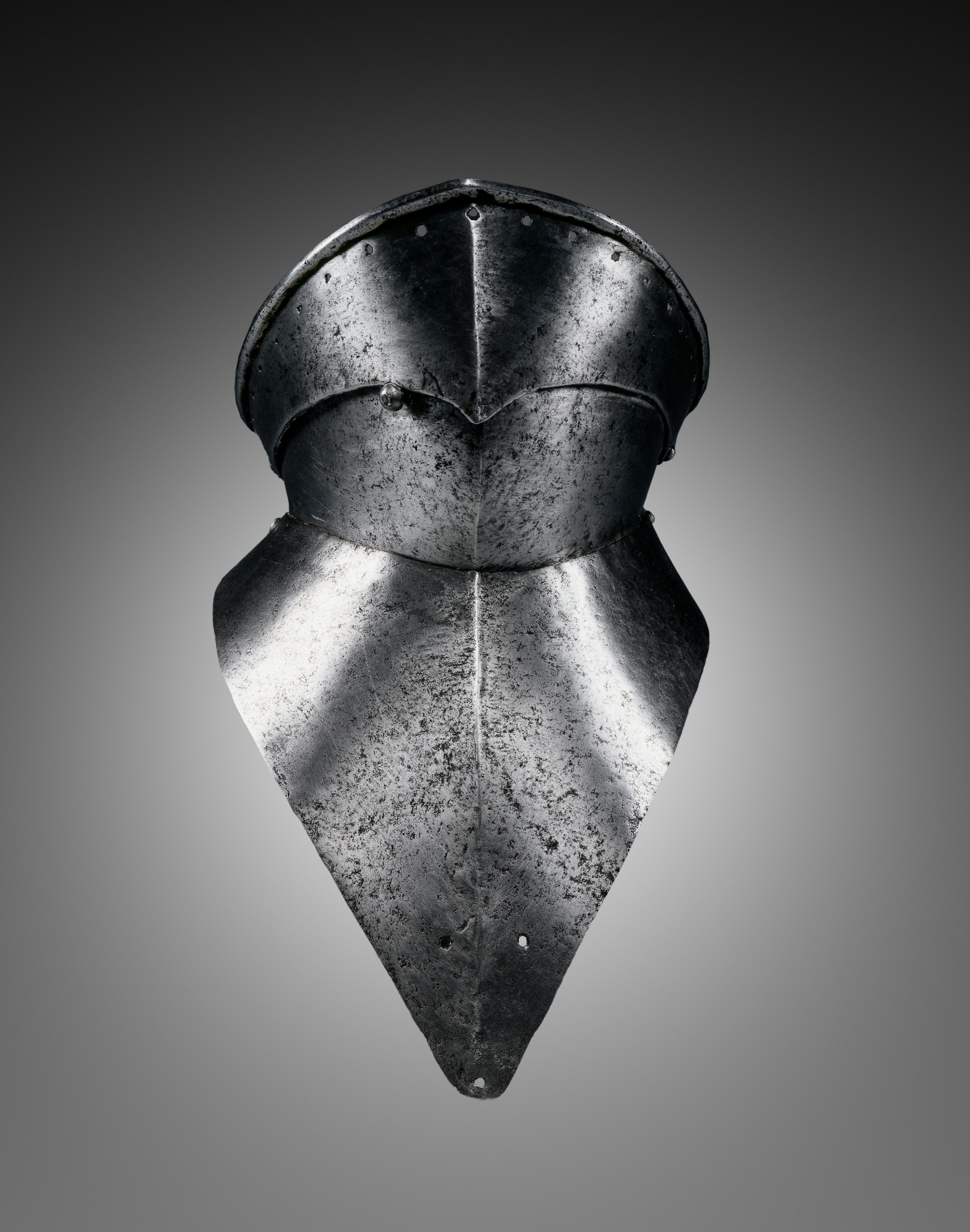
Deconstructing the Gothic Bevor: A Technical and Stylistic Analysis for Zoey Fashion Lab
The Gothic Bevor, a piece of 15th-century Hispano-Flemish steel armor, represents a pinnacle of medieval metallurgical artistry and functional design. For Zoey Fashion Lab, this artifact is not merely a historical relic but a DNA strand—a foundational genetic code that can be spliced, mutated, and re-expressed through an avant-garde lens. This analysis deconstructs the Bevor’s technical, structural, and symbolic DNA, proposing a radical reinterpretation for contemporary high-fashion application.
I. The Original DNA: Technical and Material Analysis
The Hispano-Flemish Gothic Bevor is distinguished by its asymmetrical, sculptural form, designed to protect the neck and lower face while allowing for head mobility. Typically forged from a single piece of medium-carbon steel, it features a pronounced, flared lower edge that rests on the gorget, and a pointed, upward-sweeping visor-like extension that guards the chin. The surface is often adorned with gilded or etched decorative bands, reflecting the Flemish preference for intricate, linear ornamentation combined with Spanish robustness.
From a structural engineering perspective, the Bevor’s genius lies in its stress distribution. The steel is hammered to varying thicknesses—thicker at the point of impact (the chin) and thinner at the articulation points—creating a dynamic, almost organic tension. The flared flange at the base functions as a load-bearing collar, channeling force downward into the torso armor. The surface finish, often a dark, blued patina or polished mirror, was not merely aesthetic but a corrosion-resistant treatment that also served to deflect blows.
For Zoey Fashion Lab, the Bevor’s DNA is encoded in three key technical attributes: asymmetrical geometry, variable material density, and integrated ornamentation that enhances structural integrity. The flared lower edge, for instance, is not decorative; it is a counterbalance to the forward-thrusting chin piece, creating a visual and physical equilibrium.
II. Deconstructing the Avant-Garde Mutation
To translate this 15th-century steel into an avant-garde fashion statement, we must first sever the original DNA—detach the Bevor from its martial context and re-imagine it as a wearable sculpture that challenges conventional silhouette, materiality, and gender norms. The avant-garde style at Zoey Fashion Lab is defined by deconstruction, reconstruction, and hybridity. The Bevor becomes a template for a new species of garment—a “necklace-armor” that blurs the line between jewelry, protective gear, and architectural drapery.
Material Mutation: The steel is replaced with laser-sintered titanium alloy for its lightweight, high-strength properties, but the surface treatment is inverted. Instead of a polished or blued finish, we introduce a matte, micro-porous texture that mimics the patina of aged steel while being chemically inert against skin. The gilded borders are reimagined as flexible, 24-karat gold-plated mesh that can be detached and reconfigured, allowing the wearer to modulate the piece’s formality.
Structural Deformation: The Bevor’s rigid, single-piece construction is fractured into seven interlocking segments, each connected by invisible, spring-loaded hinges. This allows the piece to collapse flat for storage or expand into a dramatic, three-dimensional collar that extends 15 cm from the neck. The flared lower edge is exaggerated into a trapezoidal, asymmetrical wing that can be articulated via internal cabling—a nod to the original’s load-bearing function, now transformed into a dynamic, kinetic element.
Ornamental Re-Engineering: The etched decorative bands are replaced with embedded fiber-optic strands that emit a low, pulsating light in hues of deep burgundy and charcoal—colors derived from the original Spanish steel’s bluing process. The light is not merely decorative; it is synchronized with the wearer’s biometric data (heart rate, breath), making the Bevor a responsive, living interface. The original’s gilding is abstracted into thin, detachable gold wires that can be woven into the wearer’s hair or draped across the shoulders, creating a second, ephemeral skin.
III. Stylistic Integration: The New DNA Strand
In the context of an avant-garde collection, the deconstructed Bevor is not a standalone piece but a connective node in a larger garment system. It becomes the collar of a hybrid armor-couture dress that fuses medieval silhouette with post-human aesthetics. The dress itself is constructed from recycled carbon-fiber fabric that mimics the drape of velvet but possesses the tensile strength of steel. The Bevor’s flared flange extends into a corset-like bodice with integrated exoskeletal ribs, referencing the original’s stress-distribution logic.
The asymmetry of the Bevor is echoed in the dress’s hemline—a sharp, diagonal cut that reveals one leg and a high-heeled boot with articulated steel toes. The boot’s design borrows the Bevor’s pointed chin guard as a toe cap, creating a visual rhyme from neck to foot. The overall silhouette is architectural, imposing, and androgynous, challenging the wearer to embody both knight and muse.
Symbolic Deconstruction: The original Bevor was a symbol of martial authority and social status. In our avant-garde reinterpretation, it becomes a meditation on vulnerability and protection. The open, segmented structure exposes the neck—historically a fatal weak point—while the articulated wings suggest a readiness to shield or attack. The biometric lighting transforms the piece from a static object into a narrative of the wearer’s internal state, making the garment a partner in performance rather than a mere costume.
IV. Conclusion: The Avant-Garde as Historical Mutation
The Gothic Bevor, when deconstructed through Zoey Fashion Lab’s avant-garde methodology, reveals itself as a timeless blueprint for human augmentation. Its steel DNA—asymmetry, variable density, integrated ornamentation—is not bound to the 15th century but is a universal language of form and function. By mutating its materiality, fracturing its structure, and re-engineering its ornamentation, we create a new strand of fashion DNA that honors the original while propelling it into a speculative future.
This analysis demonstrates that the Bevor is not a relic to be preserved under glass but a living template for innovation. For Zoey Fashion Lab, the goal is not to replicate history but to re-sequence its genetic code, producing garments that are at once armor, art, and interface. The result is a collection that speaks to the eternal human desire to protect, adorn, and transcend—a dialogue between the medieval forge and the digital age.