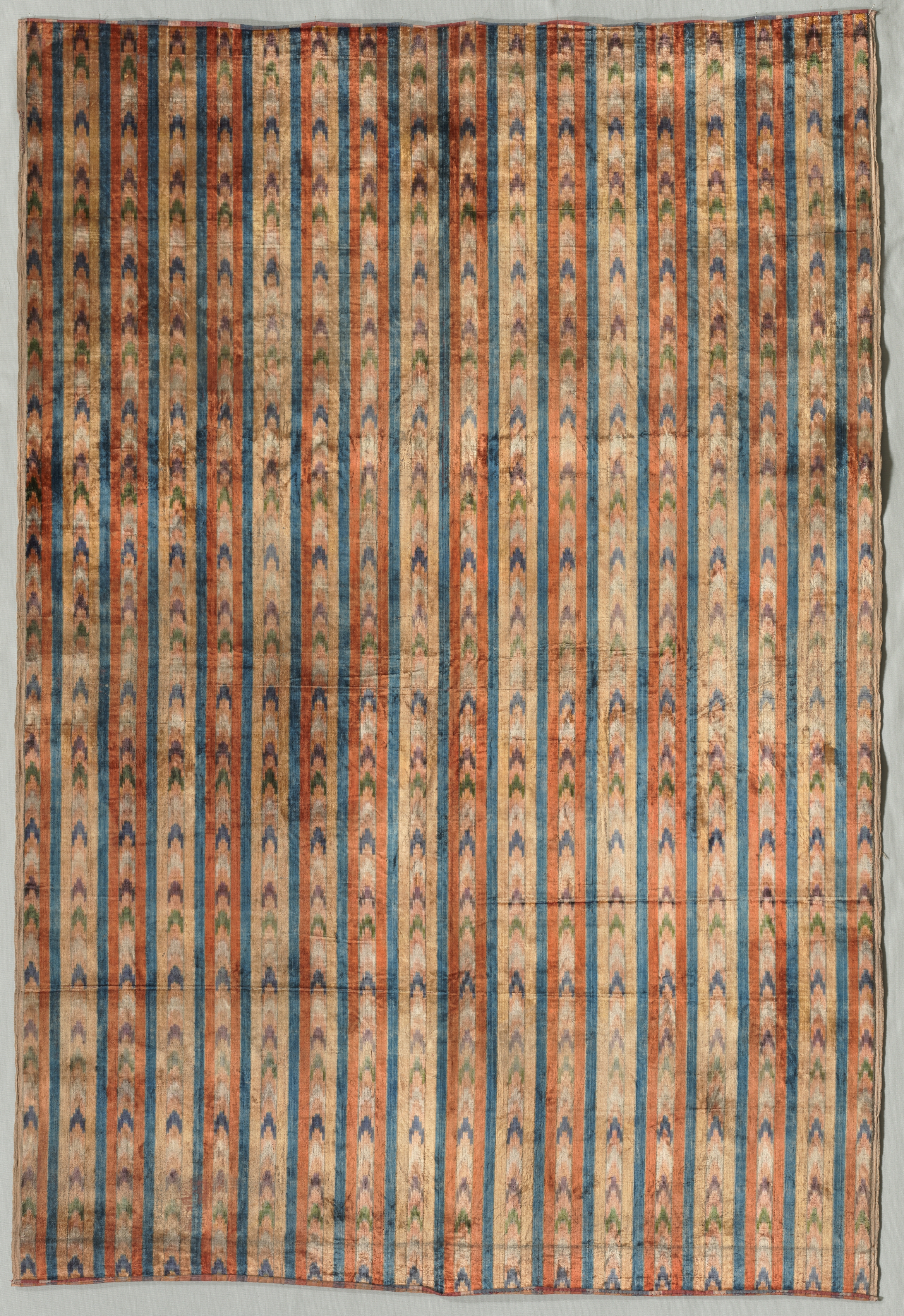
Deconstructing the Velvet Panel: An Avant-Garde Analysis for Zoey Fashion Lab
In the pursuit of redefining contemporary fashion through historical resonance, the Zoey Fashion Lab presents a critical deconstruction of a 19th-century Iranian velvet panel. This artifact, more than a mere textile, serves as a New DNA Strand—a genetic blueprint for an avant-garde aesthetic that challenges conventional design paradigms. As Chief Fabric Deconstructionist, I dissect this panel’s technical, cultural, and material properties, proposing a transformative methodology that fuses heritage with radical innovation.
Technical and Material Analysis of the Velvet Panel
The velvet panel, originating from 19th-century Iran, exemplifies the pinnacle of Safavid and Qajar-era textile craftsmanship. Its construction involves a complex weaving technique where pile threads are woven over metal rods, then cut to create a dense, lustrous surface. The base fabric, typically silk or a silk-cotton blend, provides structural integrity, while the pile—often silk—offers a deep, tactile richness. This panel’s specific design features intricate floral motifs and geometric patterns, executed through a combination of voided velvet and pile-on-pile techniques. The voided areas reveal the ground weave, creating a stark contrast between matte and reflective surfaces. The color palette, dominated by deep crimson, indigo, and gold, derives from natural dyes such as madder, indigo, and saffron, lending the velvet a subtle, uneven patina that modern synthetics cannot replicate.
From a deconstructionist perspective, the velvet panel’s physical properties are both a strength and a constraint. The pile’s fragility—susceptible to crushing and fading—demands careful handling, yet this impermanence aligns with avant-garde principles of decay and transformation. The panel’s weight and drape, influenced by its dense weave, suggest a sculptural quality that can be manipulated through cutting, fraying, or layering. The interplay of light and shadow across its surface, due to the pile’s directional nap, offers a dynamic visual rhythm that can be exploited in deconstructed garments. The historical context of this velvet—likely used for royal garments or ceremonial hangings—imbues it with a narrative of power and opulence, which the Lab can subvert through fragmentation and reassembly.
The Velvet Panel as a New DNA Strand for Avant-Garde Design
Conceptualizing the velvet panel as a New DNA Strand reframes its role from static artifact to dynamic design catalyst. In genetic terms, DNA carries instructions for development; here, the velvet’s structural and symbolic codes inform a new fashion language. The panel’s motifs—floral, arabesque, and calligraphic—are not merely decorative but encode cultural memory. For the avant-garde, this DNA can be spliced, mutated, and recombined with contemporary materials like neoprene, metal mesh, or recycled plastics. The velvet’s pile can be selectively burned or laser-cut to create organic, cellular patterns, mimicking biological growth. The ground weave, once exposed, can be reinforced with conductive threads for interactive garments, merging textile heritage with wearable technology.
The New DNA Strand metaphor also implies a departure from linear chronology. The 19th-century Iranian velvet, when deconstructed, becomes a temporal anomaly—a fragment of the past reanimated in the present. This aligns with avant-garde fashion’s penchant for time distortion, where historical references are not revived but recontextualized. The velvet’s original function as a symbol of status is inverted; in the Lab, it may serve as a raw material for garments that critique luxury, such as deconstructed jackets with exposed seams, asymmetrical draping, or unfinished hems. The DNA strand is thus a blueprint for de-familiarization, where the familiar velvet texture becomes alien through radical manipulation.
Deconstruction Methodology: From Panel to Garment
The deconstruction process begins with a systematic analysis of the velvet panel’s components. Each element—the pile, the ground weave, the dye, the motif—is isolated and studied for its potential to be fractured, layered, or hybridized. For instance, the pile can be shaved in gradient patterns to create a topographical effect, reminiscent of eroded landscapes. The ground weave, once revealed, can be dyed with reactive pigments that shift color based on body heat or UV light, introducing an element of ephemerality. The motifs, cut into individual shapes, can be re-embroidered onto transparent organza or bonded with thermoplastic films, creating a collage of historical and futuristic textures.
A key technique is fragmentation and reassembly. The velvet panel is cut into irregular, organic shapes—resembling tectonic plates or cellular membranes—and then recombined with contrasting materials. For example, a velvet fragment from the panel’s center might be suspended within a lattice of 3D-printed nylon, referencing both Islamic geometric art and digital fabrication. The edges of the velvet are left raw, allowing the threads to fray, which creates a soft, halo-like effect that contrasts with the rigid lattice. This method embodies the avant-garde principle of bricolage, where disparate elements are combined to generate new meanings.
Another approach is inversion and exposure. The velvet’s backside, often overlooked, reveals the structural weave and the knots of the pile. By turning the panel inside out, the design exposes the labor of its creation—the tension of the threads, the irregularities in the dye—which becomes a form of visual text. This inverted velvet can be used as a lining or as an external panel in a garment, challenging the hierarchy of finish and rawness. The contrast between the plush front and the utilitarian back creates a dialogue between luxury and utility, a central theme in avant-garde fashion.
Avant-Garde Applications and Conceptual Frameworks
The deconstructed velvet panel can be applied to a range of avant-garde silhouettes. Consider a deconstructed coat: the velvet forms a single, asymmetrical sleeve that extends into a train, while the rest of the garment is constructed from translucent resin panels. The velvet’s pile is selectively burned to reveal the ground weave, which is then embroidered with silver thread to mimic neural networks. This design references the New DNA Strand as a metaphor for connectivity, where the historical velvet becomes a node in a network of materials and ideas.
Alternatively, a hybrid dress could incorporate the velvet as a corset-like insert, with the motifs laser-cut into lace patterns that overlay a base of biodegradable cellulose film. The dress’s hem is left unfinished, with velvet threads trailing like roots, suggesting growth and decay. This garment challenges the notion of completeness, embracing the unfinished as a aesthetic choice. The Iranian velvet, with its rich symbolism, is thus transformed into a commentary on cultural hybridity and environmental consciousness.
The avant-garde also demands a critical engagement with the body. The velvet panel’s weight and texture can be used to distort the silhouette, creating exaggerated shoulders, cinched waists, or cascading folds. By integrating the velvet with pneumatic structures or shape-memory alloys, the garment can change form in response to movement or environment. This aligns with the New DNA Strand concept as a living, adaptive system. The velvet’s historical association with luxury is subverted; it becomes a tool for exploring the boundaries of the human form and the garment’s agency.
Conclusion: The Velvet Panel as a Catalyst for Innovation
The 19th-century Iranian velvet panel, when deconstructed through the lens of the New DNA Strand, offers a rich repository of techniques, textures, and narratives for Zoey Fashion Lab. Its technical intricacies—the pile, the weave, the natural dyes—provide a foundation for radical manipulation, while its cultural weight invites critical reinterpretation. By fragmenting, inverting, and hybridizing this historical textile, the Lab can produce garments that are not merely fashion but fashion as theory. The velvet panel becomes a living DNA strand, its codes rewritten for a future where heritage and avant-garde coexist in dynamic tension. This analysis serves as a blueprint for a new design vocabulary, one that honors the past while tearing it apart to build something unprecedented.