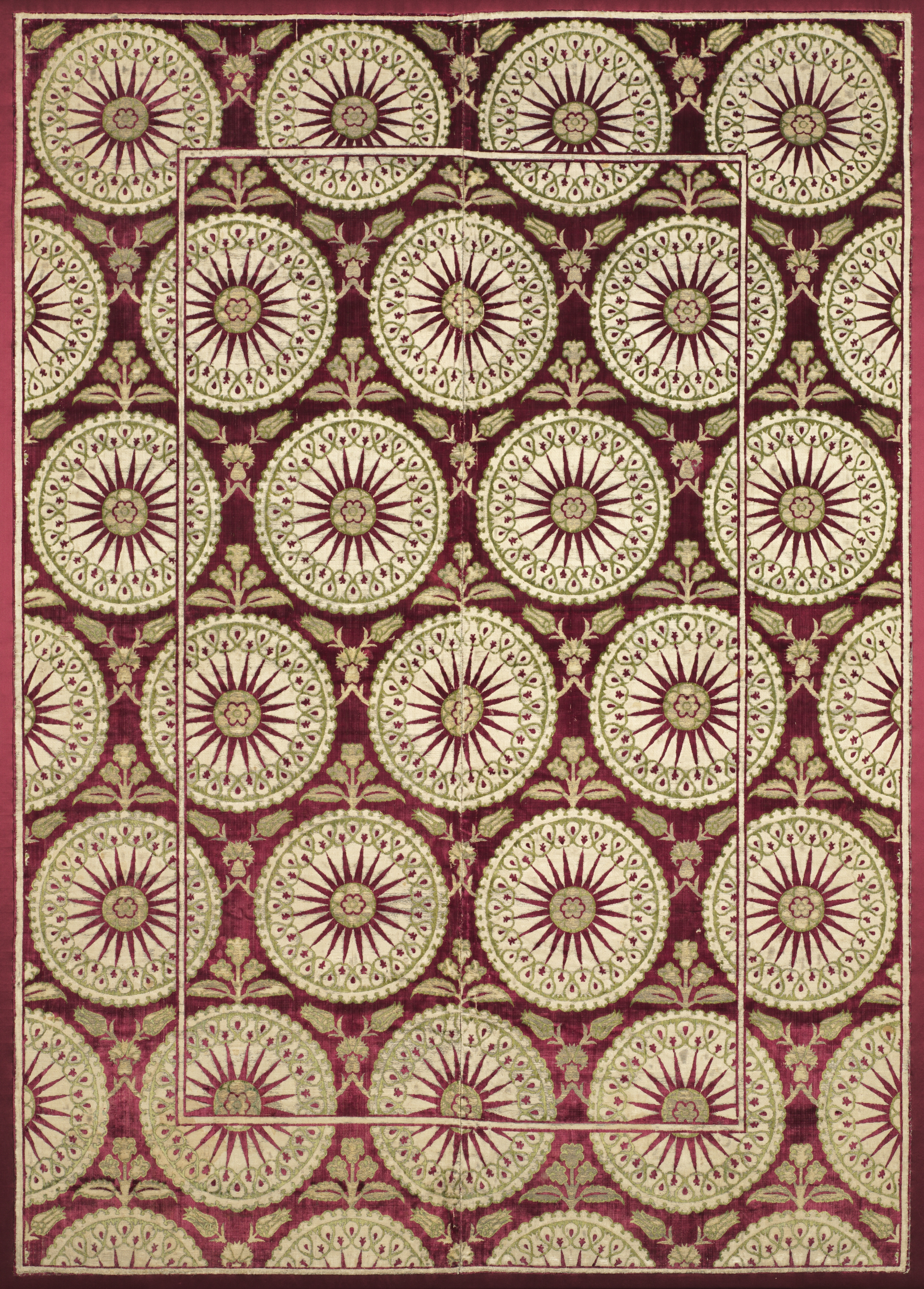
Technical Deconstruction: The Anatomical Blueprint
The object in question is not merely a textile; it is a complex, stratified ecosystem of materials and techniques. Our analysis begins at the foundational level: the ground is a cut velvet. This technique involves weaving two sets of warp threads to create a dense, short-pile surface against a plain weave ground. The pile, likely of silk given the origin and era, provides the luxurious, light-absorbing depth that is velvet's signature. However, this is merely the canvas.
The Brocaded Superstructure
Upon this velvet ground, a secondary, discontinuous weft is introduced—the brocading weft. This is where the narrative unfolds. The brocading elements are a triumvirate of materials:
Silk: Used for the organic, flowing elements of the sunburst design—perhaps the softer rays or underlying floral motifs. It provides color saturation and a matte contrast to the metals.
Gilt- and Silver-Metal Threads: These are the protagonists of the sunburst. Historically, these would be thin strips of metal (often silver or gilded silver) wound around a silk or linen core. Their application is not embroidery but integral weaving. The metal threads are "floated" across the back of the textile, brought to the surface only where the pattern demands, creating a raised, luminous effect. This technique consumes precious material only where it is seen, a testament to both opulence and technical economy.
Cotton: Likely employed as the binding warp or in the ground weft, cotton provides structural integrity and a cost-effective, stable base for the lavish surface elements. This material combination—silk for luxury, metal for glory, cotton for strength—epitomizes the Ottoman textile philosophy of hierarchical material use.
Conceptual Analysis: The "New DNA Strand" Reference
The directive to reference a "New DNA Strand" is pivotal. It moves us from historical artifact to avant-garde blueprint. We do not see this as a literal genetic code but as a metaphor for recombinant heritage.
Deconstructing the Sunburst Motif
The sunburst, or şemse, in Ottoman art is a symbol of cosmic power, divine radiance, and imperial authority. Traditionally centralized and symmetrical, it represents order and universe. Our avant-garde interpretation must mutate this code. Imagine the sunburst not as a singular emblem, but as a pattern of fragmented, deconstructed rays scattered across the garment's form. A single, explosive burst could be pulled apart into its constituent rays, each traveling along a sleeve seam, across a shoulder, or radiating from a dart. The gilt threads might not form perfect lines but could be shattered, spliced, or interwoven with contrasting modern materials—recalling the "metal" and "cotton" elements of the original DNA.
Furthermore, the "DNA" implies a double helix. This can be translated into design through asymmetric pairing and twisted construction. One panel of a garment could feature the brocaded velvet in its full glory, while its mirrored panel reveals the technical "back" of the weave—the floating threads, the raw structure, the hidden labor. The garment itself becomes a helix of front and back, seen and unseen, opulence and mechanism.
Avant-Garde Application: Zoey Fashion Lab Prototype Directions
Guided by this deconstruction, we propose three concrete avenues for development, treating the original textile as our genetic source material.
1. Material Splicing & Hybridization
We honor the material triad by reinterpreting it with contemporary counterparts. The silk velvet could be replaced with or fused to a technical velvet, such as recycled polyester or a bio-fabricated cellulose velvet, dyed with microbial pigments for unexpected, organic color. The metal threads are translated into laser-cut, anodized aluminum foil strips laminated onto translucent tape, or into conductive threads woven with micro-LEDs, allowing the sunburst to literally pulse with light. The cotton base becomes a technical mesh or a stark, heavyweight canvas, exposing the "infrastructure" of the design.
2. Structural Deformation
The avant-garde thrives on challenging form. The brocaded pattern, traditionally flat and majestic, should be subjected to gravitational and structural stress. Imagine a draped column dress where the sunburst is woven not to lie flat, but calculated to distort and realign when the garment is worn—the rays stretching over the curve of a shoulder or compressing at the waist. Alternatively, we could create modular pieces: panels of the brocaded textile, finished with technical bindings, that can be attached or detached from a base garment, allowing the wearer to reconstruct their own emblem of power.
3. Contextual Displacement
The most powerful mutation lies in application. This textile, born of courtly ceremony, must be placed in antithetical contexts. We propose its use in utilitarian-adjacent silhouettes: a severe, tailored blazer with sunbursts exploding across the back; a technical cargo pant with brocaded pockets; or a structured hoodie where the metal threads trace the outline of the hood's interior. This juxtaposition—imperial ornament on democratic form—creates a potent dialogue between historical authority and contemporary identity.
Conclusion: From Archive to Algorithm
The brocaded velvet from Istanbul or Bursa is a data-rich archive. Its technical specifications are its base pairs; its sunburst motif is a dominant gene. The mandate for Zoey Fashion Lab is not to replicate, but to sequence, splice, and express this code in a new organism. By deconstructing its material hierarchy, fragmenting its symbolic language, and re-contextualizing its grandeur, we develop a truly avant-garde collection. It will not speak of the Ottoman court but will instead articulate a new language of luxury—one that is intelligent, recombinant, and powerfully aware of the strand of history from which it has been unspooled.