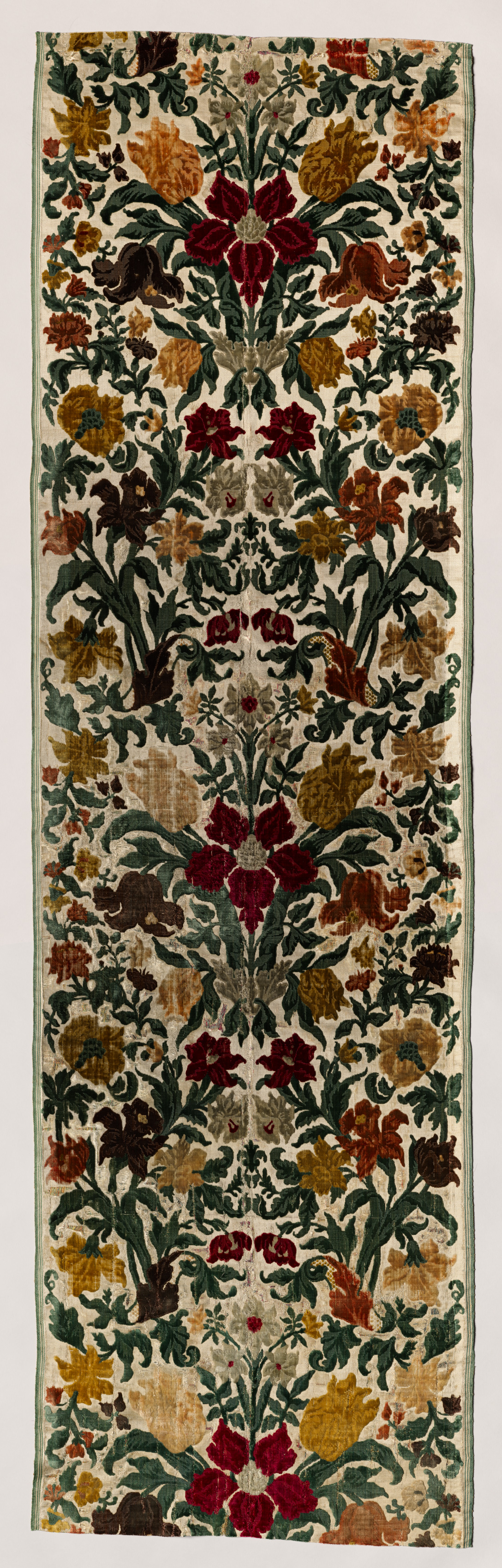
Deconstructing the Genetic Code of Opulence: The Floral Velvet of Genoa
At Zoey Fashion Lab, our mandate extends beyond the mere examination of textiles; we engage in a rigorous process of fabric deconstruction, unearthing the latent narratives woven into every fiber. Today, our analysis turns to a singular artifact: a length of floral velvet originating from the historic looms of Genoa, Italy. This is not merely a fabric; it is a biological manifesto rendered in silk. Our reference point, the "New DNA Strand," serves as a conceptual framework—a lens through which we decode the structural, tactile, and visual genetics of this avant-garde material. The piece in question challenges the very definition of velvet, proposing a future where tradition and mutation coexist in a state of elegant tension.
I. The Genoese Lineage: A Historical Mutation
Genoa, a maritime republic with a mercantile soul, was not just a producer of velvet but a catalyst for its evolution. Unlike the courtly confines of French or Florentine production, Genoese velvet was a product of global trade, infused with the exoticism of the East and the pragmatism of a seafaring economy. This historical context is critical. The velvet we analyze is not a relic of the 16th century, but a contemporary reinterpretation that carries the genetic memory of that port city’s audacity. The "New DNA Strand" reference is apt: this fabric has been spliced, its original genetic code of dense pile and rigid structure has been edited to produce a fluid, almost liquid, architectural form. The silk base—a protein filament of unparalleled luster—provides the backbone, while the pile, in its various forms, acts as the expressive gene expression.
II. Technical Anatomy: The Cut, The Uncut, The Void
The technical construction of this velvet is where the deconstruction becomes most profound. We are presented with a trifecta of pile techniques, each contributing to a complex topographical surface that defies flatness.
Cut Velvet (Velluto Cesellato): Here, the loops of silk are sheared open, creating a dense, plush surface that catches light with an almost hypnotic intensity. In this specimen, the cut pile forms the primary structure of the floral motif—the petals and leaves that rise from the ground. This is the dominant gene, expressing a tactile richness that invites touch. The light does not simply rest on this surface; it is absorbed and refracted, creating a deep, chromatic resonance that shifts with the viewer’s perspective.
Uncut Velvet (Velluto Riccio): In stark contrast, the uncut loops remain intact, forming a secondary, lower-profile layer. This is the recessive gene, yet it is equally vital. The loops create a subtle, granular texture that interrupts the smoothness of the cut pile. This is not a flaw; it is a deliberate design choice that introduces a visual static, a low-frequency hum that grounds the exuberance of the cut areas. The uncut pile acts as a shadow, a secondary textural voice that prevents the design from becoming saccharine.
Voided Velvet (Velluto Vuoto): The most avant-garde aspect of this piece is the strategic use of voiding. Here, the pile is entirely absent, exposing the bare silk foundation. This is the silent gene, the negative space that defines the positive. In traditional Genoese velvet, voiding was used for contrast. In this "New DNA" iteration, the voids are not merely background; they are active participants. They create channels of raw, reflective silk that slice through the plush landscape, forming a topographical map of light and shadow. This voiding is not a subtraction; it is an addition of absence, a deliberate act of sculptural negation that gives the floral pattern a sense of floating, disconnected from the ground.
III. The Floral Motif: A Genetic Anomaly
The floral pattern itself is a departure from the symmetrical, formalized blooms of the Renaissance. This is a mutated botanica. The flowers are not depicted with naturalistic precision but are abstracted into organic, almost cellular structures. The "New DNA Strand" is visible in the way the stems and vines are rendered—not as continuous lines, but as fragmented, helical sequences that twist and turn, mimicking the double-helix structure of DNA itself. This is a conscious intellectualization of the floral form, transforming it from a decorative element into a symbol of life’s underlying code. The scale is deliberately oversized, pushing the motif to the edge of abstraction. It is no longer a pattern on a fabric; it is a microscopic view of a living system magnified to a macroscopic scale.
IV. Tactile and Visual Synesthesia
The genius of this velvet lies in its ability to create a synesthetic experience. Visually, the contrast between the deep, absorbent cut pile and the reflective, glossy voids produces a chiaroscuro effect that is almost painterly. The uncut loops add a third value, a mid-tone texture that prevents the contrast from becoming stark. Tactilely, the fabric is a landscape of extremes. Running a hand across the surface, one experiences the plush resistance of the cut pile, the subtle friction of the loops, and the cool, slick smoothness of the silk voids. This is not a passive textile; it demands interaction. It is a fabric that responds to touch, changing its appearance as it is manipulated. The weight of the silk base provides a substantial drape, allowing the velvet to fall in heavy, architectural folds that hold their shape, yet the voided sections introduce a surprising flexibility, allowing the fabric to bend and pivot in ways that conventional velvet cannot.
V. Avant-Garde Application: Beyond the Garment
For the avant-garde designer, this velvet is not for the faint of heart. It is a sculptural medium, not a simple covering. Its application should be considered in terms of architecture and movement. Imagine a garment where the voids are positioned at the joints—the elbows, the knees, the shoulders—allowing for unprecedented freedom of movement while the plush areas create a powerful, armored silhouette. The fabric could be used to construct a piece that appears to be a solid, monolithic form, but which deconstructs and reveals the skin through the strategic placement of the voided silk. It is a fabric that speaks to the deconstruction of the human form, reimagining the body as a landscape of light, shadow, and texture. The "New DNA Strand" is not just a technical reference; it is a philosophical one. This velvet is a new beginning, a mutation that challenges our preconceptions of what a luxury textile can be. It is a testament to the power of historical technique when fused with a fearless, contemporary vision. In our lab, we do not simply preserve tradition; we re-sequence its DNA to create the future of fashion.