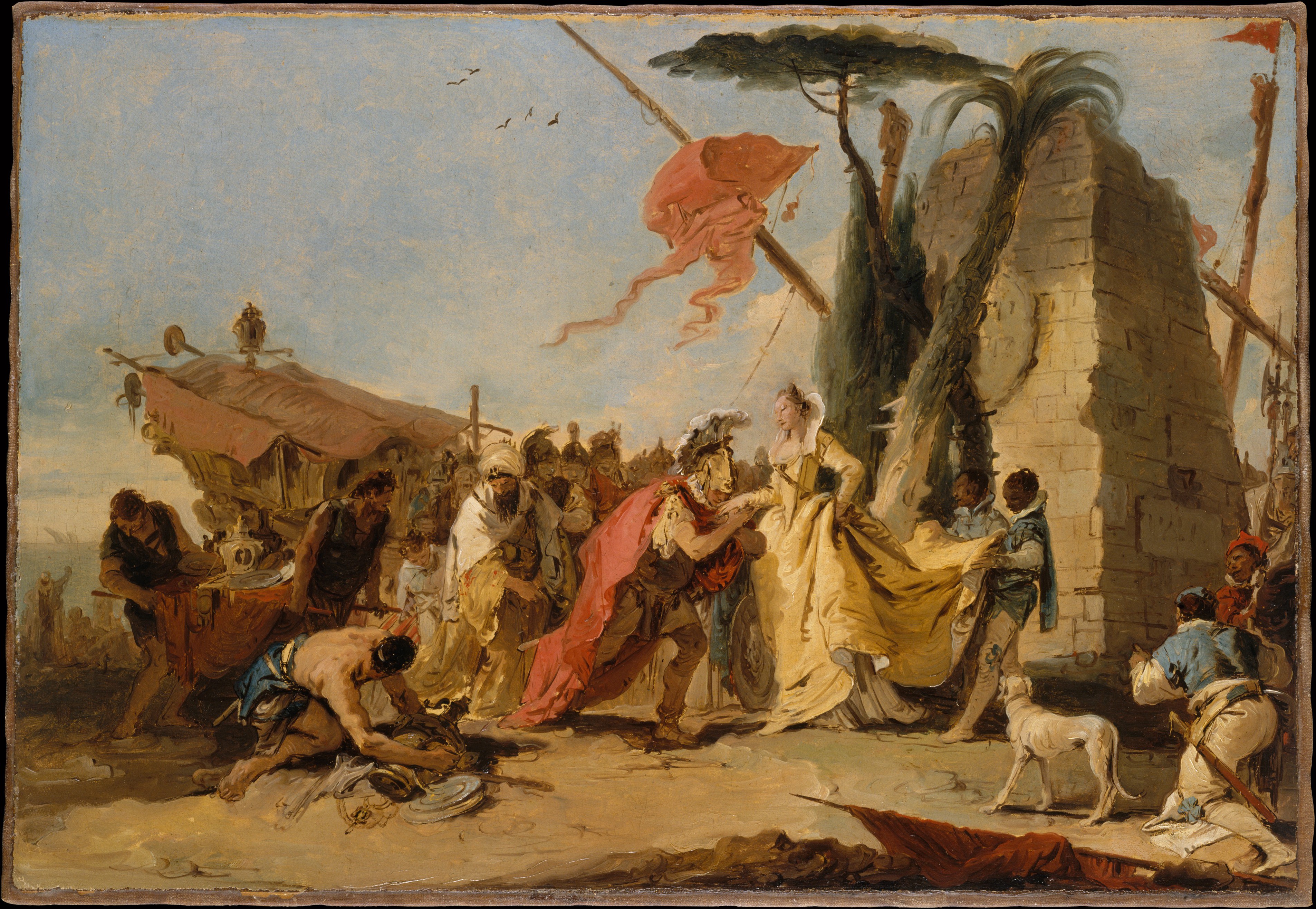
The Geopolitics of Silk and Steel: Deconstructing Antony and Cleopatra for SS26
The Western canon’s most enduring tragedy of statecraft and desire—the meeting of Antony and Cleopatra—has long been rendered in the languid strokes of Orientalist oil painting. For Zoey Fashion Laboratory’s SS26 avant-garde study, we reject the romantic tableau. We do not see a lovers’ tryst; we see a summit of two collapsing empires, a collision of Ptolemaic opulence and Roman martial rigor. Our analysis strips the canvas of its narrative sentiment and re-architects its political tension into a new material language. The result is not a costume drama, but a blueprint for structural garments that negotiate power through negative space, asymmetric tension, and the brutalist elegance of hybridized textiles.
This is not homage. It is a vivisection. We isolate the painting’s core vectors—the diagonal thrust of Antony’s armored torso, the radial folds of Cleopatra’s gilded himation, the liminal space of the barge deck—and translate them into a futuristic silhouette that challenges the very notion of the body as a stable form. The SS26 collection, titled Nilotic Tensile, posits that the future of couture lies not in covering the body, but in negotiating the interface between biological flesh and architectural exoskeleton.
I. The Armored Silhouette: Reinterpreting Roman Cuirass as Soft Structure
Antony’s presence on the canvas is defined by the lorica musculata—a molded bronze cuirass that idealizes the torso into a heroic, static geometry. In our avant-garde reading, this is not a symbol of masculine dominance but a precursor to modular, load-bearing garment systems. For SS26, we deconstruct the cuirass into segmented, articulated panels that no longer mimic muscle but instead create a new, post-human topography. The material is a proprietary composite: recycled carbon fiber bonded with liquid silicone and coated in a micro-thin layer of Nile-green ceramic. This compound is rigid under tension yet pliable under compression, allowing the garment to shift from a protective shell to a flowing membrane with the wearer’s micro-movements.
The silhouette is aggressively asymmetric. The left shoulder is encased in a high, cantilevered pauldron that extends past the deltoid, creating a sharp, horizontal line that echoes the horizon of the Mediterranean. The right side, however, is stripped bare, exposing a fine mesh of knitted stainless steel that traces the intercostal muscles. This is a deliberate political statement: the duality of the Roman state—public armor versus private vulnerability—is rendered as a literal, wearable dialectic. The waist is cinched not by a belt, but by a series of interlocking, 3D-printed vertebrae that flare outward at the hip, creating a silhouette that is simultaneously wasp-waisted and structurally monumental.
II. Cleopatra’s Draped Field: From Flowing Silk to Kinetic Architecture
If Antony is the architecture of conquest, Cleopatra is the fluidity of sovereignty. The oil painting’s depiction of her robes—heavy with gold thread and Tyrian purple—is typically read as decadent. Our laboratory interprets it as an early exploration of dynamic pleating and self-organizing fabric systems. The SS26 interpretation abandons passive drapery in favor of shape-memory alloys woven into a base of bio-fabricated silk. These alloys, activated by body heat, cause the garment to slowly unfold from a compressed, almost geometric block into a sweeping train that measures over three meters in length. This is not a static reveal; it is a continuous, slow-motion metamorphosis that mirrors the shifting political alliances of the Ptolemaic court.
The silhouette is defined by a radical re-imagining of the kolpos—the overfold of the Greek chiton. Instead of a soft blousing effect, our version is a rigid, concave shell that projects forward from the sternum, creating a void between the fabric and the body. This negative space is the collection’s signature: a literal gap that signifies the unspoken negotiations, the secrets, and the strategic silences of the meeting. The shell is laser-cut with a pattern derived from the Nile’s annual flood maps, creating a lattice that casts intricate, ever-changing shadows as the wearer moves. The color palette is not the saccharine gold of historical paintings, but a muted, oxidized palette: verdigris, rust, bone, and the deep, iridescent black of obsidian.
III. The Liminal Barge: Constructing the Threshold Garment
The meeting itself occurred on a barge—a vessel suspended between land and sea, between Rome and Egypt. This liminality is the most potent conceptual driver for our structural innovation. We introduce the “Threshold Silhouette,” a garment that is neither fully jacket nor fully dress, but a hybridized exoskeleton that bifurcates the body along a diagonal axis. The front half is constructed from rigid, lacquered panels resembling the hull of a warship; the back half is a cascade of translucent, liquid-crystal-embedded organza that mimics the rippling wake of the barge. The seam between these two halves is not sewn but held together by a series of magnetic clasps that can be disengaged mid-stride, allowing the garment to split into two separate pieces—one for the public summit, one for the private aftermath.
This design challenges the conventional runway presentation. We propose that models not walk, but process—slowly, deliberately, with the weight of the garments dictating their pace. The footwear is a single, sculpted sabot that extends into a blade-like heel, forcing a gait that is both regal and precarious. This is not about comfort; it is about the embodiment of political tension through physical instability. The accessories are minimal but brutalist: a headpiece of polished, fossilized palm wood that arcs over the cranium, and a series of finger rings that are actually miniature, functional compasses—a nod to the navigational technology that made the meeting possible.
IV. Material Alchemy: The Chemistry of Empire
Our material research for SS26 focuses on upcycling the "ruins" of the past into futuristic composites. The gold leaf of the painting is translated into a fine powder mixed into a bio-resin, creating a surface that is not shiny but matte and granular, like sand. The deep blues of the Mediterranean are replicated via a dye extracted from a genetically modified algae, which is then applied to a fabric made from recycled fishing nets. The result is a textile that is both luxurious and deeply ecological, reflecting a modern avant-garde ethos that cannot separate aesthetic innovation from planetary responsibility.
The most radical material innovation is the Canopic Cloth, a multi-layered textile that incorporates micro-encapsulated essential oils of myrrh and frankincense. As the wearer moves, the friction of the layers releases the scent, creating an olfactory aura that precedes the wearer by several meters. This is a direct reference to the incense that would have filled the barge, but re-engineered as a dynamic, interactive component of the garment's architecture. It is not a perfume; it is a spatial declaration, a chemical boundary that asserts presence before the physical body arrives.
V. Conclusion: A New Iconography of Power
The Meeting of Antony and Cleopatra, when stripped of its romantic gloss, is a masterclass in strategic display. For Zoey Fashion Laboratory, the SS26 study is not about recreating that historical moment but about weaponizing its structural logic for the contemporary wearer. The future silhouette is not a singular form but a system of tensions—between rigidity and fluidity, between protection and exposure, between the public spectacle and the private negotiation.
Our garments are not for the passive observer. They are for the architect of their own narrative, the individual who understands that clothing is the most immediate interface between personal identity and geopolitical reality. The Nilotic Tensile collection is a manifesto: that true avant-garde couture is not escapism, but a rigorous, materialist engagement with the forces that shape our world. The canvas is dead; long live the garment.