Deconstructing the Blade: The Scramasax as Avant-Garde Textile
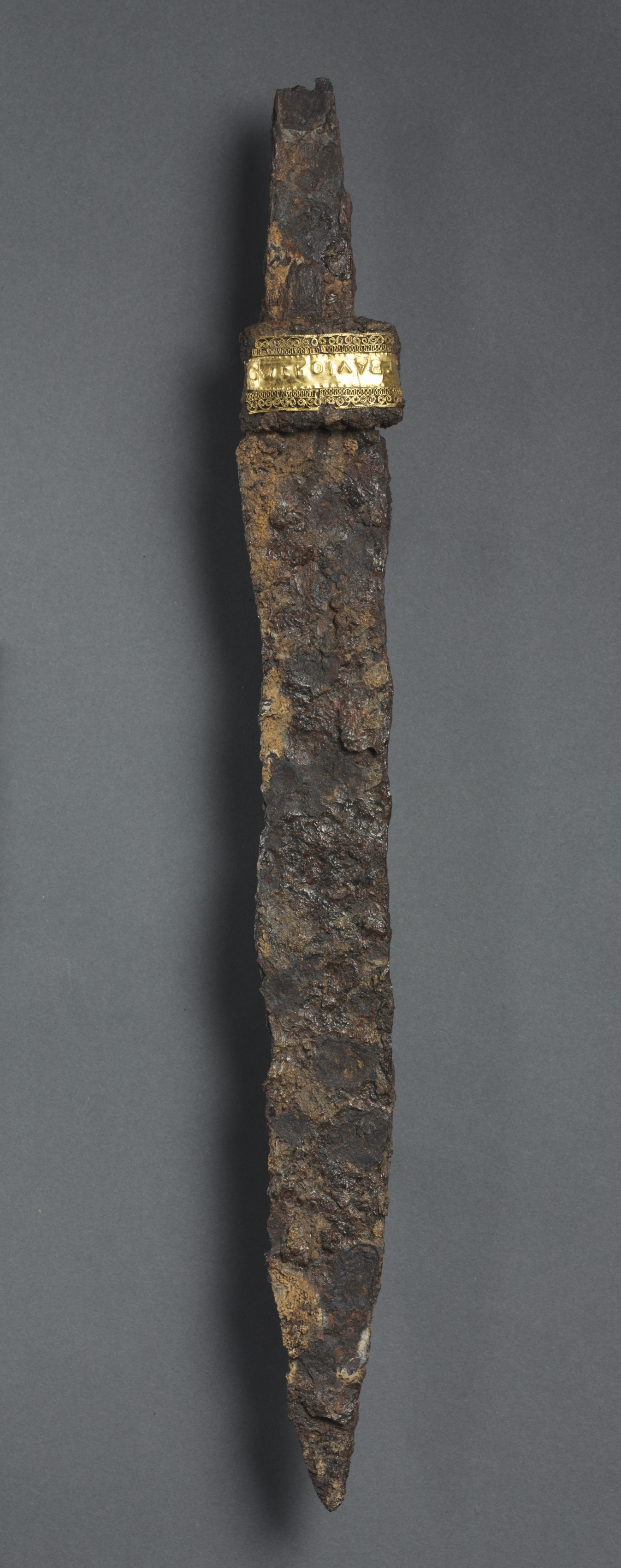
At Zoey Fashion Lab, we do not simply examine historical artifacts; we dissect their material grammar to extract a lexicon for future silhouettes. Today, our focus is the Single-Edged Knife (Scramasax), a Frankish weapon from the 7th century, allegedly from the Champagne region. On the surface, it is a tool of violence and utility. But through the lens of avant-garde fashion, this object—forged from iron, copper, and gold foil—becomes a masterclass in dualism, structural tension, and the alchemy of surface treatment. We are not interested in its history as a weapon; we are interested in its material biography as a precursor to modern wearable sculpture.
I. The Metallurgical Palette: Iron as Structural Memory
The Scramasax's blade is predominantly iron—a material of raw, unyielding density. In fashion terms, this translates to our structural base layer. Think of a sculpted wool crepe or a bonded technical jersey that holds its shape without compromise. The iron's weight is not a flaw; it is a statement of presence. For our upcoming collection, we propose a series of asymmetric, single-sleeve outerwear pieces where the "blade" is interpreted as a sharp, extended tail that cuts through the body's silhouette. The iron's dark, matte patina—often pitted and corroded—informs our choice of oxidized black denim and charred cotton velvet. We deliberately avoid polishing these fabrics; instead, we embrace their uneven, almost brutalist texture to echo the metal's weathered surface.
However, the iron is not monolithic. The single-edged design—a sharp cutting side and a thick, blunt spine—creates an inherent asymmetric balance. This is our first design principle: a garment that is aggressive on one side, yet protective and solid on the other. We envision a coat where the left panel is razor-thin, almost transparent, while the right panel is heavily padded and opaque. This is not a stylistic choice but a direct translation of the blade's functional geometry. The spine becomes a rolled collar; the edge becomes a sharp, laser-cut hemline.
II. Copper and Gold Foil: The Surface as Narrative
Here is where the artifact transcends its martial purpose. The presence of copper and gold foil inlay on the blade's surface is a deliberate act of contradiction. Why adorn a weapon with precious metals? Because the Frankish elite understood that power is not just about brute force—it is about visual resonance. The Archive Resonance note speaks of "a smooth silver mirror with intricate golden palm leaves" versus "a cold sarcophagus with relief-carved life narratives." This duality is our core creative thesis.
In our fabrication, we interpret this as contrasting surface treatments. The copper suggests warmth, conductivity, and a subtle, rosy glow. We translate this into liquid metallic silk organza and hammered copper lamé used for underlayers—visible only when the wearer moves. The gold foil, meanwhile, is not a solid sheet but a fractured application. We use gold leaf appliqué on sheer mesh, but we crack it deliberately, creating a web of fine lines that mimic the aging of the foil on the blade. This is not about luxury; it is about the memory of luxury—a surface that tells a story of time, pressure, and transformation.
III. The Archive Resonance: Mirror vs. Sarcophagus
The provided reference—"一面是光洁银镜上以黄金镶嵌的纷繁棕叶纹,另一面是冰冷石棺板上以浮雕诉说的生命叙事"—is the key to unlocking the garment's emotional core. Let us break this down.
The Mirror Side: This represents the performative exterior. The "smooth silver mirror" is our polished, reflective shell. In our design, this becomes a high-shine PVC outer layer or a liquid vinyl trench. The "golden palm leaves" are not botanical; they are fractal, geometric abstractions. We will laser-cut gold foil into sharp, angular palmettes and appliqué them onto the reflective surface. These ornaments are not placed randomly; they follow the trajectory of a blade's edge, creating a diagonal flow across the garment. This side is about projection—how the garment catches light, how it dazzles, how it hides the wearer's vulnerability behind a gleaming facade.
The Sarcophagus Side: This is the interior narrative. The "cold stone coffin" is our lining. But this is not a soft, comfortable lining. We use a stiff, bone-colored jacquard with a raised, relief-like texture. The "life narrative" is depicted through embossed, abstract figuration—not literal human forms, but the suggestion of movement, struggle, and repose. This side is only revealed when the garment is turned inside out or when the wearer lifts a heavy flap. It is a private history, a hidden story that only the wearer knows. This is the essence of avant-garde: the public garment is a spectacle, but the private garment is a confession.
IV. Technical Construction: The Foil as a Joining Mechanism
Technically, we must address how to integrate these disparate materials—iron-like weights, copper warmth, and gold fragility—into a wearable structure. We propose a modular construction inspired by the blade's layered forging. The iron core is our base fabric. The copper is a fused interlining, bonded via heat-pressing to provide structure without stiffness. The gold foil is our top-stitching thread—not literally, but as a visual line. We will use metallic gold thread to create exposed, raw-edge seams that mimic the foil's cracked surface. These seams are not finished; they are deliberately frayed and oxidized, creating a "ruined" aesthetic that contradicts the garment's sharp silhouette.
Furthermore, the single-edged nature dictates our closure system. We reject traditional buttons or zippers. Instead, we use asymmetric toggle closures made of blackened bronze, positioned off-center to echo the blade's spine. The garment will not close symmetrically; it will wrap and overlap, creating a diagonal tension line across the torso. This is a direct nod to the blade's form—a line that is both aggressive and elegant.
V. The Avant-Garde Silhouette: From Weapon to Wearable
Our final silhouette is not a coat or a dress; it is a hybrid garment—a "blade-cloak." It features a severe, dropped shoulder on one side and a high, structured collar on the other. The hem is asymmetrical, with a sharp point extending to the knee on the "edge" side, while the "spine" side falls straight to the ankle. The entire piece is lined with the sarcophagus-inspired jacquard, but the outer shell is a combination of oxidized denim, liquid vinyl, and cracked gold appliqué.
This garment is not for the faint-hearted. It is for the individual who understands that fashion is a conflict—a negotiation between the desire to be seen and the need to protect one's inner self. The Scramasax, in our hands, is no longer a tool for cutting flesh; it is a tool for cutting through social norms. It is a wearable argument for the beauty of contradiction: heavy yet delicate, reflective yet opaque, violent yet refined. At Zoey Fashion Lab, we do not revive the past; we re-forge it into a future that has not yet been worn.