Deconstructing the Lacquer Box: An Avant-Garde Study for SS26
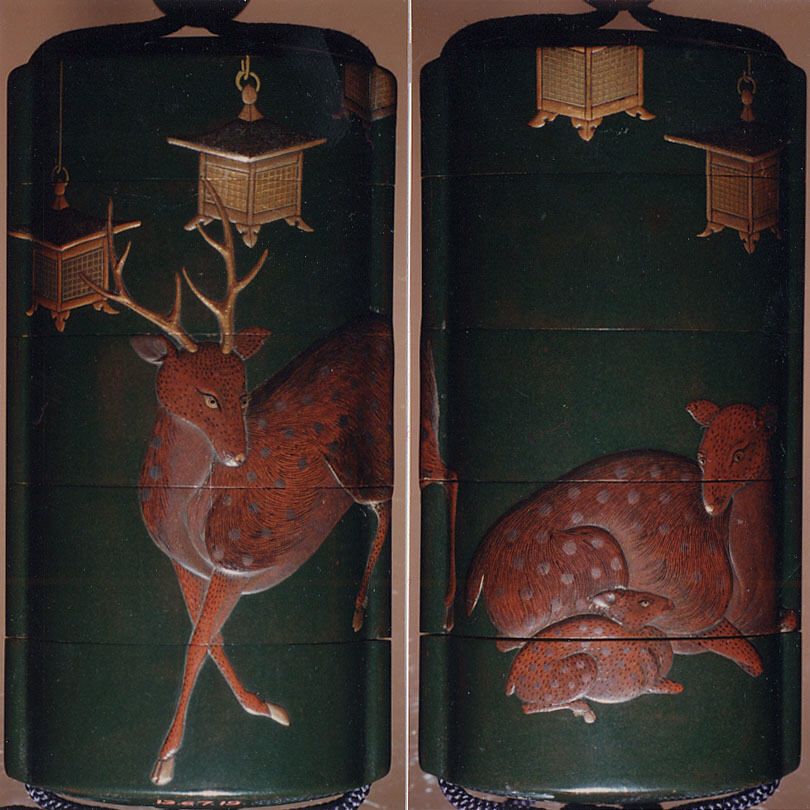
The Edo-period Inrō, a portable medicine case suspended from the obi, is often relegated to the dusty vitrine of ethnographic curiosity. Yet, for the Zoey Fashion Laboratory, this object is not a relic; it is a blueprint for a new corporeal architecture. The specific case in question—adorned with gold and silver maki-e depicting deer and lanterns at Kasuga Shrine, secured by a coral ojime and a carved wooden netsuke of a mouse on a mushroom—offers a radical thesis on modularity, material alchemy, and the silent dialogue between the sacred and the organic. For SS26, we are not borrowing motifs; we are extracting the structural DNA of this object to engineer silhouettes that defy gravitational logic and temporal categorization.
I. The Inrō as a Proto-Modular System
The Inrō’s genius lies in its compartmentalized anatomy. Multiple stacked tiers, each a self-contained volume, are unified by a single cord that runs through the entire structure. This is not mere decoration; it is a sophisticated system of kinetic tension and release. For SS26, we translate this into a radical departure from the monolithic garment. We propose the “Segmented Silhouette”: a series of independent, rigid panels—crafted from bio-resin infused with metallic dust—that float over a fluid, second-skin base layer. These panels are not sewn but connected via an external, adjustable tensioning system, echoing the Inrō’s cord. The wearer becomes the architect, reconfiguring the volume of a jacket or skirt in real-time, shifting from a compressed, columnar form to an expanded, sculptural mass.
The visual rhythm of the Kasuga deer and lanterns, repeated across the lacquer surface, informs our placement of these panels. Rather than a uniform grid, the panels cluster asymmetrically—dense around the left hip, sparse across the right shoulder—creating a choreographed imbalance that mimics the organic scatter of lantern light in a forest. This is not about covering the body; it is about constructing a habitable environment around it. The future of couture, as evidenced by this historical precedent, is not in fabric alone but in the engineered relationship between void and volume.
I.A. The Cord as a Structural Spine
We must elevate the humble ojime and cord from fastening to primary structural element. In our SS26 interpretation, the cord becomes a visible, functional exoskeleton. High-tensile, luminous filaments—woven with phosphorescent microfibers that recall the glow of the maki-e silver—will traverse the garment’s exterior, cinching, releasing, and redirecting fabric. The coral bead, traditionally a simple stopper, is reimagined as a biometric clasp: a 3D-printed, coral-textured node that houses a micro-sensor, adjusting the garment’s drape based on the wearer’s posture and movement. This is the “Intelligent Ojime”, a fusion of ancestral craft and cybernetic function, transforming a static object into a responsive, living interface.
II. Material Alchemy: From Lacquer to Bio-Luminescence
The dark green lacquer of the Inrō is not a surface; it is a depth of field. The maki-e technique, sprinkling metallic powder onto wet lacquer, creates a microscopic landscape that shifts with light. For SS26, we reject flat textiles in favor of “Living Surfaces”. We are developing a proprietary material: a flexible, photovoltaic film coated in a dark, algae-based resin that absorbs ambient light and re-emits it as a faint, green-tinted luminescence. The deer and lantern motifs are not printed but grown onto this surface using a process of bacterial cellulose deposition, creating a texture that is both organic and machine-precise.
The pewter inlays, with their matte, lunar quality, inspire our treatment of secondary materials. We introduce “Lunar Pewter Mesh”: a chainmail-like fabric of recycled pewter and titanium, laser-cut into the negative space of the Kasuga lanterns. This mesh is not worn as armor but as a transparent second layer, floating over the bio-luminescent base. The effect is a parallax of textures—the smooth, living green beneath the cool, metallic grid—creating a visual oscillation that mirrors the interplay of gold and silver on the original lacquer. This is material storytelling, where each layer holds a different temporal resonance: the ancient earth (green lacquer) and the futuristic alloy (pewter).
II.A. The Netsuke Paradox: Weight and Levity
The netsuke—a mouse on a mushroom—is a masterclass in sculptural counterweight. It is a dense, carved object that anchors the entire hanging assembly. In our avant-garde context, we invert this logic. The netsuke becomes the “Anti-Gravity Anchor”. We design oversized, hollow forms—mushroom caps of inflated, transparent TPU with a single, carved wooden mouse inside—that are attached to the trailing hems of our outer garments. These are not weights but ballasts of air, catching thermal currents and causing the fabric to billow and hover. The garment appears to defy its own mass, floating as if suspended in a zero-gravity chamber.
This paradox—the dense, earthy subject matter rendered as a buoyant, levitating device—is the conceptual core of SS26. We are not ignoring the historical function of the netsuke; we are re-engineering its purpose for a new physics of dress. The mouse, a creature of the earth, now floats; the mushroom, a symbol of decay, becomes a vessel of lift. This is the avant-garde mandate: to take the familiar and render it uncanny, to extract the latent potential within the artifact and project it into a future where clothing is not worn but inhabited.
III. Silhouette Architecture: The Kasuga Forest in Motion
The final innovation lies in the silhouette itself. The Inrō’s rectilinear form is a constraint, a box. Our SS26 garments must honor that restraint while exploding its geometry. We propose the “Lantern Trajectory” silhouette: a sharp, asymmetric shoulder line that cascades into a narrow, elongated torso, then flares dramatically at the hem—not in a circle, but in a faceted, polygonal sweep reminiscent of the stone lanterns’ bases. This is achieved through a series of hidden, articulated struts within the fabric, allowing the wearer to snap the hem into different angular configurations, from a tight, pencil-like line to a wide, architectural plinth.
The deer, with its graceful, leaping form, informs the dynamic seam lines. Seams will not follow the body’s natural contours but will instead trace a leaping parabola across the torso, mimicking the animal’s motion. These seams are not hidden; they are emphasized with the Lunar Pewter Mesh, creating a visual map of movement across the garment’s surface. The result is a silhouette that feels both ancient and alien—a tribute to the sacred groves of Kasuga, reimagined as a cybernetic forest where light, material, and body converge in a state of perpetual, elegant flux. This is the definitive avant-garde statement: history not as a mirror, but as a launchpad.