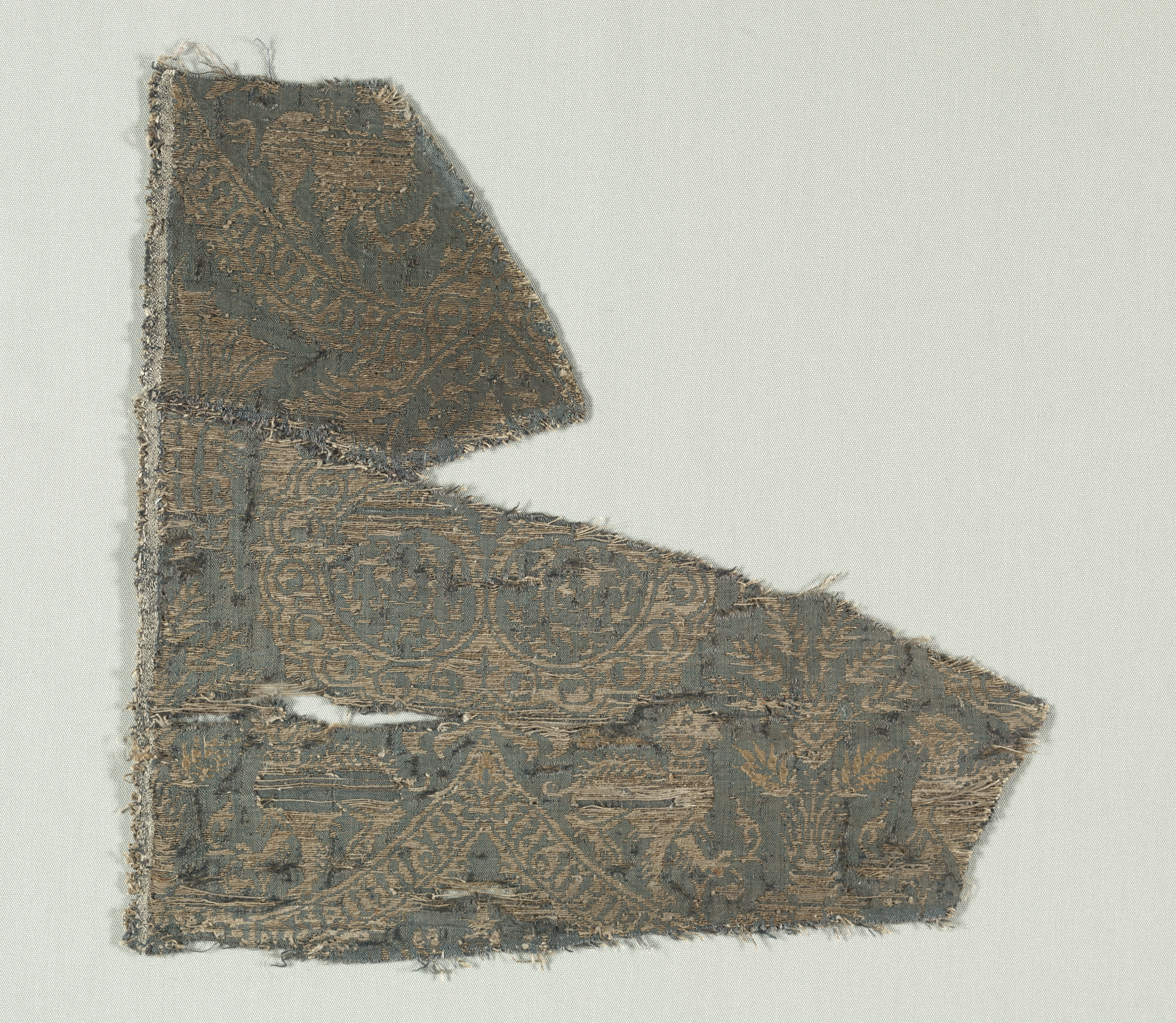
Deconstructing the Swaying Band: An Avant-Garde Reading of a 14th-Century Italian Silk
At Zoey Fashion Lab, our mandate is not merely to preserve historical textiles but to dissect their genetic code, extracting the latent avant-garde impulses that pulse beneath their centuries-old surfaces. The subject of today’s analysis—a silk lampas woven in Italy during the last third of the 14th century, featuring dogs and Arabic script within undulating, swaying bands—presents a fascinating paradox. It is, on the surface, a relic of medieval luxury. Yet, beneath its silver-threaded shimmer lies a proto-modernist sensibility: a disruptive play of semiotics, a kinetic visual rhythm, and a radical material hybridity that resonates profoundly with contemporary avant-garde fashion theory. We shall treat this textile not as a static artifact, but as a New DNA Strand—a genetic sequence of design innovations that prefigures our own disruptive aesthetics.
I. Material Genetics: The Lampas Weave as Structural Avant-Gardism
The technical construction of this piece is our first point of departure. The combination of a 2/1 twill and a 1/5 twill in a single lampas weave is not a mere technicality; it is a deliberate act of structural subversion. In conventional weaving, a single ground weave dictates the fabric’s drape and surface. Here, the weaver has engineered a dual-system fabric where two distinct twill structures coexist, creating a complex, multi-layered relief. The 2/1 twill, with its tighter, more diagonal ribbing, forms a dense, matte ground. The 1/5 twill, conversely, is looser and more exposed, allowing the supplementary silver thread to float across the surface with a luminous, almost liquid quality.
This is not a simple pattern-on-pattern technique. It is a material argument. The silver thread—likely gilded silver wrapped around a silk core—does not merely decorate the fabric; it is the fabric’s second voice, speaking in a different tense. The interplay between the matte silk ground and the reflective silver creates a dynamic optical flicker, a pre-cinematic shimmer that anticipates the kinetic art of the 20th century. For the avant-garde designer, this is a masterclass in surface tension: the fabric is not a flat canvas but a topographical field of varying light absorption and reflection. This duality—matte versus lustrous, dense versus airy—is precisely the kind of textural dissonance that contemporary designers like Iris van Herpen or Junya Watanabe deploy to challenge the viewer’s perception of form and volume.
II. Semiotic Dissonance: Dogs, Arabic Script, and the Swaying Band
Our deconstruction now turns to the iconographic program. The presence of dogs in a luxury silk is not anomalous in medieval Italian textiles; they often symbolize fidelity or the hunt. However, the juxtaposition with Arabic script is a semiotic collision of profound consequence. This is not a simple case of cultural appropriation. Rather, it is a strategic deployment of the Other to generate a new, hybrid visual language. The Arabic characters, likely pseudo-Kufic or actual Arabic blessings, are rendered not as static calligraphy but as swaying, undulating bands that weave through the composition. They do not sit on the ground; they move across it.
This kinetic treatment of script is the textile’s most radical gesture. The letters are not legible in a traditional sense; they are transformed into abstract, rhythmic strokes. The swaying bands become a visual analogue for the movement of the human body, the sway of a dancer, or the flow of water. By decontextualizing sacred or foreign script and setting it into a fluid, ornamental motion, the 14th-century designer achieved a form of typographic abstraction that predates Futurist and Dadaist experiments by six centuries. The dogs, conversely, are rendered in a more naturalistic, albeit stylized, manner. They provide a grounding anchor—a familiar, terrestrial motif—against the alien, calligraphic flux. This tension between the representational (the dog) and the abstract (the script) is a core strategy of avant-garde fashion, where a recognizable silhouette is often disrupted by unexpected surface treatment or material logic.
III. The Sway as a Structural Principle: Beyond Ornament
We must not misread the “swaying bands” as mere decorative flourish. In our lab, we identify this as a generative structural principle. The bands do not simply frame the dogs; they actively reorganize the pictorial space. They create a diagonal, serpentine flow that destabilizes the vertical and horizontal axes typical of earlier Gothic textiles. This is a radical shift in composition. The eye is forced to follow a serpentine path, never resting on a single focal point. This is a deliberate strategy of visual disorientation, a precursor to the Op Art movement’s exploitation of retinal fatigue and spatial ambiguity.
For the avant-garde fashion house, this principle translates directly into garment construction. Imagine a coat where the seams follow the swaying band’s trajectory, creating a bias-cut drape that moves organically with the wearer. Or a dress where the silver-threaded bands are not woven but applied as three-dimensional appliqués, creating a sculptural, undulating surface that mimics the fabric’s original optical effect. The sway is not a motif; it is a design algorithm. It instructs the eye and the body on how to move, how to perceive. This is the essence of avant-garde dress: the garment is not a passive covering but an active participant in the wearer’s kinetic and social performance.
IV. The New DNA Strand: Deconstructing for the Future
Our analysis at Zoey Fashion Lab concludes with a synthesis. This 14th-century silk is not a museum piece; it is a living genetic archive. The “New DNA Strand” we extract is not a literal biological sequence but a conceptual one. It comprises three core mutations:
1. Hybrid Materiality: The deliberate combination of disparate weaves and materials (matte silk + reflective silver) to create a fabric that is both structurally complex and optically dynamic. This is the DNA of future smart textiles and performance fabrics that respond to light and movement.
2. Semiotic Collision: The fearless juxtaposition of unrelated cultural signifiers—naturalistic dogs, abstract Arabic script—to generate new meaning. This is the DNA of postmodern fashion, where cultural codes are sampled, remixed, and recontextualized to challenge hegemonic narratives.
3. Kinetic Composition: The use of swaying, undulating bands as a primary structural and visual device, prioritizing movement and flow over static symmetry. This is the DNA of contemporary drapery and zero-waste design, where the fabric’s behavior is as important as its appearance.
In conclusion, the Italian silk from the last third of the 14th century is a precocious avant-garde manifesto in woven form. It demonstrates that the impulse to disrupt, to hybridize, and to set meaning into motion is not a modern invention but a perennial force in the history of material culture. For Zoey Fashion Lab, this textile is a benchmark. It challenges us to see beyond the historical surface and to recognize the radical, forward-thinking energy embedded in the hands of a medieval weaver who dared to let the script sway and the dogs run wild within a field of silver light. This is not a relic; it is a blueprint.