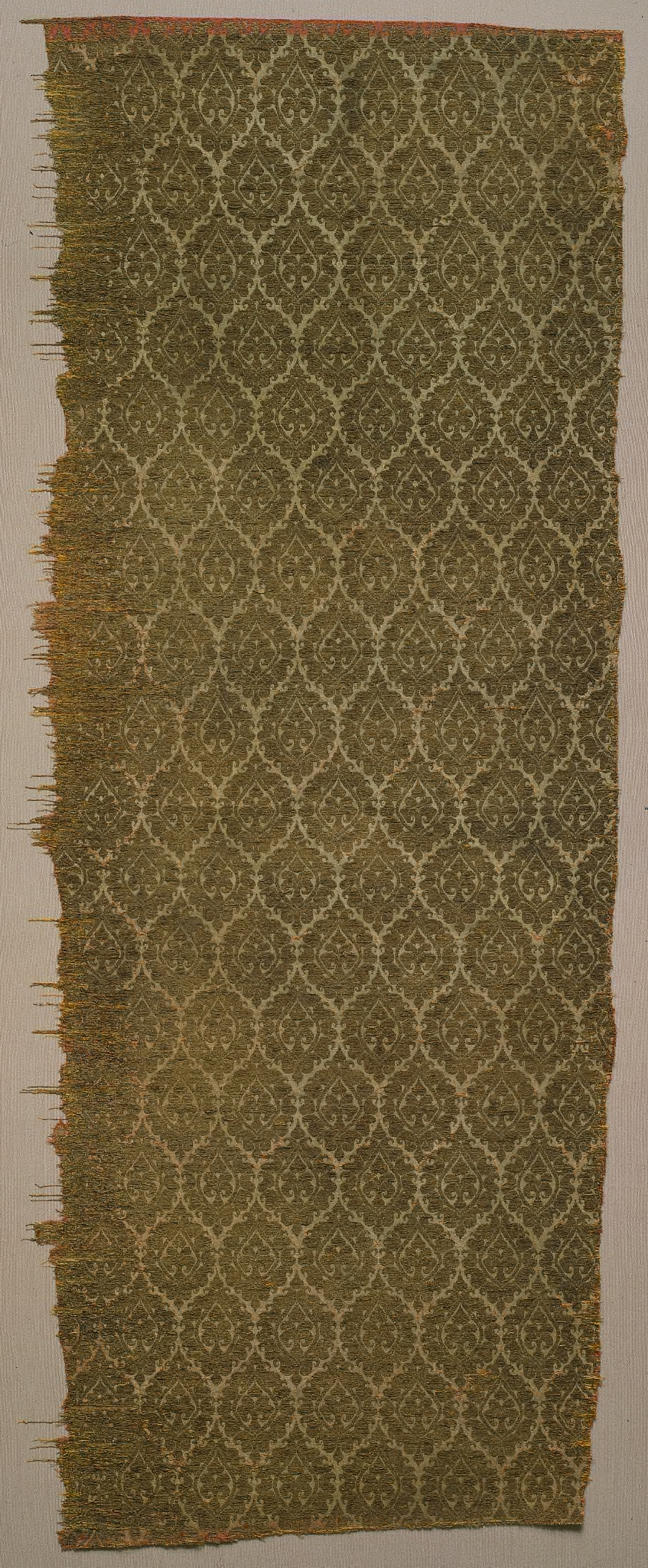
Technical Deconstruction & Material Analysis: Il-Khanid Silk with Palmettes
This textile specimen, originating from the Il-Khanid Mongol sphere in Central Asia, represents a zenith of medieval Eurasian luxury production. Its technical construction is a masterclass in material synergy and deliberate opulence. The foundation is a fine silk tabby (plain weave), providing a stable, luminous ground. The defining decorative motif—the palmette—is executed in supplementary weft patterning, a technique where additional, non-structural threads are woven into the base fabric.
The true alchemy, however, lies in the material of this supplementary weft: gold thread. Typically, this would be a silk core tightly wrapped with a thin strip of gilded leather or membrane, a technique known as "file." This creates a thread that is both malleable for weaving and spectacularly reflective. The contrast between the matte, deep-hued silk ground and the raised, shimmering gold motifs is not merely decorative; it is a direct manifestation of power, wealth, and celestial symbolism. The weaving process was immensely slow and required exceptional skill, positioning this textile as a deliberate artifact of elite consumption, likely for courtly vestments or diplomatic gift-giving.
Archive Resonance: Decoding the Eurasian Synthesis
The provided archival fragment resonates profoundly with this textile: "在人类文明的长河中,器物与绘画不仅是时代技艺的结晶,更是文化碰撞与美学交融的无声见证。十六至十七世纪...." While the fragment leaps to the 16th-17th century, its core thesis is the perfect lens through which to view this earlier Il-Khanid work. This textile is a preeminent "silent witness" to cultural collision and aesthetic fusion.
The palmette motif itself is a traveler. With ultimate origins in ancient Egypt and Mesopotamia, it was refined through Sassanian Persian art into a lush, rhythmic, and highly stylized form. The Il-Khanid Mongols, as rulers of a vast empire spanning China to Iran, did not merely appropriate this motif; they facilitated its re-contextualization. In this fragment, we can detect the Persianate elegance of the scrolling vine and the symmetrical, blossoming palmette. Yet, the density of the pattern, the balance of positive and negative space, and the flow of the design field may also whisper of influences from Chinese textile traditions, accessible via the Mongol-controlled Silk Roads. This is not a copy, but a new synthesis born of the Pax Mongolica—a tangible product of a connected world.
Avant-Garde Interpretation: The Zoey Fashion Lab Proposition
For Zoey Fashion Lab, this textile is not a relic but a radical blueprint. Our deconstruction moves beyond historical appreciation into the realm of conceptual and material innovation. The avant-garde ethos demands we interrogate its core principles and re-manifest them for a contemporary consciousness.
Core Principles for Deconstruction:
1. The Duality of Material: The stark dialogue between humble (silk) and precious (gold) is key. Modern translation: explore the tension between biodegradable base fabrics (like algae-derived cellulose or peace silk) and innovative "precious" elements. These could be laser-etched recycled metals, conductive threads that pulse with light, or foil applications derived from post-consumer waste. The contrast must be ethical and technological, not just visual.
2. The Motif as Code: The palmette is a unit of cultural data. We will decompile this data. Using 3D scanning, we can abstract its form into a digital point cloud, distorting it through algorithms that simulate cultural drift or digital decay. The resulting forms can be translated into laser-cut patterns, heat-transfer prints, or exaggerated, distorted embroideries that question notions of "heritage" and "authenticity."
3. Structural Revelation: The "supplementary weft" technique adds a layer. Avant-garde practice makes the hidden visible. We propose garments where the supplementary structure is exaggerated, left unfinished, or becomes functional. Imagine a tailored coat where one side is pristine, and the other reveals a cascading, riotous explosion of gold-thread embroidery spilling out like the internal workings of a device. The "back" of the fabric becomes the "front."
The Collection Concept: "Il-Khanid Datascape"
We propose a capsule collection that treats the original textile as a source code. Garments will embody fragmented palmette patterns, printed on sheer overlays that shift against solid underlays, creating moiré effects reminiscent of screen glitches. The "gold" will be replaced with metallic coatings on technical meshes, or with amber-hued, transparent silicone inserts, suggesting fossilized resin preserving digital artifacts.
Silhouettes will merge the voluminous, cross-cultural robes of the Mongol court with sharp, architectural tailoring. A *kaftan* is reimagined as a deconstructed trench, its lining featuring a hyper-magnified, pixelated segment of the original weave. Asymmetric gowns will use draped sections of ethically sourced silk, juxtaposed with panels of neoprene or recycled polyester tech-fabric embroidered with the "decoded" palmette motif in glowing, photoluminescent thread.
This is not historical costume. It is an archaeology of the future. We extract the Il-Khanid textile's DNA—its material contrast, its syncretic pattern, its status as a networked object—and re-engineer it for a world where identity is similarly fluid, layered, and digitally mediated. The collection becomes a new "silent witness" to our own era of collision and fusion, proving that the most radical innovations are often conversations with the deep past. The archive does not constrain; it liberates.