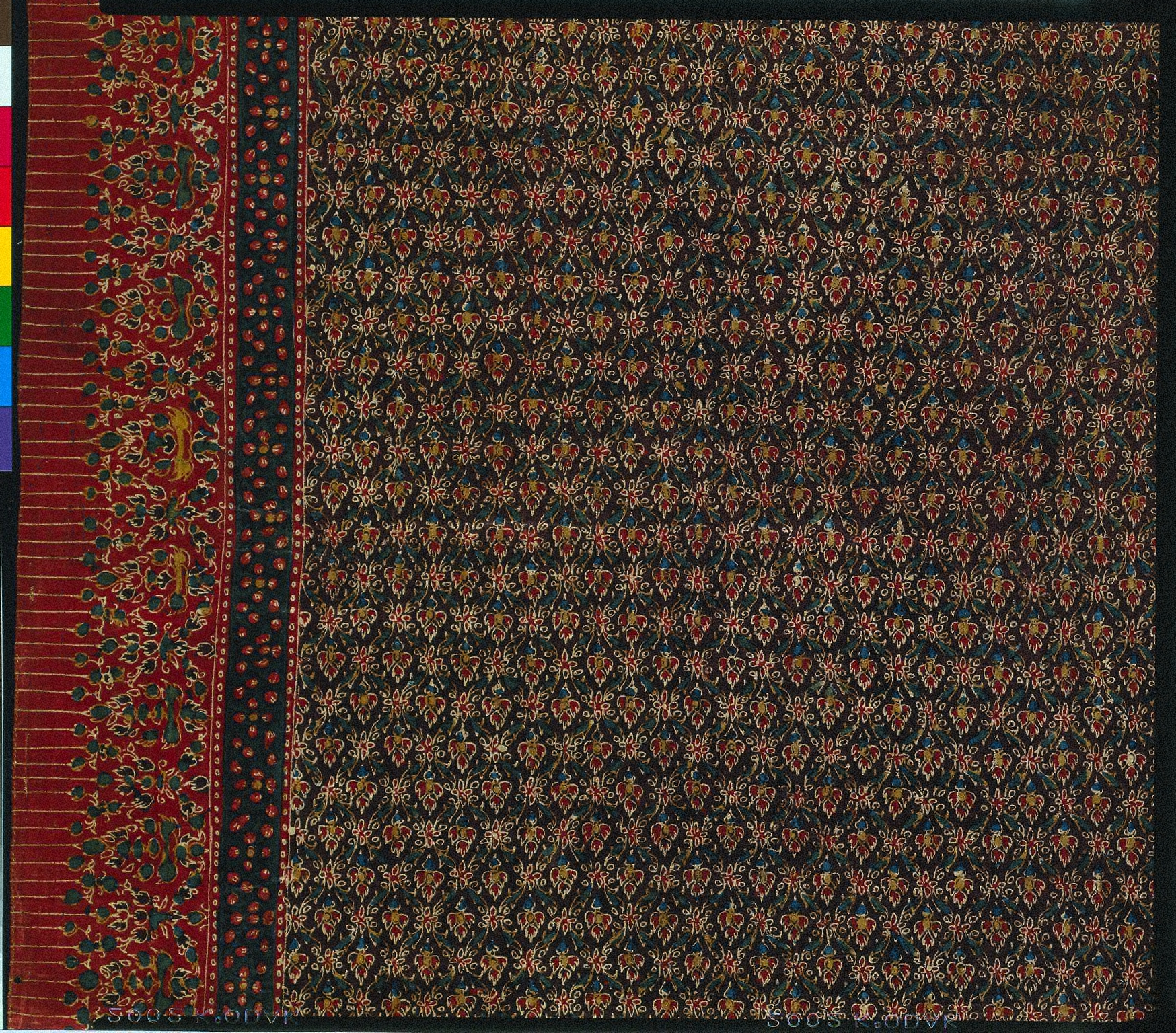
Deconstructing the Drape: The Pha Nung as Proto-Avant-Garde Architecture
In the hallowed halls of fashion history, the wrapped garment is often relegated to the status of a primitive antecedent—a simple precursor to the tailored suit or the constructed gown. However, for the Zoey Fashion Lab, the Pha Nung from India’s East Coast (late 19th–early 20th century) is not a relic. It is a radical manifesto in cotton. This analysis deconstructs the technical and cultural DNA of this singular textile, repositioning it not as a passive cloth, but as an active, avant-garde architectural system that predates modern deconstructionism by a century.
I. Technical Autopsy: The Alchemy of Tabby and Resist
The Grid of Restraint: Tabby Weave
At its most fundamental level, the Pha Nung employs a tabby weave—the simplest, most democratic interlacing of warp and weft. Yet, this simplicity is deceptive. In the context of avant-garde theory, the tabby weave functions as a neutral grid, a Cartesian plane upon which chaos is meticulously plotted. Unlike the structural complexity of brocade or jacquard, which imposes a predetermined pictorial hierarchy, the tabby weave offers a blank, unadorned canvas. It provides no visual noise, forcing the eye to focus entirely on the surface intervention—the dye. This is the first act of subversion: choosing a humble, utilitarian base to carry a high-complexity artistic intervention.
The Chemistry of Chaos: Mordant Resist and Batik
The technical virtuosity of this piece lies in its dual resist system. The combination of mordant resist and batik (wax resist) is not merely a production method; it is a philosophical dialogue between permanence and ephemerality.
The mordant—a metallic salt—bonds chemically with the cotton fibers, creating a permanent, insoluble foundation for the dye. This is the "structural skeleton" of the design, the immutable truth. Conversely, the batik wax acts as a temporary mask, a fragile barrier that is cracked, shattered, and ultimately boiled away. The resulting "crackle" effect—the fine, spider-web lines of dye bleeding into the resisted areas—is not a flaw. It is the signature of the hand, a record of movement and pressure. In the Zoey Fashion Lab framework, this crackle is the analog equivalent of glitch art—a deliberate disruption of the digital (or in this case, chemical) perfection. The cloth does not depict a landscape; it embodies the tension between control (mordant) and accident (wax).
II. The Drape as Deconstruction: Re-reading the Wrapped Form
Beyond the Body: The Cloth as Independent Volume
Western fashion traditionally treats fabric as a second skin, cut and sewn to conform to the body’s silhouette. The Pha Nung inverts this hierarchy. It is a rectangular plane, a geometric absolute that refuses to be pre-shaped. Its form is not dictated by the tailor’s shears but by the wearer’s negotiation with gravity and movement.
This is the essence of its avant-garde nature. The garment does not exist until it is worn; it is a performative architecture. The folds, the tension points, the accidental ripples—these are not secondary effects but the primary design. When we consider the work of avant-garde designers like Issey Miyake or Yohji Yamamoto, who famously rejected the Western cut in favor of flat, geometric construction, we see a direct lineage to this Indian textile. The Pha Nung is the ur-form of their philosophy: a garment that is a sculpture in motion, not a static shell.
The Semiotics of the Unpinned: Freedom and Flux
In the context of the late 19th century, when European fashion was constrained by corsets and rigid tailoring, the Pha Nung offered a radical alternative: a garment in a state of perpetual flux. It is secured not by buttons or zippers but by tucking and folding—a system that is inherently unstable and requires the wearer’s active participation. This instability is not a weakness; it is a political statement of autonomy. The cloth can be draped as a full skirt, a shoulder wrap, a head covering, or a hip sash. It is a shape-shifting entity, a single tool with infinite applications. This versatility challenges the capitalist notion of the "wardrobe" and the specialization of garments, proposing instead a nomadic, modular approach to dress that resonates deeply with contemporary sustainable fashion discourse.
III. Archive Resonance: The Ghost of the 16th Century
The reference note from the archive—"在人类文明的长河中,器物与绘画不仅是时代技艺的结晶,更是文化碰撞与美学交融的无声见证" (In the long river of human civilization, objects and paintings are not only the crystallization of the era's techniques, but also the silent witnesses of cultural collision and aesthetic fusion)—is critical here. This Pha Nung is not a purely "Indian" object. It is a palimpsest of global trade routes. The mordant resist technique has ancient roots in the subcontinent, but the batik wax method is strongly associated with Southeast Asian, particularly Javanese, traditions. This cloth, found on India's East Coast, is a living document of maritime exchange, a physical testament to the movement of ideas, technologies, and aesthetics across the Bay of Bengal.
For the Zoey Fashion Lab, this cross-cultural DNA is the ultimate avant-garde credential. It proves that innovation is not invention but recombination. The Pha Nung is not a pure, isolated artifact; it is a hybrid, a fusion of techniques that were themselves born from contact. This challenges the nationalist, purist narratives that often dominate fashion history. The cloth whispers that the future of fashion lies not in seeking a singular origin, but in embracing the diasporic, the creole, the hybrid. It is a silent witness, as the archive notes, to the fact that beauty is born from collision, not isolation.
IV. Avant-Garde Implications for Contemporary Practice
From Relic to Prototype
Our analysis concludes that the Pha Nung is not a museum specimen but a working prototype. Its lessons for the modern designer are manifold:
- Material Honesty: The cotton is unadorned, letting the dye do the talking. We must resist the urge to over-engineer and instead celebrate the inherent properties of the fiber.
- Process as Aesthetic: The crackle of the batik, the bleed of the mordant, are not imperfections but narratives of making. We should design for the trace of the hand, not against it.
- Zero-Waste Geometry: The rectangular form is inherently zero-waste. It is a challenge to the industry’s profligate cutting practices, proposing a geometry of economy that is both ancient and urgently contemporary.
- Wearer as Co-Designer: The garment is incomplete without the wearer’s body and movement. This is the ultimate form of user-centric design, a collaborative performance between cloth and human.
In conclusion, the Pha Nung is a masterpiece of functional deconstruction. It tears down the walls between art and craft, between structure and drape, between East and West. It does not shout; it drapes. And in its silent, folded geometry, it contains more radical potential than a century of avant-garde manifestos. It is, in the truest sense, a garment for the future, finally arriving from its past.