Deconstructing the Avian Signifier: The Tairona Bird Pendant as Proto-Avant-Garde Artifact
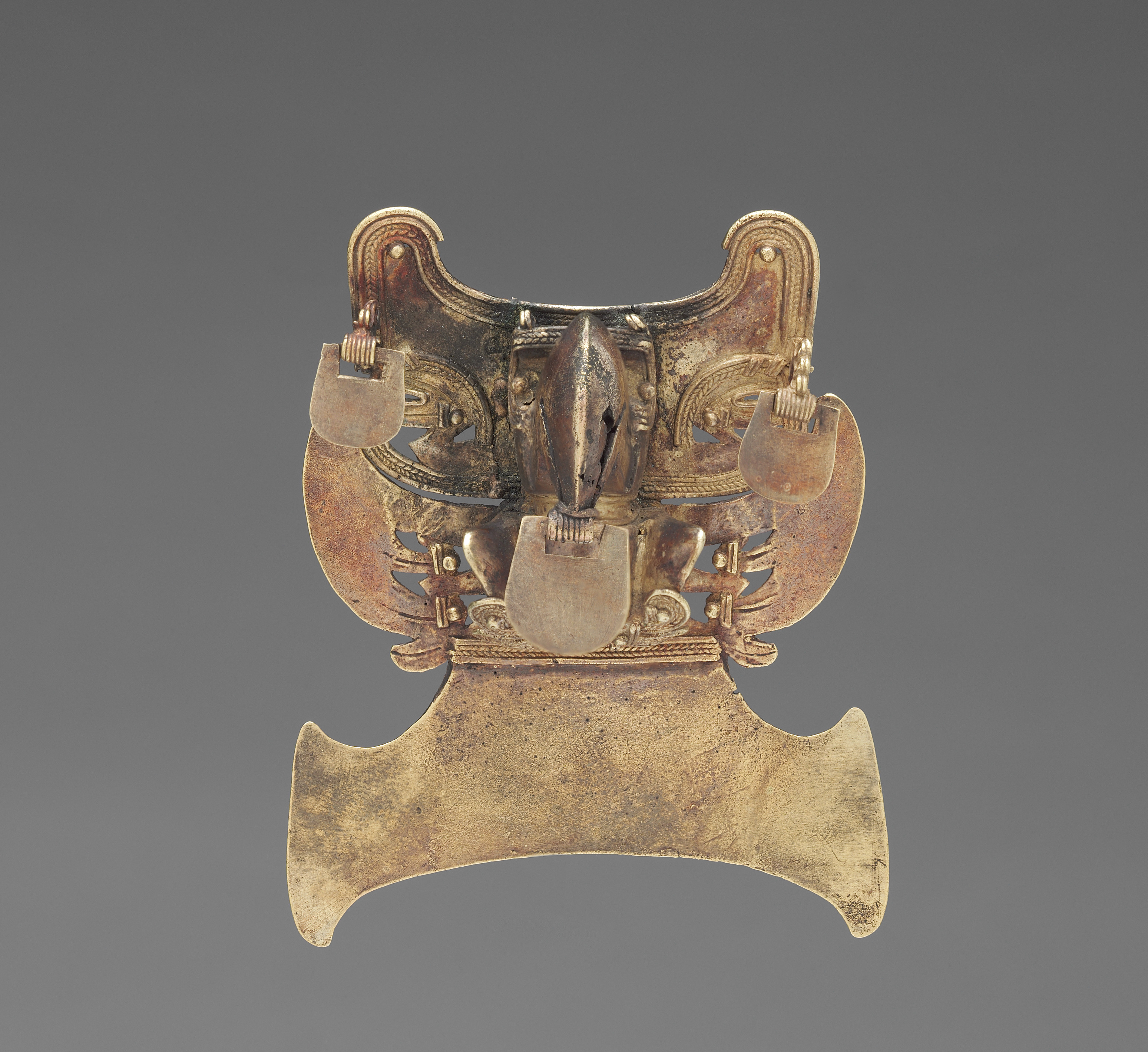
At Zoey Fashion Lab, our mandate transcends the mere cataloguing of historical adornment. We engage in a radical praxis of fabric deconstruction, not of textiles alone, but of the semiotic threads that bind material culture to identity, power, and temporality. The subject of this analysis—a Tairona bird pendant from pre-Columbian Colombia, executed in cast gold—presents a formidable challenge to the contemporary gaze. It is not an object of passive beauty, but an active agent of disruption. Through the lens of the Archive Resonance reference—which juxtaposes a polished silver mirror inlaid with gold palm fronds against the cold narrative relief of a sarcophagus—we decode this pendant as a proto-avant-garde manifesto, one that collapses the boundaries between ornament, cosmology, and technological futurism.
I. Metallurgical Subversion: The Cast as a Gesture of Radical Permanence
The technical choice of lost-wax casting is not incidental; it is a deliberate act of ontological defiance. Unlike hammered sheet gold, which is additive and corrective, casting is a subtractive, sacrificial process. The original wax model—the artist’s initial intention—is destroyed to birth the metal form. This mirrors the avant-garde principle of tabula rasa: the necessity of annihilation for creation. The Tairona goldsmith, operating within a sophisticated chemical and pyrotechnical knowledge base, achieved a granular, tactile surface that resists the sterile polish of Western metonymic gold. Instead, the pendant’s surface is a topography of loss and gain, of micro-cavities that capture light and shadow differently at every angle. This is not a mirror reflecting the world; it is a fractured lens that forces the viewer to reconstitute the image of the bird from fragmented visual data.
In the context of the Archive Resonance, the pendant aligns with the gold-inlaid palm fronds on the mirror—yet with a critical inversion. The mirror’s gold is decorative, a secondary application to a primary reflective surface. The Tairona pendant, however, is all gold, yet its surface is deliberately non-reflective, matte, and granular. It refuses the narcissistic function of the mirror. Instead, it proposes a different form of reflection: not of the viewer’s face, but of the viewer’s cognitive dissonance. The bird is not a realistic avian; it is a schematic, almost cubist distortion of flight—wings splayed, beak exaggerated, body reduced to geometric planes. This is a deconstruction of avian anatomy, achieved centuries before European modernism. The cast gold becomes a vehicle for conceptual density, not material opulence.
II. The Bird as Liminal Navigator: Between the Silver Mirror and the Stone Sarcophagus
The Archive Resonance’s dual imagery—the living, reflective mirror and the dead, narrative stone—provides the perfect dialectical framework for the pendant’s iconography. The Tairona bird is not a mere ornament; it is a psychopomp, a being capable of traversing the vertical axis of the cosmos. In Tairona cosmology, birds occupied a privileged position between the earthly realm of the shaman and the celestial realm of the ancestors. The pendant, worn on the chest, placed the wearer at the intersection of these worlds. This is a wearable interface, a biological-architectural bridge.
Contrast this with the sarcophagus relief. The stone tells a linear story—a narrative of a life, a death, a passage. It is fixed, heavy, and immobile. The gold bird, however, is dynamic. Its form suggests motion arrested in a moment of potential energy. The cast details—the curl of the tail feathers, the pronounced curvature of the beak—are not naturalistic but expressionistic. They evoke the turbulence of flight, the rush of air, the vibration of a hummingbird’s wings. Where the sarcophagus is a closed book, the pendant is an open question. It does not narrate a biography; it proposes a state of being. The wearer does not simply display the bird; they become the bird, adopting its liminal agency. This is the essence of avant-garde adornment: to transform the wearer into a hybrid entity, a living sculpture that challenges the fixed categories of human and animal, mortal and divine.
III. Avant-Garde Temporality: The Pendant as a Machine for Seeing
The term “avant-garde” is typically reserved for early 20th-century European movements—Futurism, Cubism, Dada. Yet, to confine the Tairona pendant to the category of “pre-Columbian artifact” is an act of epistemic violence. It is a chronopolitical object that refuses its historical slot. Its formal language—the aggressive abstraction, the rejection of mimetic naturalism, the emphasis on process over product—resonates more powerfully with the work of Alexander Calder or Julio González than with the decorative arts of its own era. The pendant is not a primitive precursor to modernism; it is a fully realized avant-garde statement that modernism, in its Eurocentric blindness, failed to acknowledge.
From a technical standpoint, the casting process allowed for an internal structural logic that is remarkably modern. The pendant’s weight distribution, its hollow sections, and its balanced asymmetry suggest an intuitive understanding of engineering principles. This is not folk art; it is precision engineering with a symbolic payload. The bird’s openwork design—the negative spaces between the cast elements—functions as a visual filter. When worn, it projects patterns of light and shadow onto the wearer’s skin, creating a ephemeral, secondary tattoo. This is a dynamic, performative aspect that static museum display completely erases. The pendant is a kinetic light modulator, a precursor to contemporary wearable technology that responds to environmental stimuli.
IV. The Pendant as a Critique of Colonial Materialism
Finally, we must address the material itself: gold. In the Western archive, gold is the ultimate signifier of wealth, stability, and value. The Tairona pendant, however, subverts this. Its gold is not bullion; it is semantic flesh. The value lies not in the metal’s exchange rate but in its capacity to hold a complex cosmological code. The pendant’s cast surface, with its deliberate imperfections, rejects the capitalist fetishization of the flawless ingot. It is a critique of the very concept of “precious metal” as a passive store of value. Instead, it proposes gold as an active medium of communication, a material that can be taught to speak in the language of flight, transformation, and spiritual navigation.
The juxtaposition with the silver mirror is again instructive. The mirror’s silver is a surface for human vanity; the gold fronds are an attempt to “naturalize” that vanity with botanical motifs. The Tairona bird, in contrast, is not decorative. It is functional. It is a device for orientation—not in physical space, but in metaphysical space. It tells the wearer where they are in the cosmos, who their ancestors are, and how to move between worlds. This is a utilitarian object, but its utility is of a higher order than that of a mirror or a coin. It is a tool for survival, not of the body, but of the cultural soul.
V. Conclusion: A Blueprint for Zoey Fashion Lab’s Future Praxis
For Zoey Fashion Lab, the Tairona bird pendant is not a historical curiosity; it is a design directive. It instructs us to abandon the tyranny of the flat surface, the sterile grid, and the mimetic representation. It demands that we embrace the cast—the process of destruction and rebirth—as a core methodology. It challenges us to create adornment that is not merely worn but inhabited, that functions as a sensorium of cultural memory and future possibility. The pendant’s ability to hold both the mirror’s reflective vanity and the sarcophagus’s narrative gravity in a single, suspended moment of flight is the ultimate act of avant-garde synthesis.
Our future collections will be informed by this artifact’s radical logic. We will explore granular surfaces that resist optical clarity, openwork structures that create dynamic shadow play, and zoomorphic abstractions that challenge the boundary between the human and the animal. The Tairona bird is not a relic; it is a living blueprint. It is the original deconstructionist, a goldsmith who understood that to create a bird, one must first destroy a wax model—and in doing so, destroy the very idea of what a bird, a pendant, or a civilization should be. At Zoey Fashion Lab, we accept this mandate. We will not mirror the world; we will cast it anew.