Deconstructing the Imperial Echo: An Avant-Garde Analysis of the Byzantine Pendant Necklace
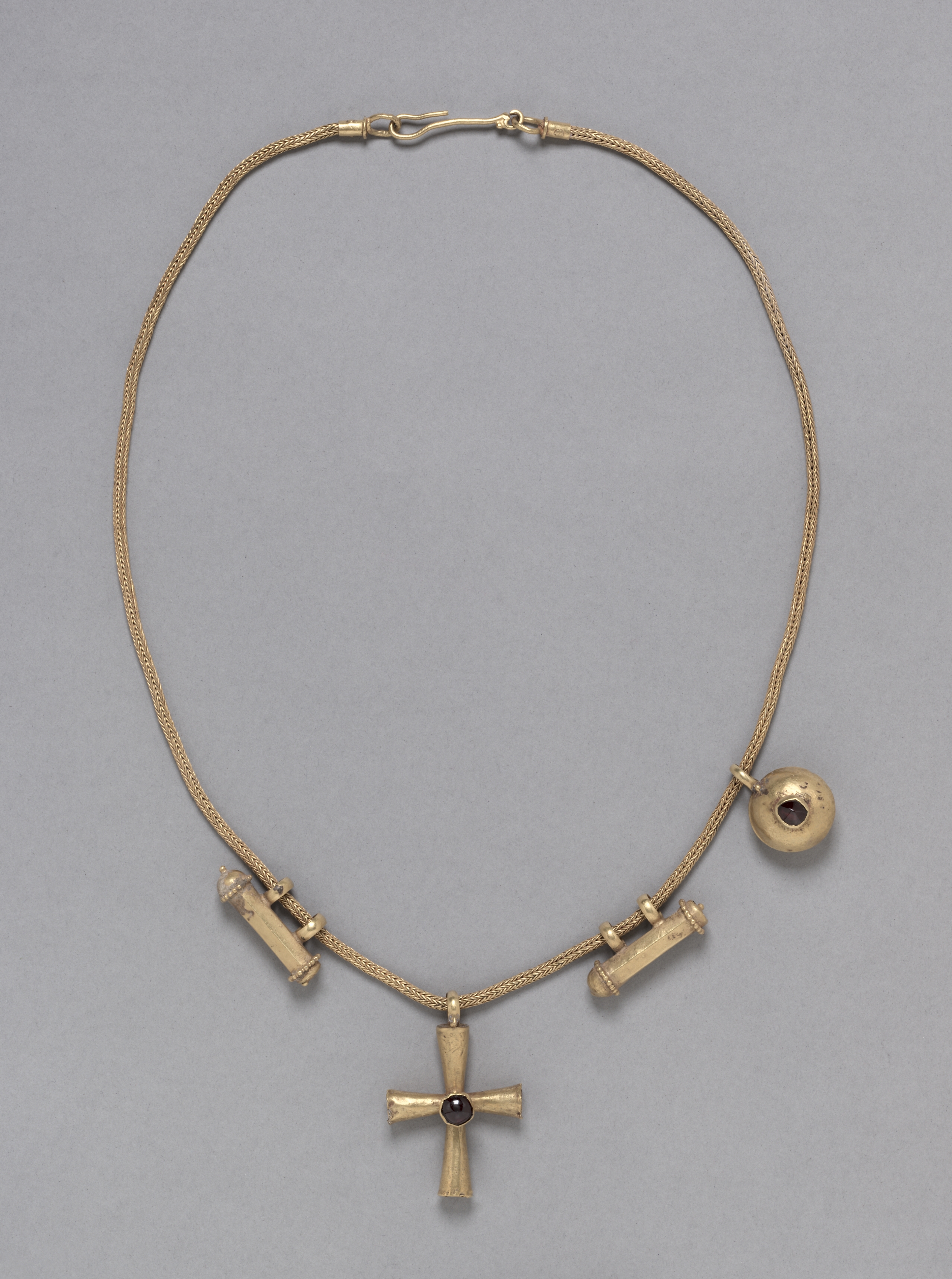
At Zoey Fashion Lab, we do not merely study artifacts; we dissect their temporal DNA. We extract the structural grammar, the material syntax, and the cultural resonance that pulses beneath the surface of historical ornament. Our current subject—a 6th-century Byzantine necklace of gold and garnets, purportedly from Constantinople—is not a relic to be admired from behind glass. It is a blueprint for radical, avant-garde expression. When viewed through the lens of Archive Resonance, specifically the poetic tension between a polished silver mirror inlaid with golden acanthus leaves and a cold sarcophagus lid narrating life in relief, this necklace transforms from a symbol of imperial piety into a manifesto of material contradiction. This analysis deconstructs the piece to reveal how its Byzantine core can be re-engineered into a disruptive, futuristic statement for the contemporary fashion vanguard.
I. Material Dialectics: The Alchemy of Gold and Garnet
The necklace’s primary materials—gold and garnet—are not chosen for mere opulence. In the early Byzantine court, gold was the sun’s solidified essence, a divine, immutable metal reserved for the imperial aura. Garnet, with its deep, blood-like translucency, was the stone of life force, passion, and martyrdom. Together, they form a dialectical pair: the eternal versus the visceral, the immutable versus the volatile. For the avant-garde designer, this is not a historical footnote but a technical challenge. The traditional cloisonné technique, where gold wires create cells for flat garnet slices, produces a mosaic-like surface. This is a two-dimensional, controlled expression of light.
To deconstruct this, we must shatter the flatness. Instead of polished, flat cabochons, we propose raw, unpolished garnet shards suspended in a matrix of oxidized, blackened gold. The contrast would be jarring: the matte, organic irregularity of the stone against the cold, machined precision of the gold frame. This inversion—using a precious metal in a brutalist, unfinished state—speaks to the Archive Resonance of the sarcophagus. The gold is no longer a radiant halo but a structural cage, a tomb for the gem’s internal fire. The wearer becomes a living reliquary, not of a saint, but of raw, unmediated energy. The necklace ceases to be jewelry; it becomes a wearable tectonic event.
II. Structural Grammar: The Pendant as Architectural Anchor
Byzantine pendants often follow a hierarchical logic: a central, dominant medallion flanked by smaller, subordinate elements. This mirrors the imperial and ecclesiastical hierarchy of Constantinople. The central pendant often bore the image of Christ, the Virgin, or a reigning emperor. In our deconstruction, we eliminate the figurative center. Instead, we propose a void—a negative space framed by an exaggerated, oversized gold ring, perhaps 8 centimeters in diameter. Within this void, a single, massive garnet is suspended, not by a chain, but by a single, visible gold pin, as if it were a specimen in a laboratory.
This structural shift is a direct response to the “Mirror with Split-Leaf” imagery. The polished silver mirror of the archive reflection suggests a surface for self-contemplation. Our pendant ring becomes a mirror, but a broken one. The garnet is the splinter. The surrounding smaller pendants—instead of being identical drops—would be asymmetrical, kinetic elements. Some would be hollow gold spheres, others flat, faceted discs, and one might be a sharp, elongated spike. This creates a mobile-like structure, a chaotic constellation that defies the static, symmetrical order of the original. The necklace’s rhythm is no longer a hymn; it is a percussive, syncopated beat.
III. The Archive Resonance: From Silver Mirror to Stone Narrative
The provided reference—a contrast between a luminous silver mirror and a sarcophagus lid—is the conceptual key. The mirror represents the surface: the public, polished, imperial facade. The sarcophagus represents the depth: the private, mortal, narrative interior. The original necklace is a surface object, designed for display in the earthly court and, later, in the celestial one. It is a symbol of triumph over death, its gold and garnets promising eternal light.
Our avant-garde reinterpretation must fuse these two states. We achieve this by introducing a dual-faced pendant. The front face is a highly polished, convex gold disc, mirror-like, reflecting the viewer’s gaze and the surrounding environment. This is the “silver mirror” of the archive—pure, immediate, and deceptive. The back face, however, is a concave, hammered gold surface, deeply textured and oxidized, into which we laser-etch a fragmented narrative—not a saint’s life, but a deconstructed version of the original necklace’s own history. We etch the blueprint of the Byzantine cloisonné, then score it with lines of erasure. This is the “sarcophagus” narrative: the story of the object’s own making and unmaking.
This dual-face design forces a new relationship with the wearer and the observer. The necklace is no longer a passive ornament. It demands to be turned, touched, and interrogated. The wearer can choose to present the confident mirror or the vulnerable, scarred interior. This is a powerful metaphor for the contemporary condition—the constant negotiation between our curated digital surfaces and our complex, internal realities. The necklace becomes a tool for performative identity, not just a decorative accessory.
IV. Avant-Garde Synthesis: Wearable Contradiction
To finalize the deconstruction, we must address the chain. The original would have been a delicate, woven gold loop. We replace this with a rigid, segmented torque—a solid gold bar, hinged at the back, that sits high on the neck like a collar, but with a deliberately rough, unfinished edge. This is a power statement, referencing imperial authority, but subverted by its brutalist execution. The torque would be asymmetrical, thicker at one side, creating an intentional imbalance on the body. This physical discomfort is a reminder of the weight of history and the burden of legacy.
Furthermore, we introduce a tactile element: small, articulated gold leaves that are not polished but left with a granular, sand-cast texture. These leaves would be placed at the junction of the torque and the central pendant, echoing the “split-leaf” motif of the archive. However, they would be sharp-edged, almost dangerous, suggesting a plant that has become a weapon. This is the acanthus leaf of the mirror, evolved into a defensive, post-organic form.
In conclusion, the 6th-century Byzantine necklace is not a closed chapter. It is an open source code for exploring themes of power, mortality, materiality, and identity. By applying the principles of Archive Resonance—contrasting the polished facade with the buried narrative—we have transformed a static historical artifact into a dynamic, avant-garde prototype. The new necklace is not an homage; it is a rebellion. It rejects the passive beauty of the original for an active, uncomfortable, and intellectually rigorous form. It is jewelry that argues, that questions, and that ultimately, refuses to be a mere ornament. It is a statement of intent for the future of fashion, grounded in the deepest past.