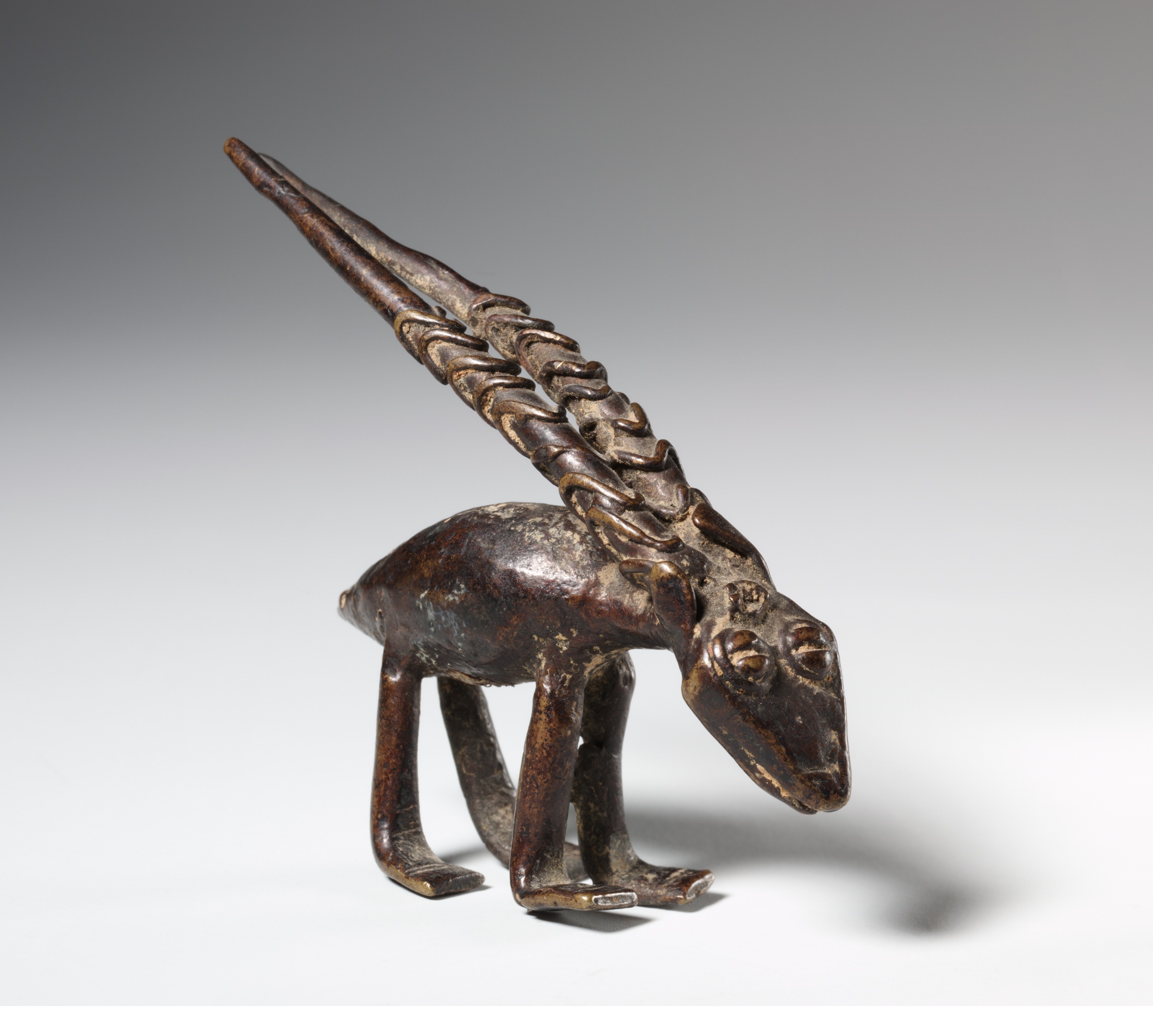
Deconstructing the Akan Gold Weight: An Avant-Garde Analysis of the Antelope Abrammuo
At Zoey Fashion Lab, our mandate transcends the mere cataloging of historical artifacts. We engage in a process of fabric deconstruction—a methodological dismantling of material, form, and cultural resonance to extract the latent design principles that inform our avant-garde collections. This analysis focuses on the Gold Weight (abrammuo) depicting an Antelope, a copper alloy object originating from the Akan-style artists of Ghana, West Africa. Through the lens of Archive Resonance, we juxtapose this diminutive sculpture against a conceptual dichotomy: the gleaming silver mirror with its gold-inlaid palm leaf motifs versus the cold sarcophagus narrating life through relief. The antelope, trapped in metal, becomes the nexus of these opposing forces—a testament to the avant-garde’s obsession with paradox.
Material Dialectics: The Alchemy of Copper Alloy
The technical specification of copper alloy is not a mere footnote; it is the primary text. Unlike the precious gold that historically defined Akan wealth, this abrammuo is cast in a base metal—often brass or bronze—that mimics gold’s luster while subverting its value. This is the first deconstructive act. The Akan artist employed the lost-wax casting technique, a process of meticulous creation where a wax model is encased in clay, heated to melt away the original, and then filled with molten metal. The result is a negative space made positive, a ghost of the original form.
In our avant-garde framework, this process mirrors the Archive Resonance reference. The “glossy silver mirror” represents the polished, reflective surface of contemporary fashion—the immediate, the superficial, the instantly consumable. The gold-inlaid palm leaves are the decorative overlays we apply to mask structural realities. In contrast, the antelope abrammuo is the sarcophagus relief: a dense, unpolished narrative etched into a durable, unyielding surface. The copper alloy does not reflect; it absorbs. It holds the patina of time, the fingerprints of countless transactions, and the weight of proverbial wisdom. For the designer, this materiality demands a rejection of sterile perfection in favor of tactile authenticity.
The Antelope as Semiotic Signifier
The antelope is not a random zoological choice. In Akan culture, the antelope—particularly the adowa or the royal otrom—symbolizes agility, grace, and a connection to the wild, untamed spirit. Yet, in the context of a gold weight, it is rendered static. This is the avant-garde tension: movement frozen in time. The weights were used to measure gold dust, the currency of trade and diplomacy. Thus, the antelope is not merely an animal; it is an instrument of economic exchange, a physical embodiment of value.
Our deconstruction reveals three layers of meaning. First, the literal form: a quadruped in a poised stance, horns swept back, musculature suggested through stylized lines. Second, the proverbial function: gold weights often accompanied sayings or anansesem (spider stories), making the object a mnemonic device. The antelope might allude to the proverb, “The antelope runs, but the hunter’s net is patient.” This introduces a narrative of fate versus agency. Third, the abstract geometry: when viewed from a 360-degree perspective, the antelope’s silhouette creates negative spaces that are as significant as its solid mass. These voids are the “silver mirror” reflecting the viewer’s own cultural biases.
Avant-Garde Application: From Archive to Runway
How does this ancient object inform a forward-thinking fashion laboratory? We translate the abrammuo into structural silhouettes. The antelope’s elongated neck and angular haunches suggest a new form of shoulder padding—not the soft, rounded shapes of bourgeois fashion, but sharp, asymmetric panels that jut outward like horns. The copper alloy’s weight informs our choice of fabrics: we advocate for metallic-threaded jacquards and heavy, felted wools that drape with a similar sense of grounded permanence.
The Archive Resonance reference further guides our color palette. The “glossy silver mirror” translates to high-shine, liquid-like liquid satin and PVC overlays for outerwear. The “gold palm leaves” become intricate laser-cut appliqués in brass-toned leather, applied not as decoration but as structural seams. Conversely, the “cold sarcophagus” inspires a matte, stone-washed finish on our denim and a textured, bark-like knit that mimics the lost-wax mold’s interior. The garment becomes a wearable artifact, a conversation between the ephemeral and the eternal.
Proportion and Asymmetry
The Akan weight’s compact scale—typically 2 to 4 inches—belies its monumental presence. In our avant-garde collection, we amplify this through extreme proportion play. A miniature antelope motif, embroidered in copper thread, sits at the nape of a voluminous, floor-length coat. This juxtaposition of micro-detail against macro-silhouette creates a visual dissonance that challenges the viewer’s perception of scale. Similarly, the antelope’s natural asymmetry—one horn slightly higher, one leg advanced—is translated into asymmetric zippers, off-center closures, and staggered hemlines. This is not chaos; it is a deliberate, choreographed imbalance that mirrors the unpredictable nature of the wild.
Philosophical Underpinnings: The Weight of Existence
Finally, we must address the object’s name: Gold Weight. In a literal sense, it is a counterbalance. But in our deconstruction, it becomes a metaphor for the existential weight of fashion. The industry is often criticized for its superficiality, its “silver mirror” facade. The antelope abrammuo reminds us that true avant-garde design carries weight—cultural, historical, and emotional. It is not afraid to be heavy, to be dark, to be complex.
The “sarcophagus relief” is not a morbid symbol but a celebration of narrative. Just as the coffin’s carvings told the story of a life, our garments must tell stories. The copper alloy’s rough edges are a rejection of the seamless, mass-produced garment. We embrace visible seams, raw hems, and exposed hardware. The antelope’s horns become our structural boning, supporting the silhouette from within, unseen but essential. This is the ultimate deconstruction: honoring the internal architecture that gives form to the external aesthetic.
Conclusion: A Synthesis of Opposites
The Akan gold weight of the antelope is a masterclass in material storytelling. It bridges the gap between the functional and the symbolic, the mundane and the sacred. For Zoey Fashion Lab, it serves as a blueprint for an avant-garde practice that refuses to choose between beauty and meaning. The silver mirror and the sarcophagus are not opposites; they are two sides of the same coin—or in this case, the same cast metal. By integrating the antelope’s form, the copper alloy’s texture, and the Akan proverbial wisdom, we create garments that are not merely worn but inhabited. They carry the weight of history, the agility of the antelope, and the reflective potential of the mirror—all in a single, deconstructed silhouette. This is the future of fashion: rooted in the archive, yet leaping forward with the grace of a creature that refuses to be tamed.