Deconstructing the Renaissance: The Velvet Fragment as a New DNA Strand
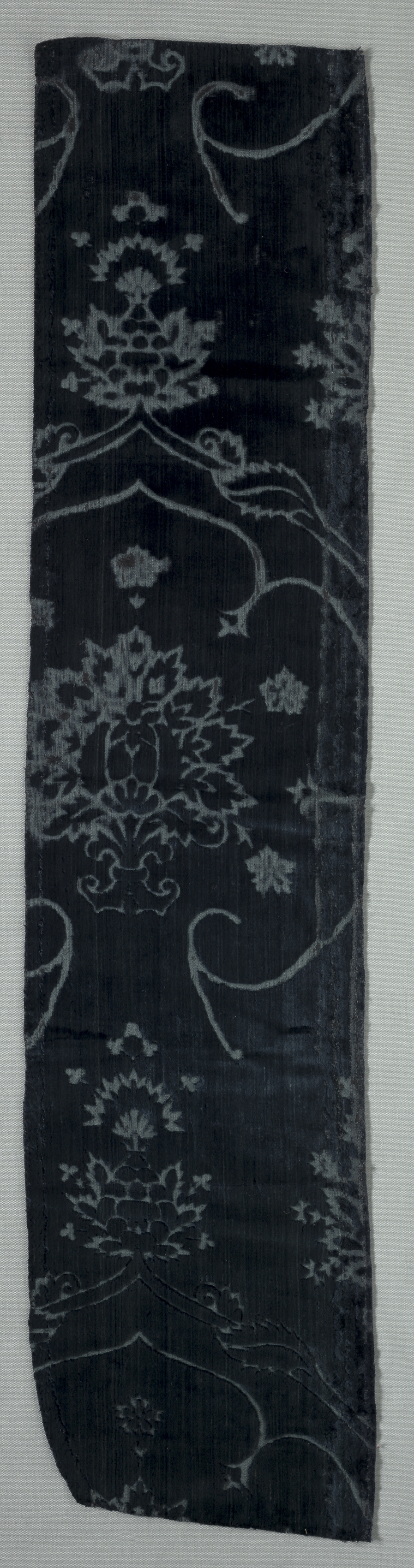
At Zoey Fashion Lab, our mandate extends beyond the mere observation of historical textiles. We engage in a process of fabric deconstruction, where each artifact is not a relic but a living blueprint. The subject of this analysis—a 15th-century Italian velvet fragment, specifically of the cut and voided variety—presents a paradox. It is at once a pinnacle of artisanal perfection and a primitive genetic code. When viewed through the lens of our avant-garde design philosophy, this fragment ceases to be a piece of cloth and becomes a New DNA Strand, offering a sequence of structural, optical, and tactile instructions that can be recombined to forge a future of radical garment architecture.
I. The Genetic Code: Technical Mastery of Cut and Voided Velvet
To decode this strand, we must first isolate its primary nucleotides. The technical construction of 15th-century Italian velvet is a feat of engineering that rivals modern composite materials. The cut technique involves the use of a pile warp that is sliced during weaving, creating a dense, upright surface of silk filaments. The voided aspect refers to the intentional absence of this pile in specific areas, leaving a ground weave of satin or taffeta exposed. This is not a random pattern; it is a deliberate manipulation of light and shadow, of texture and void.
In our lab, we do not see a historical limitation but a binary system. The pile is 'on'; the void is 'off'. This is the original pixel, a pre-digital data set where the artisan's hand controlled the porosity of the surface. The fragment’s design—often featuring pomegranate or artichoke motifs—is not merely decorative. It is a structural map, demonstrating how density can be varied to create tension, release, and optical illusion. For the avant-garde designer, this fragment dictates a new rule: fabric is not a uniform plane but a topographical terrain.
II. The Mutation: Translating Historical Opulence into Avant-Garde Form
The challenge for Zoey Fashion Lab is to mutate this genetic code without destroying its essential vitality. Traditional velvet is heavy, rigid, and associated with aristocratic drapery. Our avant-garde interpretation must subvert these properties. We propose a series of mutations that extract the DNA and splice it with contemporary technologies.
Mutation 1: The Deconstructed Pile. Instead of a continuous pile, we propose a laser-etched velvet where the pile is selectively vaporized. This allows for a 'voided' effect at a micro-scale, creating a gradient from plush to sheer within a single garment. The 15th-century artisan used metal rods to create the void; we use photonic precision. The result is a garment that appears to be in a state of controlled decay, where the fabric breathes and reveals the body in unexpected, fragmented ways.
Mutation 2: The Structural Void. The original voided areas were flat. We propose to invert this. By using high-temperature molding on a synthetic-velvet blend, we can force the voided areas to become concave or convex. The ground weave becomes a structural rib, while the pile acts as a soft, insulating membrane. This creates a three-dimensional exoskeleton, reminiscent of armor but rendered in a tactile, plush medium. The avant-garde silhouette is no longer draped; it is architectural, with the velvet fragment serving as the foundational blueprint for a garment that stands independent of the body's form.
III. The Expression: The Fragment as a Narrative of Time
Our analysis also considers the temporal dimension of the fragment. A 15th-century velvet is a time capsule. Its colors—deep madder reds, weld yellows, and indigo blues—were derived from organic sources. The slight fading and wear patterns are not flaws; they are recorded history. In our avant-garde practice, we treat these imperfections as a unique signature, a non-replicable barcode.
We propose a new series, “Relic Futurism,” where the velvet fragment is not restored but amplified. We use digital printing to exaggerate the fading, turning a subtle patina into a bold, graphic gradient. We then pair this with asymmetrical cutting, raw edges, and industrial zippers. The juxtaposition is jarring yet coherent: the luxurious, historical pile is set against the utilitarian hardware of the modern age. This creates a dialogue between the sacred and the profane, the courtly and the subversive. The wearer is not simply clothed; they are wearing a thesis on the passage of time.
IV. The Synthesis: A New Garment Taxonomy
From this fragment, we derive a new taxonomy for garment construction. The first principle is Surface as Structure. The velvet fragment teaches us that the surface is not a skin to be decorated; it is a load-bearing element. Our designs will use the pile to create thermal insulation, while the voided areas provide ventilation and articulation points. This is not a passive covering but an active environmental interface.
The second principle is Negative Space as Design. The void is not empty; it is a positive design element. In our avant-garde pieces, we will use strategic voiding to create windows of skin, to disrupt the silhouette, and to create a sense of mystery. The eye is drawn to the void, making the covered areas more alluring. This is a psychological manipulation of the viewer, a tool we have learned directly from the 15th-century weavers who used voids to make the velvet appear even more opulent.
The third principle is Hybrid Materiality. The original fragment is 100% silk. Our new strand must be a hybrid. We will splice the velvet pile with recycled metallic fibers to create a shimmering, conductive fabric. We will integrate the voided ground with a bio-based polyurethane to make it waterproof and sculptural. This is not a betrayal of the original; it is an evolution. The DNA remains, but it is expressed in a new environment.
V. Conclusion: The Strand is Infinite
The 15th-century Italian velvet fragment is not an ending; it is a beginning. For Zoey Fashion Lab, it represents the most sophisticated form of pre-industrial coding. By deconstructing its technical brilliance—the cut, the void, the density—we extract a set of universal principles that are timeless. The avant-garde is not about rejecting history; it is about recombining its genetic material to create forms that have never existed.
Our proposed collection, built upon this single fragment, will feature asymmetric cocoon coats with laser-etched topographies, sculptural bodices with molded voids, and flowing skirts that transition from plush to transparent. Each piece will carry the invisible signature of the Renaissance artisan, but speak the visual language of the future. The velvet fragment is our Rosetta Stone, and we are only beginning to translate its infinite possibilities. The strand is long, and we have just sequenced its first base pairs.