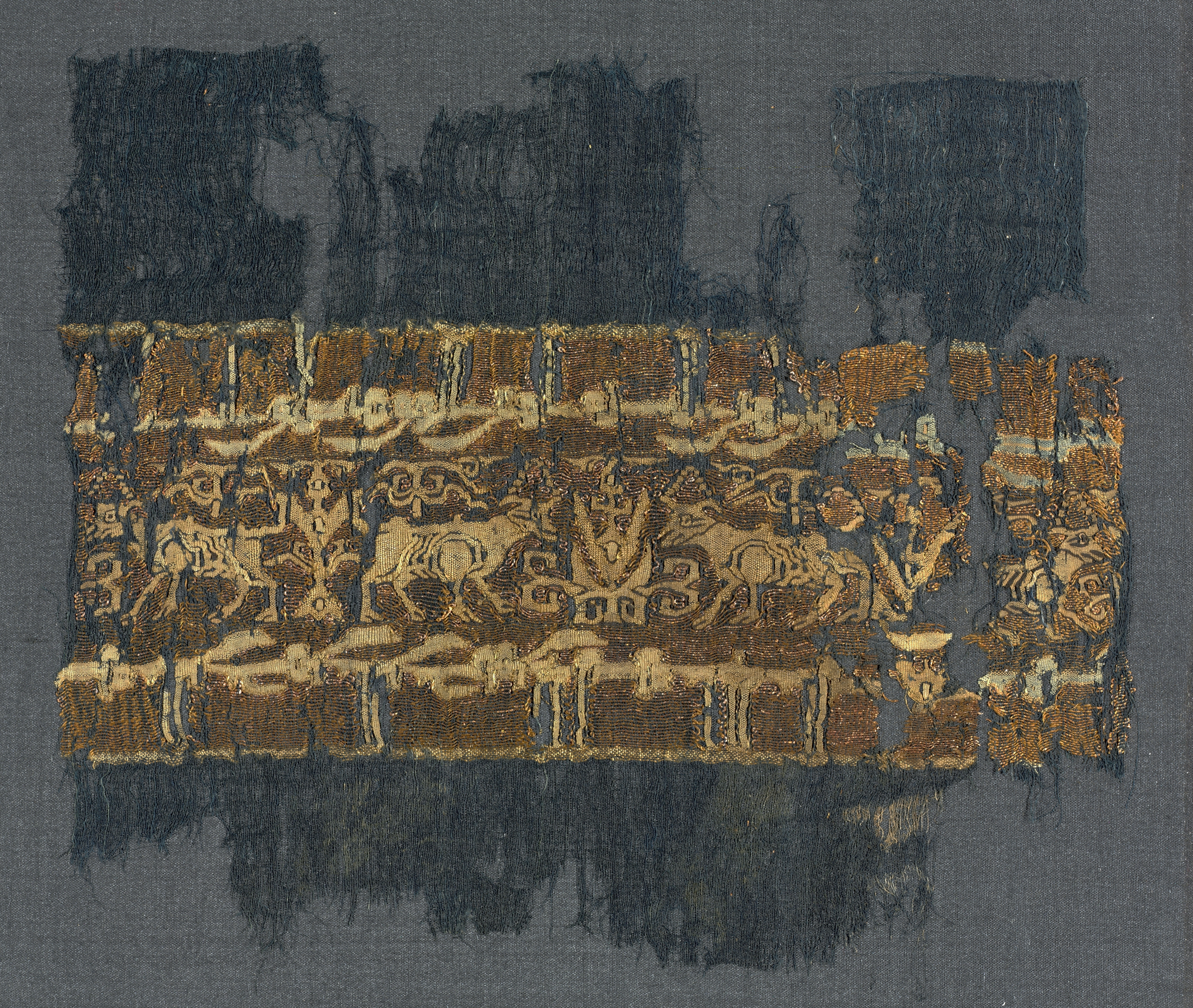
Tiraz with Gold: A Spectral Dialogue in Thread
In the hallowed intersection where archaeology meets the avant-garde, Zoey Fashion Lab presents a radical re-reading of a Fatimid masterpiece: the Tiraz with gold, woven between 1020 and 1035 under Caliph al-Zahir. This is not a relic to be preserved under glass, but a provocation—a textile that speaks in the grammar of rupture, luxury, and political transcendence. The technical specification—plain weave with inwoven tapestry weave, executed in linen, silk, and gold filé—becomes the blueprint for a deconstructive fashion philosophy that challenges the very notion of surface, value, and temporality.
Our analysis, framed by the reference to Archive Resonance—the mirror with split-leaf palmette on one side, the sarcophagus narrative on the other—positions this tiraz as a dual-faced artifact. It is simultaneously a mirror of imperial vanity and a shroud of existential memory. For the avant-garde designer, this duality is not a contradiction but a generative tension. We dissect the tiraz not to preserve its historical integrity, but to weaponize its structural and symbolic DNA for a new lexicon of wearable art.
I. The Alchemy of Materials: Linen, Silk, and the Politics of Gold Filé
The tiraz’s material hierarchy is a manifesto. Linen, the humble Egyptian staple, forms the plain-weave ground—a cool, breathable, almost monastic substrate. Into this austerity, the weaver introduces silk, a filament of imperial lust, and gold filé, a metal-wrapped thread that does not merely reflect light but captures time. In the Fatimid court, this combination was not decorative; it was a territorial claim. The gold filé, wound around a silk core, transformed the fabric into a portable treasury, a declaration of sovereignty that could be draped, folded, and displayed.
For Zoey Fashion Lab, this material triad is a call to deconstruct value systems. We propose a reverse-tiraz technique: exposing the linen’s raw, undyed edges while allowing the gold filé to unravel into loose, kinetic fringes. The silk is not woven but appliquéd in strips, mimicking the tapestry inlay but allowing for dislocation. This is not a faithful reproduction; it is a critical mimesis. The gold filé becomes a metaphor for precarious wealth—threads that tarnish, snap, and bleed onto the skin. The garment is designed to age, to oxidize, to record the wearer’s movement in metallic patina. The result is a living archive, not a static museum piece.
II. The Tapestry Inlay: Deconstructing the Split-Leaf Palmette
The inwoven tapestry weave is the tiraz’s most sophisticated technical feature. Unlike the plain weave, which is a binary grid, the tapestry inlay allows for curvilinear, pictorial forms—here, the split-leaf palmette, a motif of vegetal abundance that spirals into infinity. This motif is not merely ornamental; it is a visual mantra of cyclical renewal, echoing the Nile’s flood and the caliph’s divine mandate. The weaver’s skill lies in the interlocking of discontinuous wefts, creating a seamless transition between ground and image.
Our avant-garde intervention severs this seam. We deconstruct the palmette into its constituent leaves, each one rendered as an independent, detachable textile element. These leaves are then re-articulated on the garment as modular flaps, pockets, and asymmetric panels that can be reconfigured by the wearer. The split-leaf becomes a literal split—a fracture that reveals the underlying linen structure. We call this technique “Palmette Fracture.” The gold filé is used only on the reverse side of these flaps, so that when the wearer moves, the metallic flash is a secret, a covert opulence. This subverts the Fatimid display of power, turning it into a private, introspective luxury.
III. Archive Resonance: The Mirror and the Sarcophagus
The reference to Archive Resonance—the mirror with split-leaf palmette versus the sarcophagus with relief narrative—provides a conceptual framework for our analysis. The tiraz is the mirror: a smooth, reflective surface that projects an idealized image of caliphal glory. But it is also the sarcophagus: a woven container for memory, death, and the afterlife. The Fatimid tiraz was often used for burial shrouds, wrapping the elite in a cocoon of gold and silk for their journey to the next world. Thus, the fabric is both a celebration of life and a preparation for death.
In our avant-garde collection, this duality is expressed through double-faced construction. One side of the garment is the “mirror”—a highly finished, polished surface with the palmette motif rendered in dense gold filé, designed to catch light and project authority. The other side is the “sarcophagus”—a raw, unhemmed linen surface with the same motif embroidered in black silk thread, but deliberately unfinished, with loose ends and irregular stitches. The wearer can choose which side to present, but the garment’s internal structure—its seams, linings, and weights—remains visible through strategic slits and cutouts. This is a deconstruction of the archive itself, exposing the processes of making, valuing, and preserving.
IV. Temporal Dislocation: Weaving the 11th Century into the 21st
The tiraz is a time machine, but not a nostalgic one. Our analysis insists on temporal dislocation—the deliberate anachronism of placing a 1,000-year-old textile technique into a contemporary, streetwear-influenced silhouette. We envision oversized, asymmetric tunics with dropped shoulders, cargo pants with tiraz panels inserted into the knees, and corsets that lace with gold filé cords. The plain weave is scaled up, using a coarse, unbleached linen that references the original but feels industrial. The silk is replaced with recycled viscose, dyed in deep indigo and oxblood, to evoke the Fatimid palette while acknowledging modern sustainability concerns.
The gold filé is the most radical element. We do not use real gold; instead, we use a metallic-coated polyester thread that is then chemically distressed to mimic the tarnishing of ancient metal. This is a critique of material fetishism—the idea that authenticity resides in the preciousness of the material itself. Our gold is fake, but its affect is real. The wearer experiences the same visual and tactile opulence, but the garment is subversively democratic, accessible, and disposable. This is the avant-garde’s answer to the Fatimid court: luxury as a performative act, not a possession.
V. The Body as a Loom: Wearable Deconstruction
Ultimately, the tiraz’s most profound contribution to avant-garde fashion is its relationality. A tiraz is not a static object; it is a transaction between weaver, wearer, and viewer. The inwoven tapestry weave is a physical record of the weaver’s hand, the tension of the loom, and the choices made at each pass of the shuttle. Our garments honor this by making the construction process visible. Seams are left exposed. Frayed edges are celebrated. The gold filé is woven in incomplete bands, so that the pattern appears to be mid-creation, as if the loom is still running.
We invite the wearer to become a co-weaver. The modular palmette flaps can be repositioned, removed, or even re-woven using provided gold thread and a basic needle. This is a radical act of co-authorship, breaking down the hierarchy between designer and consumer. The garment is never finished; it is a continuous archive, accumulating the wearer’s own history. This is the ultimate resonance: not a mirror of the past, but a living loom for the future.
Conclusion: The Tiraz as a Manifesto
The Fatimid tiraz with gold is not a relic to be revered; it is a blueprint for subversion. By deconstructing its materials, techniques, and symbolic resonances, Zoey Fashion Lab transforms a thousand-year-old textile into a contemporary manifesto for critical luxury. We do not reproduce; we re-imagine. The linen is our canvas of authenticity. The silk is our thread of narrative. The gold filé is our lie that tells the truth about value. And the split-leaf palmette is our emblem of fracture—a reminder that all archives are partial, all mirrors are cracked, and all shrouds are ultimately woven by our own hands. This is not fashion history; this is fashion archaeology of the future.