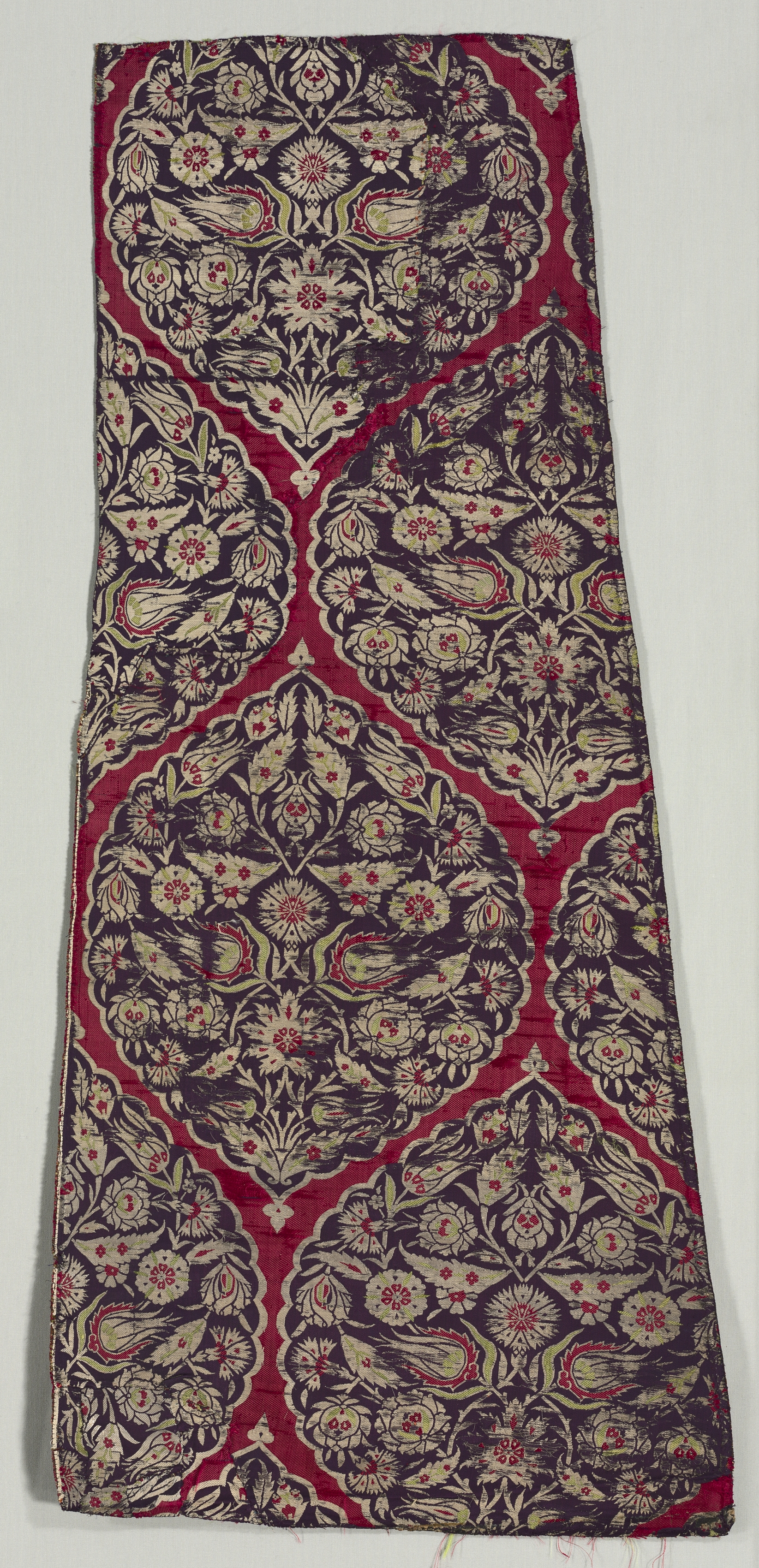
Technical Deconstruction & Material Analysis: Ottoman Brocaded Silk Lampas
The provided artifact is a superlative example of late Ottoman imperial textile craft, specifically a lampas weave. This is not a simple brocade but a complex structure where two sets of warps (foundation and pattern) and two sets of wefts (foundation and pattern) are interlaced to create a dense, reversible fabric with a pronounced pattern relief. The foundation is pure silk, providing drape, strength, and a luminous base. The defining metallic element, cataloged as "silver-metal thread," is typically a silver strip wound around a yellow silk core (sarıklıç). This construction gives the thread its brilliance and structural integrity, allowing it to be woven without breaking. Over centuries, the silver tarnishes to a deep charcoal, while the silk core remains, creating a nuanced, historic palette. The DNA of this fabric is one of regulated opulence and technical mastery—every thread is purpose-placed, resulting in a heavy, stiff textile meant to convey status rather than provide comfort.
Pattern Semiotics: The Language of the Medallion
The foliate medallion (şemse or rumi) is not mere decoration; it is a potent symbol of cosmic order and imperial authority. Its symmetrical, radiating form evokes the sun, a universal symbol of power, while the intricate foliate scrolls (hatayi) within and surrounding it speak to a paradisiacal garden. This is a non-representational, strictly stylized natural world, adhering to Islamic artistic principles that favor infinite pattern over figurative art. The pattern repeat is large-scale and static, designed to be viewed from a distance on a ceremonial kaftan, declaring the wearer's centrality in a meticulously ordered universe. The rhythm is hierarchical and formal, leaving little to chance or fluidity.
Creative Reinterpretation: From Imperial Code to Avant-Garde Protocol
For Zoey Fashion Lab, this textile is not an artifact to be reproduced but a high-level code to be hacked, decompiled, and rewritten. Our avant-garde mission is to subvert its inherent language while honoring its material intelligence. The core tension we exploit is between its static, symmetrical order and the dynamic, asymmetric human form. We move from symbolism of imperial power to narratives of individual deconstruction.
Deconstruction Strategy 1: Material Transmutation
The "silver-metal thread" is our primary target for alchemy. We propose: 1. Bio-Luminescent Weft: Replace the metallic thread with a weft of optical fibers or phosphorescent biopolymers, programmed to pulse or glow in response to sound or movement. The medallion becomes a data-visualization device, its "foliage" reacting to the wearer's environment. 2. Dissolvable Foundation: Weave the pattern with the metallic thread onto a foundation of water-soluble polymer. Post-weave, the foundation is dissolved, leaving a freestanding, three-dimensional metallic lace—the ghost of the medallion, to be applied or worn as a fragile, sculptural overlay. 3. Hybrid Yarn: Spin a new core yarn blending silk with shape-memory alloy or elastic polymer. When heated or electrically charged, the yarn contracts, causing the medallion pattern to distort, pucker, or reconfigure itself in real-time.
Deconstruction Strategy 2: Pattern Disruption & Asymmetric Propagation
The foliate medallion's symmetry is its greatest strength and our point of attack. 1. Fractured Medallions: Digitally shatter the medallion pattern. Use laser-cutting or ultrasonic welding to sever the motif along jagged, algorithmic lines, then re-assemble the fragments with gaps, overlaps, and tears onto a base of technical mesh or recycled rubber. 2. Viral Propagation: Isolate a single, small foliate motif from the grand medallion. Using AI to mimic its growth algorithm, have it spread asymmetrically across the garment like a vine or a mycelial network, clustering at stress points (shoulder, elbow) and fading elsewhere, rendered in heat-bonded foil or embroidered with conductive thread. 3. Negative Space Reversal: Treat the dense pattern as the ground, and the empty space as the figure. Create garments where the body itself becomes the "medallion" revealed through precise cut-outs in a densely brocaded, rigid shell.
Deconstruction Strategy 3: Structural Re-engineering
The lampas weave's heaviness is antithetical to avant-garde movement. We must re-engineer its very structure. 1. Laminated Fragility: Fragment the original weave concept into sheer, discontinuous layers. Sandwich ultra-thin, laser-etched metallic leaf between layers of transparent silicone or bio-acetate, creating a flexible, laminated "fabric" where the medallion appears and disappears with movement. 2. 3D Woven Substrates: Abandon the flat loom entirely. Use 3D digital knitting to create a textured substrate with built-in channels and cavities. Then, inject metallic resins or grow metallic salts crystallographically into these channels, allowing the pattern to form organically within a modern textile matrix. 3. Kinetic Assemblage: Deconstruct the textile into its component threads. Use the silk as a fine cord for macramé or tension structures, and string the metallic threads as free-hanging, articulated elements on a technical harness, creating a kinetic sound piece that moves with the wearer.
Conclusion: The New DNA Strand
The Ottoman brocade's DNA—Silk (Organic Luxury) + Metal (Opulent Permanence) + Medallion (Structured Symbolism)—is mutated for our avant-garde epoch. We propose its new genetic sequence: Bio-Tech Substrate (Responsive/Ephemeral) + Programmable Matter (Dynamic Opacity) + Fractal Pattern (Asymmetric Propagation).
Our final creations will not reference a kaftan. They might manifest as an electroluminescent harness that "brocades" light onto the body, a deconstructed robe where medallions peel away like shedding bark, or a sound-reactive membrane where foliate patterns grow and recede with audio input. We honor the Ottoman master weaver's technical rigor by applying equal rigor to our disruption, transforming a language of absolute power into one of fluid, intelligent, and profoundly individual expression. The foliate medallion is no longer a symbol of a fixed cosmos, but a map of the wearer's own dynamic data and movement.