Deconstruction Report: The Miniature Teapot as a Contradiction in Porcelain
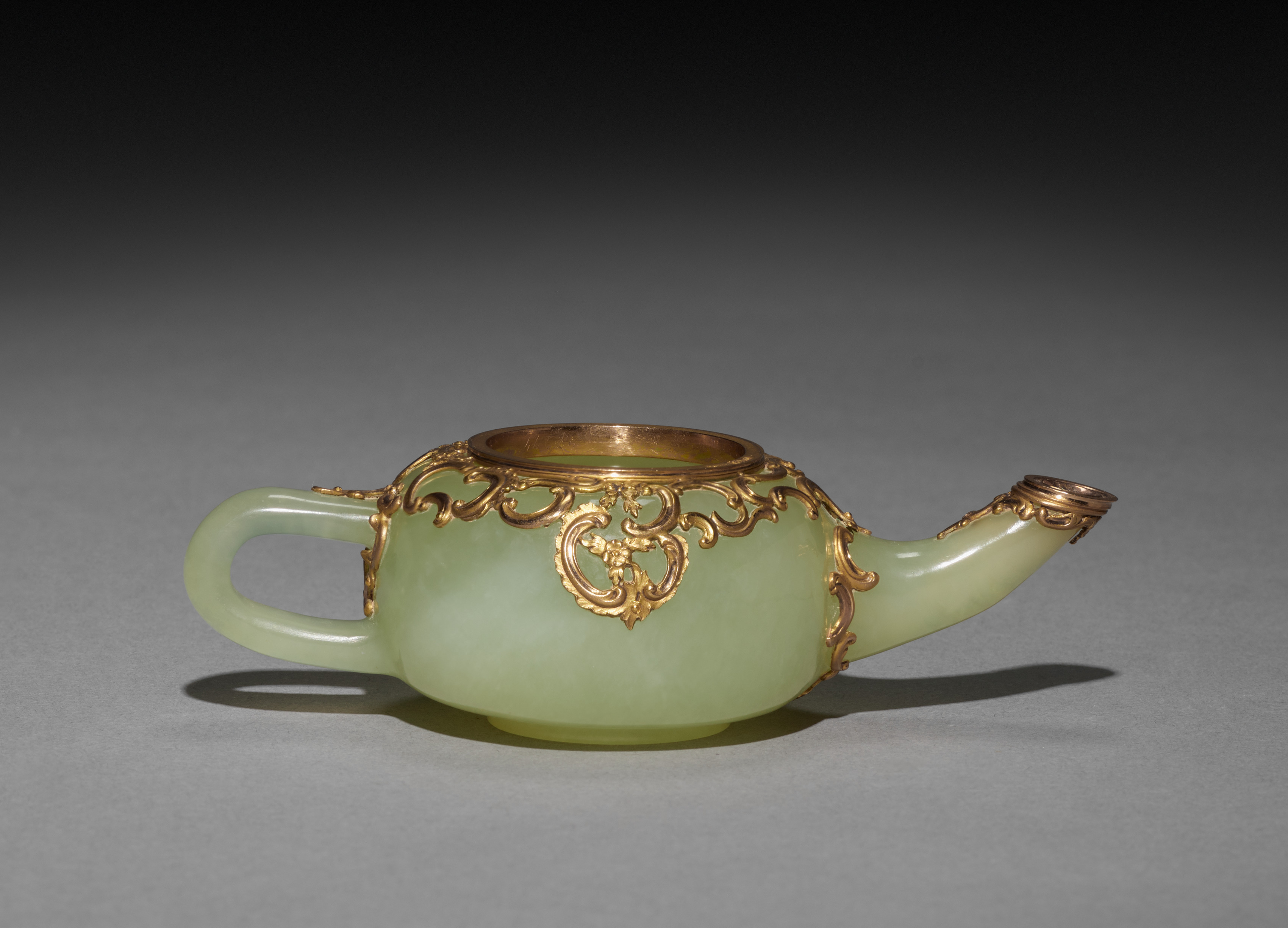
At Zoey Fashion Lab, our mandate is not merely to observe objects but to interrogate their material grammar. The subject of this analysis—a miniature teapot from St. Petersburg, crafted in gold and bowenite—presents a fascinating paradox. On the surface, it is a relic of imperial Russian craftsmanship, a jewel-like objet d’art. Yet, when filtered through our avant-garde lens, it becomes a compressed narrative of duality: the gleaming, reflective vanity of the court versus the cold, sedimentary silence of the tomb. This report deconstructs the teapot’s physical and symbolic architecture, proposing a radical reinterpretation for contemporary fashion application.
I. Material Dialectics: Gold vs. Bowenite
The teapot’s primary tension lies in its material opposition. Gold, with its malleable brilliance, has historically signified divine light, eternal power, and the performative surface of aristocracy. In the Russian context, it evokes the gilded domes of St. Petersburg and the opulent excess of the Romanov era. Conversely, bowenite—a serpentine mineral, often a deep, waxy green or creamy white—is a stone of the earth. It is dense, opaque, and cool to the touch. While gold reflects, bowenite absorbs. This is not a harmonious marriage but a violent juxtaposition: the ephemeral sparkle of human vanity pressed against the indifferent weight of geological time.
For the fashion deconstructionist, this pairing demands a textile translation. Imagine a garment where one shoulder is encased in a liquid-metal mesh of gold lamé, catching every photon, while the opposite side is constructed from a heavy, unpolished wool or a stone-washed jacquard that mimics bowenite’s matte, serpentine grain. The silhouette would be asymmetrical, not for whimsy, but to embody the tectonic clash between these two materials. The gold is the persona; the bowenite is the petrified self.
II. Scale and Subversion: The Miniature as a Loud Statement
The “miniature” scale is the teapot’s most deceptive feature. In traditional Russian decorative arts, miniaturization signified intimacy, a private treasure for a tsarina’s boudoir. However, in our avant-garde deconstruction, the miniature becomes a weapon of critique. By shrinking a utilitarian object—a teapot—to a non-functional size, the artisan has already committed an act of surrealism. It is a teapot that cannot pour. It is a vessel that holds nothing but its own aesthetic.
This logic translates directly to fashion’s relationship with function. We propose a series of garments that are deliberately non-functional in their traditional sense: sleeves that cannot hold arms, collars that do not frame a neck but instead float as independent sculptural elements. The miniature teapot teaches us that scale is a narrative device. By reducing the teapot, the maker amplified its symbolic weight. In fashion, we can apply this by creating oversized, exaggerated accessories—a bowenite-hard resin brooch the size of a fist—or by shrinking a full ball gown into a single, intricate bodice piece worn as a harness. The goal is to disrupt the viewer’s expectation of proportion, forcing a re-evaluation of what is “wearable.”
III. The Archive Resonance: Mirror and Tomb
The provided reference—Archive Resonance: 一面是光洁银镜上以黄金镶嵌的纷繁棕叶纹,另一面是冰冷石棺板上以浮雕诉说的生命叙事—is the conceptual key to this teapot. It translates to: “One side is a polished silver mirror inlaid with intricate gold palm-leaf patterns; the other side is a cold sarcophagus slab where a life narrative is told in relief.” This is not a simple binary of good and evil. It is a temporal duplicity. The mirror represents the present, the superficial, the instantaneous reflection. The sarcophagus represents the past, the historical, the permanent record.
Our teapot sits precisely at this intersection. Its gold detailing is the “mirror” side—the ornate, decorative palmettes that speak to a Victorian or Neo-Rococo taste. Its bowenite body is the “sarcophagus” side—the cool, stone-like vessel that could easily seal a chamber. The teapot, therefore, is not a domestic object. It is a memento mori disguised as a curio. It asks: “What do you preserve? Your reflection, or your story?”
In our fashion collection, this resonance manifests as a binary textile system. We propose a fabric that is reversible: on one face, a high-polish, silver-backed silk with gold embroidered palm fronds, shimmering and alive. On the reverse, the same fabric is treated with a mineral wash and heavy, raised embroidery that feels like carved stone—tactile, rough, and depicting a linear narrative (a procession, a genealogy, a fall). The wearer chooses which side to display. The garment becomes a portable archive, allowing the individual to toggle between their public reflection and their private, stone-carved history.
IV. Avant-Garde Application: The “Pouring Void” Silhouette
Finally, we must address the teapot’s inherent function: pouring. Even in miniature, the spout is a gesture of outflow. In our deconstruction, we reinterpret the spout as a symbol of leakage—the unconscious, the unspoken, the loss of control. The avant-garde fashion application is a silhouette that incorporates a “spout” element: a sharply angled sleeve that extends beyond the hand, a peplum that juts forward like a beak, or a hat with a tubular brim that suggests a pouring motion.
However, the key is that the “pour” must be empty. Nothing comes out. The gesture is suspended. This creates a permanent state of anticipation, a visual tension that mirrors the teapot’s inability to function. We call this the Pouring Void silhouette. It is constructed with internal boning to hold the shape rigid, using a bowenite-toned crepe for the body and a gold-leafed leather for the spout. The garment is a question mark, a paused ritual.
V. Conclusion: A Vessel for Nothing
The St. Petersburg miniature teapot, in its gold and bowenite, is not a nostalgic artifact. It is a philosophical engine for Zoey Fashion Lab. It teaches us that luxury is not about abundance but about contrast and containment. The gold is the lie we tell; the bowenite is the truth we bury. The miniature scale is the irony we employ. By deconstructing this object, we have extracted a new design grammar—one that values material conflict, scale subversion, and the narrative weight of the vessel itself.
Our forthcoming collection will not feature teapots. Instead, it will feature garments that hold nothing, that pour nothing, and that reflect only what the wearer chooses to face. The mirror side will be optional. The sarcophagus side will be inevitable. This is the essence of the avant-garde: to look at a tiny, pretty object and see a monument to mortality, then to wear that monument with defiance.