The Desk as Deconstructed Silhouette: Reimagining the Table en Chiffonière for SS26
The avant-garde imperative is not to create new objects, but to violently re-contextualize existing ones. In the hallowed halls of Zoey Fashion Laboratory, we do not merely observe furniture; we dissect its volumetric soul. This season, our scalpel falls upon the table en chiffonière, a relic of 18th-century domesticity, and re-forges it as a blueprint for SS26’s most radical silhouettes. Hailing from the Global Frontier—a conceptual space where colonial craft meets post-industrial futurism—this piece is not a desk. It is a wearable architecture of layered memory, a manifesto of structural innovation that defies the passive relationship between body and object.
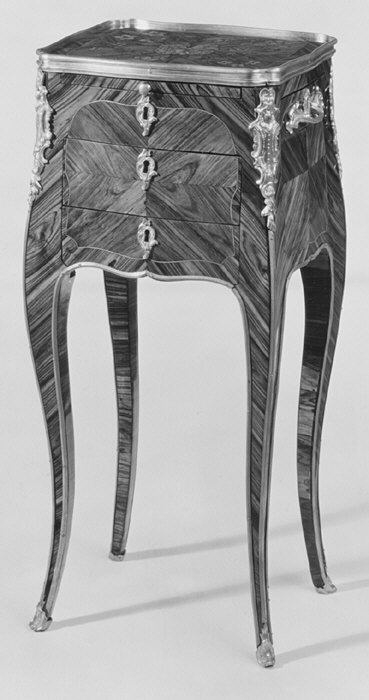
At first glance, the materials betray a decadent history: oak veneered with tulipwood, kingwood, and holly, punctuated by engraved satinwood and green-stained wood. Yet, within the Zoey Laboratory, these are not static surfaces. They are tensile membranes and compression zones. The tulipwood’s flame-like grain becomes a metaphor for kinetic drapery, while the kingwood’s dark striations suggest the shadowed undercuts of a sculpted bustier. We strip the piece of its utilitarian function—writing, storage, display—and isolate its chiffonière essence: a stack of drawers, a series of recessed planes, a vertical rhythm of containment and release. This rhythm translates directly into our SS26 collection’s core thesis: the body as a series of modular, cantilevered volumes.
Deconstructing the Drawer: Modular Volume and the New Proportion
The chiffonière’s defining feature—its graduated drawers—offers a radical departure from the fluid, body-con silhouettes that have dominated recent seasons. For SS26, we propose the ‘Drawer Bustle’: a rear-projected structure of rigid, overlapping panels that mimic the brass handles and recessed fronts of the original. These are not soft bustles of tulle, but engineered shells of resin-infused satinwood veneer, hinged to allow articulation. The silhouette is not worn; it is inhabited. The wearer becomes a living desk, their spine the central mullion, their hips the protruding drawers. This is a futuristic silhouette that rejects the biological curve for the geometric cadence of furniture joinery.
Furthermore, the gilt bronze mounts—those ornate, cast corners—are re-imagined as exoskeletal joints for the shoulders and elbows. We cast them in lightweight, recycled aluminum, then electroplate them with a ghost of the original gold. The result is a metallic lattice that cages the torso, allowing for a silhouette that is simultaneously armored and skeletal. This is not ornamentation; it is structural innovation that defines the garment’s very architecture. The shoulder line, once soft, now projects outward in a sharp, right-angled cantilever, echoing the desk’s protruding writing surface. The body disappears, replaced by a functionalist fantasy of storage and display.
Engraved Satinwood as Textile: The Patterning of Light and Shadow
Our analysis moves beyond form to surface. The engraved satinwood—with its delicate, etched floral motifs—is not a print. In our hands, it becomes a topographical map for laser-cut perforations on technical jersey. We translate the engraving’s depth into a gradient of transparency: shallow cuts yield a translucent mesh, while deeper incisions create opaque, raised welts. This is bio-mimetic patterning, where the garment’s fabric literally mirrors the wood’s relief. The green-stained wood, a symbol of patina and age, is re-imagined as a chromatic shift in our fabric dyeing process—a reactive pigment that darkens with body heat, creating a living, changing surface that mimics the oxidation of the original furniture.
The gold-tooled green leather writing surface is perhaps the most provocative element. We extract its tactile duality—hard tooling, soft hide—and apply it to the front panel of a high-collar jacket. The leather is not sewn; it is molded and heat-pressed into a rigid yet supple breastplate, complete with actual blind-tooled lines that mimic the desk’s gilt borders. This is couture as conservation, a method of preserving the object’s aura while destroying its utility. The garment becomes a museum piece for the body, a portable fragment of a lost interior.
Structural Innovation: From Furniture Joint to Garment Seam
The most critical innovation for SS26 lies in the joinery. The desk’s dovetail joints and mortise-and-tenon connections are not hidden; they are celebrated as the primary seam structure. We abandon the invisible stitch. Instead, our atelier employs visible, interlocking seams—dovetail-inspired closures that snap together with a satisfying click. Sleeves attach to bodices via a tenon-and-slot mechanism, allowing for interchangeable limbs. This is not merely a stylistic choice; it is a functional system that permits the wearer to reconfigure their silhouette in seconds, from a sharp-shouldered power suit to a capacious, drawer-like cocoon. The brass hardware of the original becomes magnetic clasps, engineered to hold the weight of the fabric without distortion.
Moreover, the holly wood, with its pale, almost white tone, is used as a color-blocking agent. In our garments, this translates to optical white panels of bonded neoprene that interrupt the darker kingwood hues of the main body. This creates a visual illusion of depth, making the wearer appear as if their torso is comprised of stacked, recessed planes—a direct homage to the chiffonière’s front elevation. The silhouette is not draped; it is assembled. Each garment is a kit of parts, a testament to the beauty of engineered construction.
In conclusion, the table en chiffonière is not a source of inspiration; it is a structural partner. For SS26, Zoey Fashion Laboratory proposes that fashion must move beyond the body’s organic limits and into the realm of designed objects. We offer a wardrobe of wearable furniture—garments that stand alone, that possess their own internal logic of support and volume. The future is not fluid; it is faceted, compartmentalized, and proudly architectural. This is the new avant-garde: not a rejection of the past, but a brutal, beautiful dismantling and re-rigging of its most treasured forms.