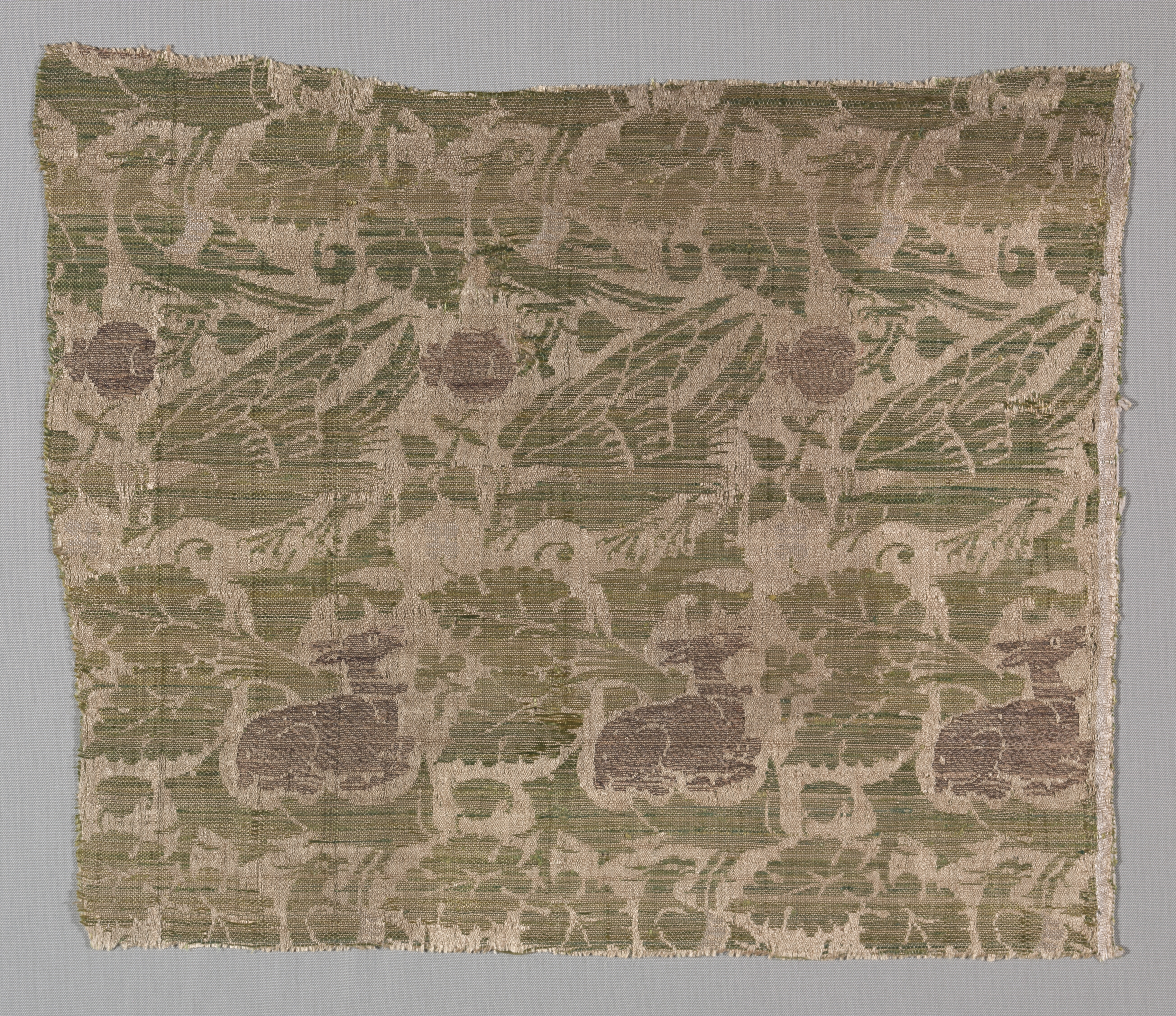
Deconstructing the Luminous: Silk and Gold Textile, Italy, 15th Century
In the hallowed archives of textile history, few artifacts resonate with the dual force of technical mastery and cultural symbolism as profoundly as the 15th-century Italian lampas weave composed of silk and gold thread. For Zoey Fashion Lab, this is not merely a relic of aristocratic opulence; it is a blueprint for subversive innovation. To deconstruct this fabric is to dismantle the very notion of surface value, revealing a complex architecture of light, power, and material dialogue that speaks directly to the avant-garde imperative of our time. The Italian Renaissance, a crucible of artistic rebirth, produced textiles that were not passive backdrops but active agents of social and political messaging. This analysis dissects the physical and conceptual strata of this textile, repositioning it as a radical precursor to contemporary experimental fashion.
Technical Stratigraphy: The Lampas Architecture
Before we can challenge its aesthetic, we must master its mechanics. The lampas weave is a compound structure, a sophisticated marriage of two or more sets of warp and weft threads. Unlike simpler brocades where supplementary threads float freely on the surface, lampas integrates a ground weave—typically a plain or twill silk base—with a pattern weave, often a satin. This is not a superficial embroidery; it is a fully integrated, double-layered construction. The technical genius lies in the binding system: the pattern weft (often the gold thread) is bound by the ground warp in a specific sequence, creating a flush, durable surface that does not snag or distort. The result is a fabric that is simultaneously structural and ethereal.
The inclusion of gold thread—typically a gilt silver strip wound around a silk core (known as *filato*)—introduces a third dimension: optical depth. The metal does not merely sit atop the silk; it is woven into the very fabric of the matrix. This creates a dynamic interplay of reflectance and absorption. Where the silk ground absorbs light, the gold reflects it with a warm, almost molten intensity. The avant-garde reading of this technique is one of material conflict: the soft, organic silk against the rigid, inorganic metal. This is not harmony; it is a controlled tension. For Zoey Fashion Lab, we interpret this as a directive to explore textiles that possess inherent kinetic potential—fabrics that change their visual identity based on ambient light, movement, and viewer perspective.
Cultural Resonance: The Archive as a Living System
Your reference to the archive—*“在人类文明的长河中,器物与绘画不仅是时代技艺的结晶,更是文化碰撞与美学交融的无声见证”*—is pivotal. The 15th-century Italian silk and gold textile is a testament to cross-cultural pollination. The techniques themselves were influenced by Byzantine and Islamic weaving traditions, which had perfected the use of metal threads. The Italian workshops, particularly in Lucca, Venice, and Florence, absorbed these influences and re-coded them with Western Christian iconography and classical motifs. The pomegranate, the artichoke, and the palmette were not merely decorative; they were symbols of fertility, resurrection, and imperial power. This textile was a silent witness to the collision of Eastern opulence and Western rationalism.
To treat this as a static artifact is to miss its radical potential. The archive is not a tomb; it is a resonance chamber. For the avant-garde designer, this textile’s true value lies in its disruptive genealogy. It challenges the contemporary obsession with minimalism and monochrome by asserting that maximalism, when executed with technical precision, can be a form of intellectual provocation. The gold is not mere decoration; it is a declaration of sovereignty. In our current era of digital saturation and ephemeral fast fashion, this 15th-century object demands we slow down and consider the labor, time, and material intelligence embedded in every centimeter. It is a protest against disposability, a call to re-invest in the tangible and the precious.
Avant-Garde Translation: From Relic to Radical Statement
How does Zoey Fashion Lab translate this dense historical material into a forward-looking design language? We propose three specific deconstruction protocols:
1. Deconstruction of Light: The original gold thread creates a binary of shine and matte. Our avant-garde interpretation will fragment this. By deconstructing the lampas weave into unbound, fraying sections, we can expose the internal warp structure, allowing the silk to hang in translucent, skeletal layers while the gold remains in rigid, architectural fragments. This creates a garment that is a study in decay and permanence, where the gold becomes a fossilized memory of opulence, and the silk becomes a living, breathing membrane.
2. Re-coding the Motif: The traditional pomegranate or palmette must be abstracted. We will not reproduce the motif; we will extract its structural logic. The symmetry, the radial growth pattern, the central axis—these will become the basis for a new, asymmetrical pattern language. Using digital jacquard looms, we can re-imagine the motif as a glitch, a corrupted file where the traditional pattern is interrupted by pixelated voids. This is a commentary on the loss of traditional knowledge in the digital age, while simultaneously using digital tools to honor the original complexity.
3. Material Substitution: While we respect the original materials, the avant-garde mandate requires experimentation. We propose a hybrid lampas where the silk is replaced with a bio-fabricated cellulose, and the gold is substituted with a recycled metallic polymer. This is not a dilution; it is a critical upgrade. The new fabric retains the structural integrity of the lampas but challenges its ecological footprint. The garment becomes a statement on sustainable luxury—a paradox that forces the wearer to reconsider what constitutes value in the 21st century. The gold is no longer mined; it is re-cycled from obsolete technology, turning the garment into a wearable commentary on resource extraction and waste.
Conclusion: The Fabric as a Philosophical Instrument
The 15th-century Italian silk and gold lampas is far more than a luxurious textile. It is a philosophical instrument that encodes the aspirations, technologies, and anxieties of its era. For Zoey Fashion Lab, it serves as a masterclass in material storytelling. The avant-garde does not mean rejecting history; it means interrogating it, deconstructing its assumptions, and re-assembling its components into new, provocative configurations. By understanding the technical complexity of the lampas weave, the cultural resonance of its motifs, and the material agency of its gold thread, we can create garments that are not merely worn but experienced. They are arguments, provocations, and silent witnesses to our own complex moment in time. This textile is not a relic; it is a resonance—and we are its modern-day interpreters, tasked with making it speak in a new tongue.