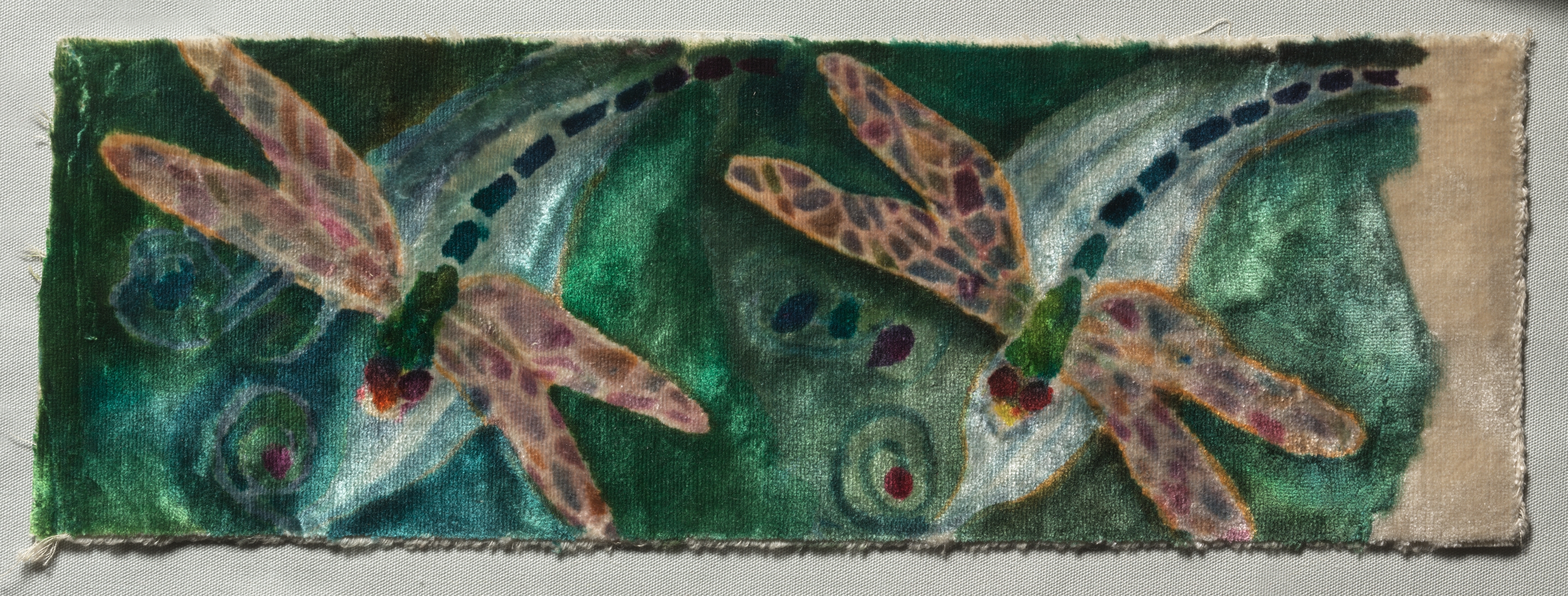
Deconstructing the New DNA Strand: An Analysis of American Stenciled Velvet
In the relentless pursuit of textile innovation, Zoey Fashion Lab encounters materials that defy conventional categorization. The subject of this analysis—a plain silk velvet, stenciled with vegetable dyes, originating from New York—presents a compelling paradox. It is at once a relic of artisanal tradition and a radical proposition for the future of haute couture. Referenced internally as the New DNA Strand, this fabric is not merely a substrate for design; it is a living blueprint, a genetic code rewritten through pigment and pile. This report deconstructs the material’s technical architecture, its avant-garde stylistic implications, and its strategic value within our design ecosystem.
Technical Provenance and Material Integrity
The foundation of this textile is unadulterated luxury: a plain (non-patterned) silk velvet. The construction is classic—a ground weave of silk filament with a cut pile of the same proteinaceous fiber. This choice is critical. Unlike synthetic velvets, silk’s natural luster and high refractive index create a dynamic surface where light is absorbed and reflected differently depending on the angle of the pile. This optical volatility is the canvas upon which the stenciling operates.
The Stenciling Process: Precision Meets Organic Chaos
The stenciling technique employed is a masterclass in controlled unpredictability. Unlike screen printing, which forces pigment through a mesh, stenciling involves the application of dye through a cut-out template. In this New York atelier, the process is executed with vegetable dyes—chromophores derived from roots, leaves, and bark. These dyes are not inert; they are living compounds that interact with the silk protein. The mordanting process (using metallic salts to fix the dye) is crucial, yet the final hue remains subject to pH, humidity, and dye batch variation. This introduces a systemic variance that mass production cannot replicate. Each yard of this velvet is a unique genetic expression, a singular iteration of the DNA strand.
The physical interaction between dye and pile is where the technical genius lies. Vegetable dyes, being water-based and less viscous than synthetic pigments, wick along the silk fibers via capillary action. When applied to the velvet’s surface, the dye does not merely sit atop the pile; it penetrates the nap, creating a gradient of saturation from the tip to the base. The result is a halo effect around each stenciled motif—a soft, diffused boundary that mimics the organic bleeding of a watercolor on paper. This is the antithesis of the crisp, hard-edged prints of commercial textiles. It is a deliberate blur, a suggestion of form rather than a declaration.
Stylistic Analysis: The Avant-Garde Imperative
To classify this fabric as merely “decorative” is to ignore its disruptive potential. The New DNA Strand reference is not arbitrary; it signifies a break from linear design evolution. This velvet does not follow the seasonal trends of color or pattern. Instead, it proposes a new syntax for the avant-garde garment.
Subverting the Language of Luxury
Silk velvet has historically been the fabric of royal courts, ecclesiastical vestments, and old-world opulence. Its weight and drape connote formality and grandeur. By applying stenciled vegetable dyes—a technique more associated with folk art and protest posters—the fabric is violently recontextualized. The stencil’s motif, which in this iteration appears as an abstract, cellular-like structure (hence the DNA moniker), is rendered in earthy, non-synthetic tones: madder root reds, indigo blues, and weld yellows. This juxtaposition creates a cognitive dissonance: the eye perceives the plush, expensive velvet, yet the pattern whispers of the handmade, the imperfect, and the organic. This is the essence of the avant-garde—the deliberate destruction of established aesthetic hierarchies.
Dimensionality and Movement
The stenciling does not flatten the velvet; it amplifies its three-dimensionality. As the garment moves, the pile crushes and recovers. The stenciled areas, where the dye has stiffened the fibers slightly, react differently to light and motion than the undyed ground. This creates a kinetic chiaroscuro—a play of light and shadow that shifts with the wearer’s gesture. The garment becomes a living sculpture, its surface in constant flux. For the avant-garde designer, this offers an unprecedented opportunity: the garment’s visual narrative is not static but evolves in real-time. The “pattern” is not a fixed image but a dynamic interaction between the fabric’s physics and the body’s choreography.
Deconstruction of the Silhouette
Given this fabric’s unique properties, the silhouette must be re-engineered. Traditional velvet tailoring relies on heavy structure and rigid interlinings to support its weight. However, to do so would negate the stenciled effect. Instead, we propose a deconstructed drape—a silhouette that utilizes the velvet’s natural fluidity. Cut on the bias, the fabric will follow the body’s contours, allowing the pile to crush and reveal the stenciled motifs in unexpected places. The garment should not be seamed to create a shape; it should be shaped by the negative space around the body. Think of a kimono-sleeve coat with asymmetrical panels, where the stenciled “DNA” sequences are allowed to wrap organically around the torso. The result is a garment that feels both primordial (the vegetable dyes) and futuristic (the genetic metaphor).
Strategic Implications for Zoey Fashion Lab
This fabric is not a commercial product; it is a conceptual weapon. Its integration into a collection signals a commitment to slow fashion, artisanal process, and intellectual rigor. The inherent variance of the vegetable dyes means no two garments are identical, allowing for a limited-edition, collectible business model. This aligns with the luxury market’s shift toward uniqueness and provenance.
Furthermore, the New DNA Strand can serve as a catalyst for interdisciplinary collaboration. The stenciled patterns can be digitally mapped and projected onto adjacent, non-textile surfaces—leather goods, footwear, even runway set design—creating a cohesive, immersive brand universe. The fabric’s story—from New York studio to silk farm to the final garment—becomes part of the marketing narrative, appealing to a consumer base that values transparency and artistry over mass-produced logos.
Conclusion: A Living Material
The stenciled silk velvet from New York is more than a textile; it is a manifesto. It challenges the binary of print versus weave, of structure versus fluidity, of tradition versus innovation. Its technical execution—the marriage of ancient dyeing with modern stencil precision—yields a material that is both historically literate and aggressively contemporary. For Zoey Fashion Lab, this fabric is not a trend to be followed but a strand to be spliced into our own design DNA. We do not simply cut and sew this velvet; we collaborate with it. We allow its organic imperfections to dictate the garment’s final form. In doing so, we move beyond fashion as mere clothing and into the realm of wearable art—a living, breathing testament to the power of material deconstruction. This is the future, and it is stenciled in root and bark, woven in silk, and coded in a pattern that has no beginning and no end.