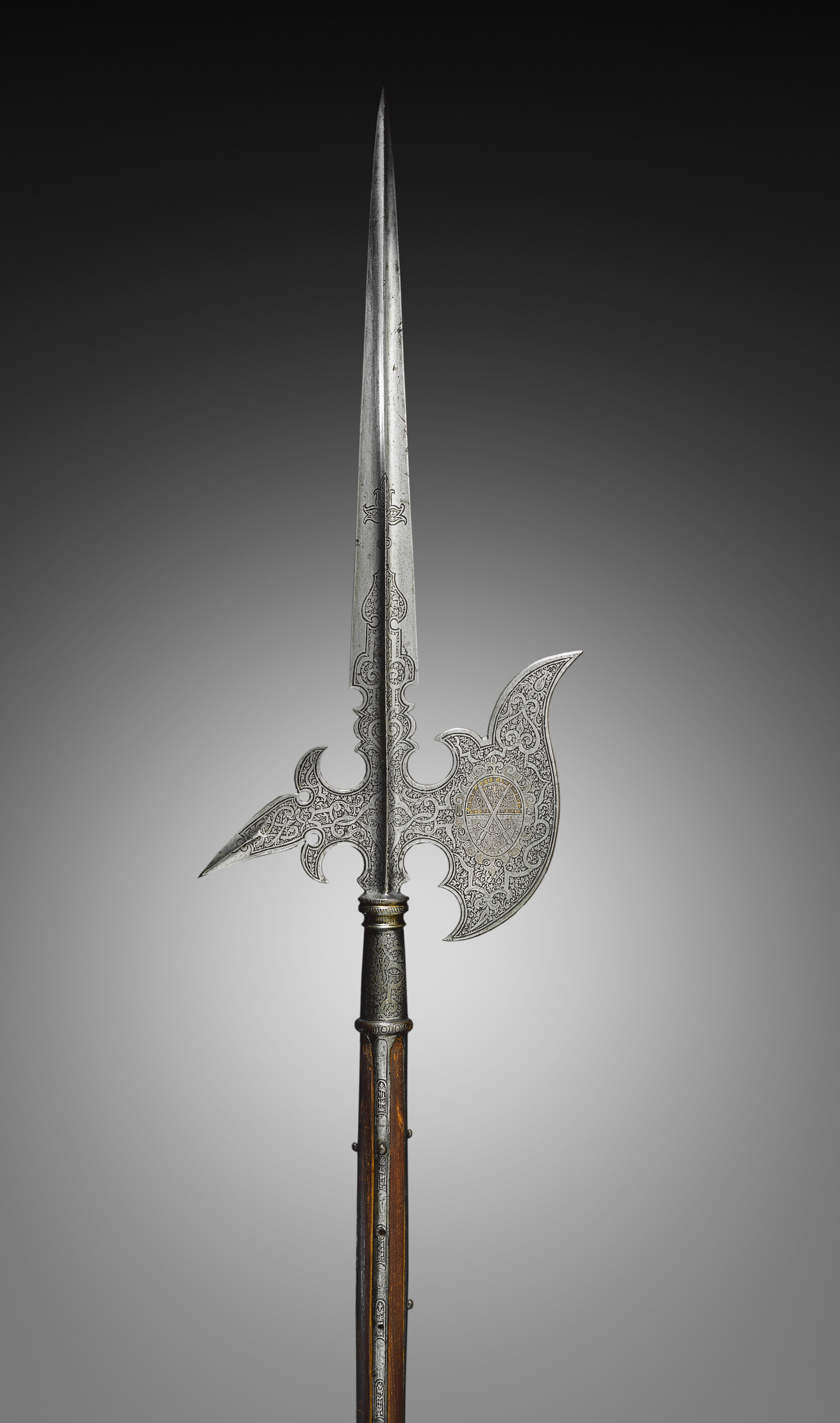
Deconstructing the Ceremonial Stance: The Parade Halberd as Avant-Garde Blueprint
At Zoey Fashion Lab, we do not merely observe historical artifacts; we interrogate them. We strip them of their original function to reveal their latent structural language, their innate rhythm, and their potential for contemporary sartorial disruption. This week’s subject, the Parade Halberd of Elector Christian I of Saxony (circa 1560-91), presents a uniquely compelling paradox. It is a weapon of war rendered useless by ornament, a symbol of authority frozen in a gesture of aggressive formality. For the avant-garde designer, this object is not a relic but a generative matrix—a source code for silhouettes that challenge the human form and redefine the relationship between garment and wearer.
I. Structural Dissection: The Halberd’s Geometric Vocabulary
The halberd’s anatomy is a masterclass in conflicting vectors. It is composed of three primary elements: the long, slender haft, the broad, leaf-shaped blade, and the prominent, upward-curving spike or fluke. In this specific Saxon example, the steel is not merely functional; it is etched and gilt, transforming a brutal tool into a shimmering, two-dimensional tapestry of light. The round wood haft provides a tactile, organic counterpoint to the rigid, metallic head.
A. The Vertical Axis and the Extended Limb
The haft, measuring roughly two meters, is the first point of departure. In fashion terms, it is an exaggerated, rigid spine. It proposes a silhouette where the body’s natural verticality is amplified to an almost absurd degree. We see this echoed in the elongated, sculptural sleeves of avant-garde couture—sleeves that extend beyond the hand, not for warmth, but to create a continuous, unbroken line from shoulder to fingertip. The halberd’s haft suggests a garment that is less worn and more carried, a prosthetic extension of the wearer’s will. The roundness of the wood, however, introduces a crucial softness. It prevents the design from becoming purely architectural; it insists on a tactile, almost sensual quality, which we translate into the use of fluid, heavy-weight wools or molded leather that wrap the body without constricting it.
B. The Blade: Asymmetric Draping and Shielded Volume
The leaf-shaped blade is the halberd’s most aggressive component. Its broad, sweeping curve is a study in asymmetric mass. It does not mirror the body; it confronts it. This translates directly into a design language of single-shoulder constructions and caped volumes. Imagine a jacket where one shoulder is built up into a sharp, rigid peak, echoing the spike, while the opposite side falls into a soft, fluid drape, mimicking the blade’s curve. The gilt etching on the steel is not decoration; it is a surface treatment. It speaks to a fascination with light reflection and pattern. For the fabric deconstructionist, this is a directive to explore lurex threads, metallic foiling, and laser-cut perforations that create a similar play of light and shadow across a garment’s surface, turning the fabric itself into a heraldic emblem.
II. Material Alchemy: From Steel to Silk
The technical execution of the halberd is paramount. The etching is not a superficial engraving; it is a deep, chemical alteration of the metal’s surface. This process of controlled corrosion and embellishment is the core of our material translation. We ask: how can we apply this logic to textiles?
A. Gilt as a Textile Concept
Rather than using literal gold, we interpret the “gilt” as a luminosity gradient. This manifests in fabrics that shift in tone depending on the angle of view—think of changeant silks, iridescent organzas, or jacquards woven with a metallic weft. The etching, with its intricate scrollwork and figural scenes, becomes a prompt for digital printing and embossing. We can create a fabric that appears to have a bas-relief surface, where the pattern is not printed on top but seems to emerge from the material’s very core, mimicking the depth of the steel’s incised lines.
B. The Haft’s Tactile Counterpoint
The round wood haft introduces a principle of material contrast. Its matte, warm, and organic texture is the perfect foil to the cold, reflective steel. In our garments, this translates to a juxtaposition of raw, unbleached canvas or cork-infused leather against the high-tech, metallic surfaces. This is not mere eclecticism; it is a structural necessity. It grounds the avant-garde silhouette, preventing it from becoming costumey. The wood’s grain suggests a pattern language of vertical striations and organic, non-repeating lines, which we can replicate in ribbed knits or hand-pleated fabrics that add a subtle, kinetic texture to the garment.
III. The Avant-Garde Synthesis: The "New DNA Strand"
The reference to a "New DNA Strand" is crucial. It implies that this historical object is not a template to be copied, but a genetic donor for a new design lineage. We are extracting the halberd’s core principles—asymmetric balance, aggressive elongation, material dichotomy, and ceremonial rigidity—and splicing them into a contemporary fashion genome.
A. Silhouette Proposals
From this analysis, Zoey Fashion Lab proposes three distinct silhouettes. First, "The Ceremonial Spine": a floor-length coat with a structural, internal corset that forces a rigid posture, with sleeves terminating in sharp, pointed cuffs that extend 30 centimeters beyond the hand. The fabric is a deep, midnight-blue wool, woven with a subtle, gunmetal metallic thread to echo the gilt. Second, "The Asymmetric Guard": a single-sleeved top where the sleeve is constructed from rigid, molded panels, while the opposite shoulder is left bare, with a sweeping, cape-like drape attached at the collarbone. This piece would be executed in a liquid, silver lamé to mimic the blade’s polished surface. Third, "The Tactical Haft": a pair of high-waisted trousers with exaggerated, straight-cut legs that are weighted at the hem with internal chains, creating a swinging, percussive movement reminiscent of the haft’s solid presence. The trousers would be in a stiff, double-faced cotton, with the inner layer in a warm, undyed linen to reference the wood.
B. Deconstruction as a Philosophy
Ultimately, the Parade Halberd teaches us that function is a starting point, not a destination. By removing its capacity to kill, we liberate its aesthetic potential. This is the essence of avant-garde fashion: to take a known form, dismantle its purpose, and reconstruct it as a pure expression of will and beauty. The halberd’s aggressive stance becomes a metaphor for the modern wearer—a person who uses clothing not to conform, but to assert a powerful, individual presence. The gilt and etching are not remnants of a royal past; they are a prophecy of a future where fabric, form, and light are fused into a singular, wearable statement. At Zoey Fashion Lab, we do not design clothes; we design arguments. And the Parade Halberd is a very compelling argument indeed.