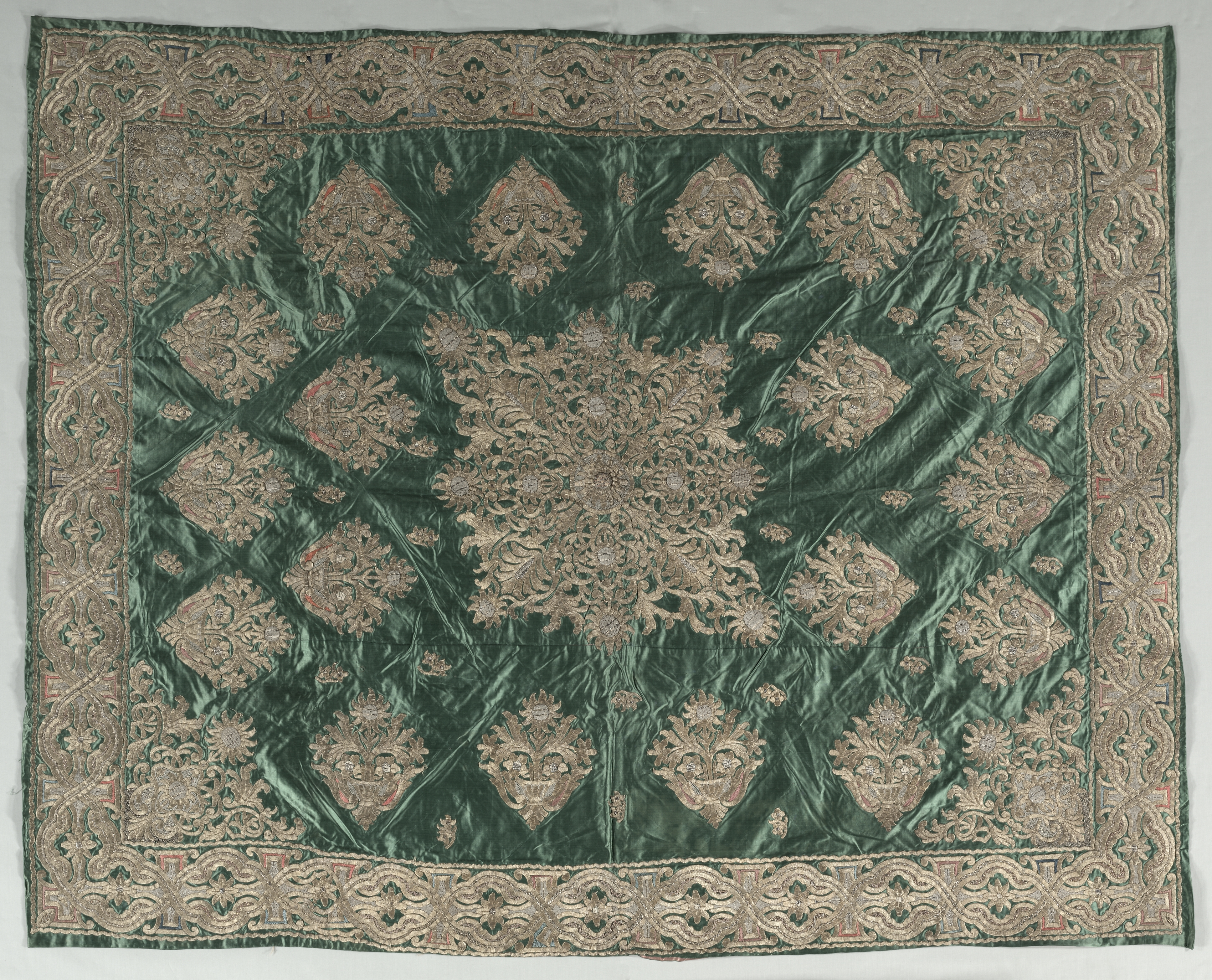
Technical Deconstruction & Material Resonance: The Ottoman Gold-Thread Embroidered Cover
As Chief Fabric Deconstructionist, I present an analysis of the specified artifact not merely as a textile, but as a stratified field of historical dialogue and avant-garde potential. The object in question—an Ottoman-period cover composed of silk, gilt-metal and silver-metal thread, over a substrate of paper and cotton padding, employing satin weave and embroidery—is a complex manifesto encoded in thread. Its described archival resonance, contrasting "the gloss of a silver mirror inlaid with golden arabesques" against "the narrative of life told in relief on cold stone sarcophagi," provides our critical entry point. This is not a textile of mere adornment; it is a portable, tactile palimpsest of Ottoman cosmological and artistic philosophy.
Stratified Construction: A Dialectic of Opulence and Transience
The material hierarchy reveals a deliberate dialectic. The foundation—paper and cotton padding—is humble, ephemeral, and structural. This base speaks to practicality and transience, the unseen support that makes grandeur possible. Upon this, the satin-weave silk ground establishes a field of visual luxury, its unbroken surface sheen acting as that "glossy silver mirror," a perfect, receptive plane. The metal-thread embroidery—the gilt and silver—is the applied narrative, the "gold inlay" and the "relief carving" simultaneously.
This stratification mirrors the Ottoman artistic ethos: a profound dialogue between the eternal and the temporal, the celestial and the earthly. The cold, enduring metal threads (gilt representing solar permanence, silver representing lunar reflection) are stitched onto the vulnerable, organic silk, which itself conceals the fragile paper core. The object physically embodies a worldview where divine, eternal patterns (the *girih*, the split-palmettes or "纷繁棕叶纹" referenced) are manifested, but never permanently fixed, onto the mutable material world. The archival note’s juxtaposition of mirror and sarcophagus is thus materially enacted: the cover reflects sublime order while tacitly acknowledging the mortal frame it adorns.
Embroidery as Narrative Relief: Beyond Ornament
The technical execution transforms embroidery from surface decoration into a low-relief narrative medium. The use of metal-wrapped threads over padding would create a pronounced tactile topography. This is the "relief on the sarcophagus panel." Each stitched motif—likely intricate saz leaves, palmettes, and floral sprays—is not a flat pattern but a micro-architecture of light and shadow. The satin ground absorbs light; the metal threads deflect it. This creates a dynamic visual field where the narrative is not "read" in a linear sense but "felt" as an interplay of luminous form.
This technique translates the monumental stone narratives of Ottoman tombs into a intimate, portable format. The "life narrative" referenced is thus abstracted into a symbolic language of growth, eternity, and paradise. The split-palmette (*rumi*) and scrolling vines speak a continuous story of regeneration, a fitting allegory for both spiritual and dynastic continuity. The embroidery, therefore, is a condensed, textile-based historiography, encoding power, faith, and aesthetic ideology in its knotted metallic paths.
Avant-Garde Proposition: The Zoey Fashion Lab Intervention
The directive for an avant-garde style necessitates a move beyond historical reverence into transformative critique. Our approach must deconstruct not just the physical layers, but the very concepts they embody.
Concept: "Palimpsest of Empire"
We propose a collection that treats the original artifact as a ghost, a resonant memory to be exposed, interrogated, and juxtaposed with contemporary forms. The core avant-garde principle will be thematic and material inversion.
1. Material Inversion: We will externalize the hidden, transient core. Imagine garments where the "padding" (cotton, paper) becomes the primary exterior textural element—crinkled, layered, and torn—while fragments of re-embroidered metal threads are embedded *within* this matrix, only partially visible, like buried artifacts. The satin "mirror" ground will be shattered, used as sharp, reflective inserts or fused onto distressed technical fabrics. We will replace the historical metal thread with modern alternatives: laser-cut Mylar strips, conductive copper yarns, and recycled foil laminates, creating a dialogue between handcraft and digital precision, between imperial opulence and sustainable critique.
2. Narrative Inversion: The archival resonance of mirror/sarcophagus will guide our silhouettes. We will create structured, architectural pieces that reference stone carving and funerary steles—hard, geometric lines in foam or molded felt. Against these "cold" forms, we will apply the "glossy" embroidered narratives, but subverted. The harmonious floral patterns will be digitally fragmented, algorithmically disrupted, or embroidered with dissenting, contemporary text in the same gilded thread, creating a visual tension between historical motif and modern voice.
Technical Execution & Final Form
The collection will manifest in three key techniques:
• Stratified Reveal: Garments constructed with peel-away layers. A top layer of impeccable, mirror-satin embroidery can be partially removed or torn to reveal chaotic, padded under-layers crisscrossed with deconstructed metal thread "scars."
• Electro-Embroidered Resonance: Using conductive metal threads, we can create embroidered circuits that connect to small, embedded audio devices. When touched, a garment might emit a faint, archival soundscape—the rustle of paper, the strike of a hammer on metal—making the material history audibly resonant.
• Photographic Sublimation: Blowing up microscopic details of the original cover's corrosion, thread breaks, and padding decay, and printing them onto silk jacquard, we celebrate entropy as part of the narrative, contrasting the ideal of permanence with the beauty of decay.
In conclusion, for Zoey Fashion Lab, this Ottoman cover is our foundational text. Our avant-garde response honors its complexity by refusing mere replication. Instead, we perform an archaeological dissection in real-time, building new garments from its philosophical and material strata. We transform the mirror into a fractured lens and the sarcophagus narrative into a living, critical dialogue. The final collection will not simply clothe the body; it will stage a confrontation between the weight of history and the fluidity of contemporary identity, wearing the palimpsest of empire as a provocative, illuminated skin.