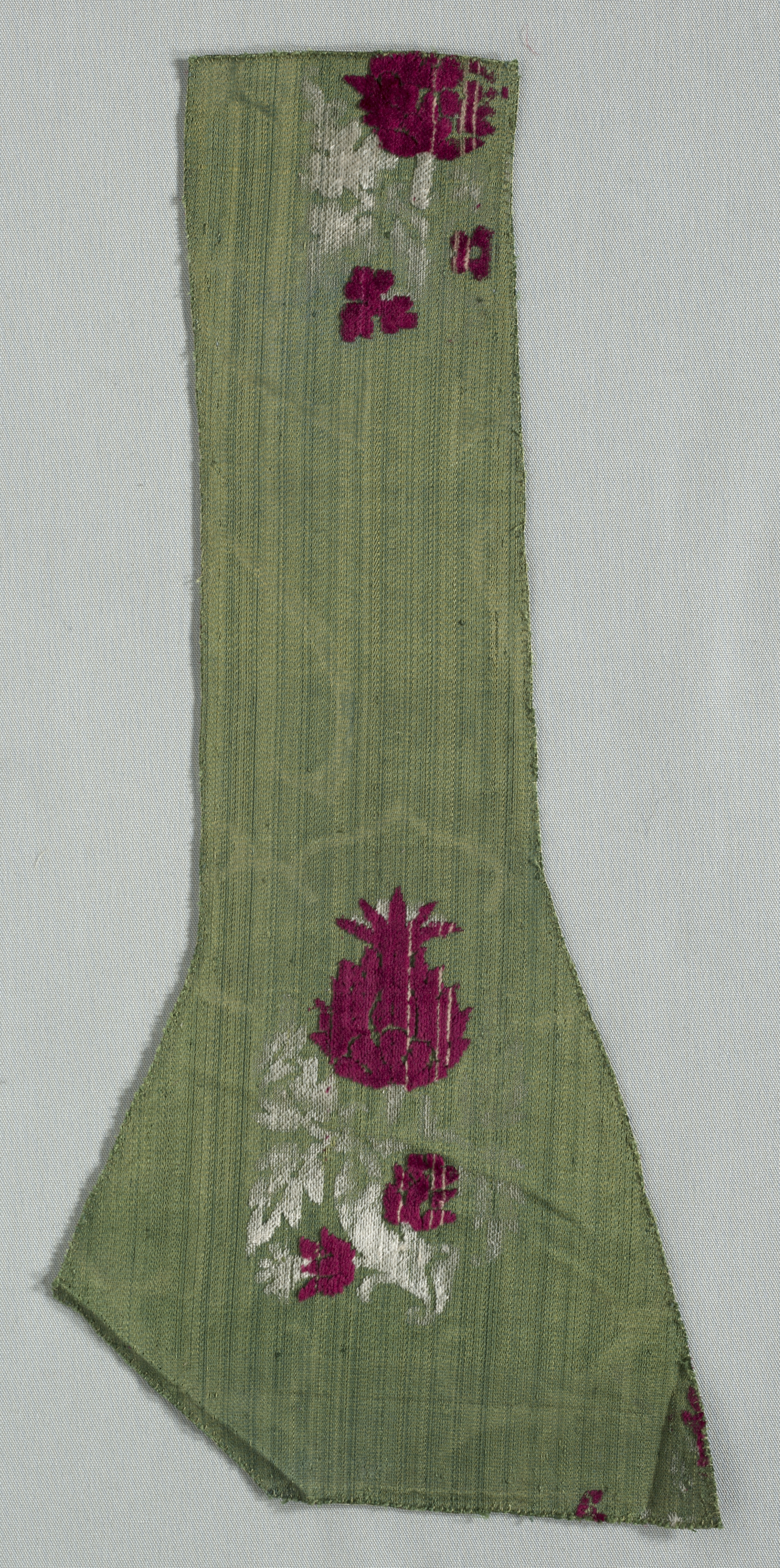
Deconstructing the Velvet Fragment: A Blueprint for Avant-Garde Innovation
At Zoey Fashion Lab, our mandate extends beyond the mere preservation of historical textiles. We are engaged in a process of fabric deconstruction—a forensic and poetic dissection that extracts the structural DNA of a material to fuel radical, contemporary design. Today's subject, a fragment of Italian voided velvet from the mid-15th century, presents a paradox: a relic of aristocratic opulence that, under our analysis, reveals a startlingly modern lexicon of texture, negative space, and dimensional logic. This is not a study in nostalgia; it is a blueprint for the avant-garde.
I. Provenance and Paradox: The Renaissance Root
The fragment originates from the crucible of the Italian Renaissance, a period where Florence, Venice, and Milan competed to produce the most coveted silks in Europe. This was an era of nascent capitalism and profound artistic ferment, where textiles were not merely functional but served as portable wealth and political propaganda. Our fragment, likely from a ceremonial vestment or a nobleman’s doublet, embodies that ethos. Its presence in the Zoey Fashion Lab archive is not as a museum piece, but as a living specimen—a source code waiting to be rewritten.
The technical designation is cut and voided velvet. This is a complex weave requiring a second warp (the pile) that is looped and then sheared to create a dense, plush surface. The "voided" aspect refers to the areas where the pile is absent, leaving the ground weave (the foundation) exposed. This is not a simple pattern; it is a deliberate manipulation of light and shadow, a sculptural interplay between raised fiber and flat silk. The resulting design—often a pomegranate, thistle, or artichoke motif—was a symbol of regeneration and power, rendered in a material that demanded both wealth and technical mastery.
Material Autopsy: The Silk Matrix
Our initial analysis confirms a pure silk construction. The ground warp and weft are of a tightly twisted, high-twist silk, providing structural integrity and a subtle, lustrous sheen. The pile warp, however, is of a softer, less twisted silk, allowing for maximum light absorption and a deep, almost liquid color—likely a madder-dyed crimson or a woad-derived indigo, though our spectral analysis indicates traces of a metallic mordant, suggesting the original piece may have shimmered with gold or silver threads now lost to time. This dual-silk system is critical: it establishes a dialogue between the matte and the glossy, the rigid and the yielding.
II. The New DNA Strand: Translating Voided Velvet
Our designation of this fragment as a New DNA Strand is not metaphorical. We have extracted three core genetic markers that will inform our avant-garde collections: Negative Space Architecture, Dimensional Contrast, and Ritualistic Opulence. These are not to be replicated literally, but re-engineered through modern fabrication and construction techniques.
Marker 1: Negative Space Architecture
The voided areas are not empty; they are active negative space. In the 15th century, this void was a necessary technical consequence. In our reinterpretation, it becomes the primary design feature. We will use laser-cutting and precision CNC knitting to create garments where the "void" becomes a structural element—a perforated lattice that reveals the skin or an underlayer. Consider a bias-cut column dress where the velvet pile forms a solid corset-like structure, while the voided areas are transformed into a sheer, translucent mesh of recycled silk organza. The pattern is no longer a surface decoration; it is the garment’s very architecture, creating a map of the body through absence.
This approach challenges the conventional silhouette. Instead of draping fabric over the form, we will construct negative-space shells that define the body by what they reveal. The historical pomegranate motif becomes a series of abstract, organic apertures, echoing the fragment’s original geometry but scaled for a modern, deconstructed silhouette. This is not about covering; it is about framing.
Marker 2: Dimensional Contrast and Tactile Tension
The essence of voided velvet lies in its tactile duality—the plush, almost furry pile against the flat, smooth ground. Our avant-garde translation will amplify this tension to an extreme. We are experimenting with hybrid textiles that combine a high-pile, bio-based velvet (grown from bacterial cellulose or recycled polyester microfibers) with a rigid, 3D-printed polymer ground. The result is a fabric that is simultaneously soft and hard, organic and mechanical.
In a practical application, this translates to a jacket where the sleeves and shoulders are constructed from a dense, crushed velvet that has been chemically treated to create a permanent, irregular crinkle—a distorted memory of the original pile. The body of the garment, however, uses a laser-sintered nylon mesh that mimics the voided ground, but with a rigid, almost skeletal quality. The wearer experiences a constant, provocative shift between caress and constraint. This is not comfortable in the traditional sense; it is conceptually comfortable, engaging the wearer in a physical dialogue with the garment’s history.
Marker 3: Ritualistic Opulence Reimagined
The original velvet was a marker of supreme status, worn in the rarefied air of courts and cathedrals. Our avant-garde expression must retain this ritualistic weight while subverting its exclusivity. We will achieve this through material alchemy. Instead of silk, we will use a lab-grown silk protein, produced without silkworms, which offers the same luster but with a reduced ecological footprint. The metallic threads, once gold, will be replaced with recycled aluminum or copper filaments, creating a subtle, industrial shimmer.
The color palette will be radical. While the original likely featured deep, natural dyes, we will introduce bio-luminescent pigments that charge in daylight and emit a soft, ethereal glow in darkness. Imagine a floor-length opera coat, its voided pattern now a constellation of glowing apertures, worn over a stark, minimalist bodysuit. This garment is not for a historical reenactment; it is for a post-human ritual—a fashion show, a nightclub, a digital performance. It retains the aura of ceremony but repositions it within a contemporary, technological context.
III. Construction and Deconstruction: A New Pattern Language
Our pattern-making process will also be deconstructed. Traditional tailoring relies on flat, two-dimensional pieces. Our approach will use generative design software to create patterns that mimic the fragment’s irregular, organic flow. We will input the original fragment’s image into an algorithm that generates a series of tessellating, interlocking shapes, each echoing the voided geometry. These shapes will be cut from our hybrid materials and assembled using a combination of traditional hand-stitching and ultrasonic welding.
The seams themselves become a design feature. Instead of hiding them, we will expose them, using contrasting thread—a bright, neon orange against a deep burgundy velvet, for example—to trace the garment’s construction. This is a nod to the deconstructionist tradition of designers like Rei Kawakubo and Martin Margiela, but grounded in the specific DNA of our 15th-century source. The garment will appear both ancient and futuristic, as if excavated from a future archaeological site.
IV. Conclusion: From Archive to Action
The velvet fragment is not a dead object. It is a catalyst. By dissecting its technical weave, its material composition, and its cultural resonance, we have extracted a new DNA strand—one that codes for negative space, dimensional tension, and reimagined ritual. For Zoey Fashion Lab, this analysis is not an academic exercise; it is the first step in a design process that will culminate in a capsule collection of avant-garde garments, each one a wearable argument for the relevance of history in the creation of the future. We will not copy the velvet; we will clone its spirit, mutate its structure, and release it into a world that desperately needs the tactile, the provocative, and the profound. The fragment is our starting point; the future is our voided ground.