Deconstructing the Sampot: A Study in Fragmented Heritage
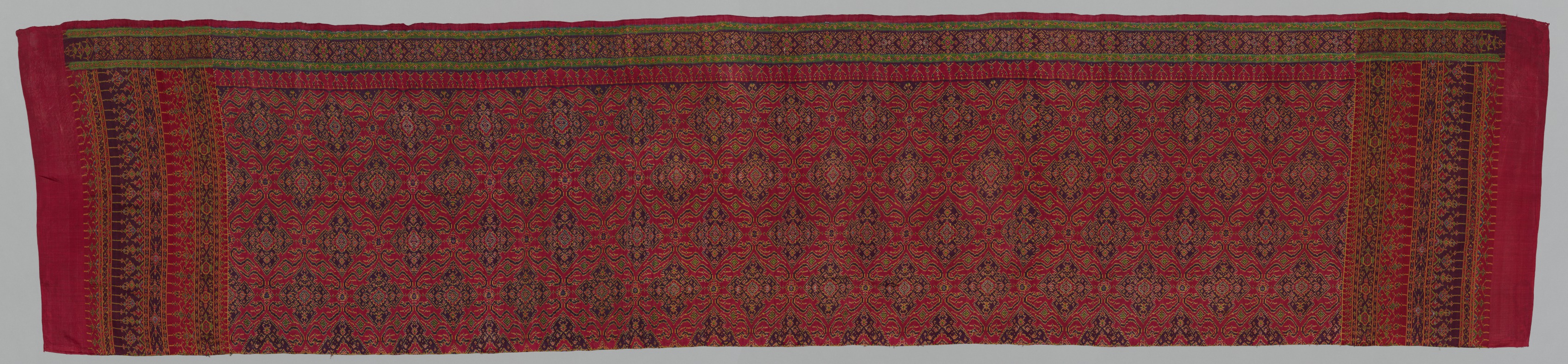
At Zoey Fashion Lab, our mission transcends the mere analysis of textiles; we engage in a dialogue with history, extracting the latent narratives woven into every fiber. The subject of our current investigation—a half-length Sampot (skirt cloth) from Cambodia, dating to the 19th or early 20th century—presents a compelling paradox. It is a fragment, yet it contains a universe. Constructed in a tabby weave with weft ikat on silk, this piece is not simply a garment; it is an archive of cultural resilience, technical mastery, and aesthetic philosophy, rendered all the more poignant by its incomplete state. For our avant-garde design ethos, this Sampot is not a relic to be restored, but a catalyst for radical reinterpretation.
The Technical Lexicon: Weave and Ikat as a Language
The technical foundation of this Sampot is deceptively simple, yet its execution reveals profound sophistication. The tabby weave, the most basic of all textile structures, serves as a neutral, disciplined ground. This plain interlacing of warp and weft creates a durable, flat canvas that does not compete with the surface ornamentation. Instead, it acts as a rigid framework, a testament to the weaver's understanding of structural integrity. The true artistry, however, resides in the weft ikat technique. This is a process of resist-dyeing the weft threads *before* they are woven, meticulously binding sections to create predetermined patterns. The precision required is staggering; a single misalignment in the dyeing process would fracture the entire design. The resulting motifs—often geometric, floral, or derived from nature—possess a characteristic, slightly blurred edge, a "halo" effect that is the signature of ikat. This blur is not a flaw but a feature, imbuing the cloth with a sense of motion and the organic imperfection of the human hand. For the Lab, this juxtaposition of rigid structure (tabby) and fluid, pre-dyed imagery (ikat) mirrors the avant-garde principle of controlled chaos—a discipline that allows for serendipity.
Fragmentation as a Conceptual Framework
The fact that we possess only half of this Sampot is arguably its most intellectually stimulating attribute. In the context of traditional Cambodian dress, the Sampot is a complete, holistic garment, wrapped and tied to form a seamless cylinder. Its fragmentation disrupts this totality, creating a state of rupture that demands a new mode of viewing. This is not a loss of meaning, but an amplification of it. The absent half becomes a void, a space of potential that the viewer is compelled to fill. In our avant-garde practice, we see this as a powerful metaphor for the nature of cultural memory itself. History is rarely delivered to us intact; it arrives in shards, in echoes, in half-remembered stories. The Sampot’s incomplete state forces us to confront the archival process—the act of selection, preservation, and interpretation that inevitably shapes our understanding of the past. It challenges the notion of a singular, authoritative narrative, suggesting instead a multiplicity of possible histories. The cut edge, raw and unhemmed, is a scar that speaks of a violent or pragmatic separation, but it also functions as a new frontier, a point of departure for creative re-engagement.
Silk and the Politics of Materiality
The choice of silk as the primary fiber is laden with cultural and economic significance. Silk in 19th-century Cambodia was not merely a textile; it was a currency of power, a marker of status, and a medium for spiritual expression. It was reserved for royalty, the aristocracy, and religious ceremonies. The lustrous, reflective quality of silk creates a dynamic interplay with light, making the ikat patterns appear to shimmer and shift as the wearer moves. This materiality is crucial. The Sampot was not a static object; it was a kinetic sculpture, a living part of the wearer's identity. In our contemporary context, silk remains a symbol of luxury and tactility, but our avant-garde lens recontextualizes it. We are interested in its vulnerability, its organic origins, and its capacity to hold dye in ways that synthetic fibers cannot. The slight irregularities in the silk’s texture, the subtle variations in thread thickness, are traces of the silkworm’s labor and the spinner’s skill. This connects the garment to the natural world and to a pre-industrial mode of production that stands in stark contrast to the anonymity of mass manufacturing. The Sampot, therefore, becomes a critique of modernity, a reminder of the value of slowness, skill, and material honesty.
From Archive to Avant-Garde: A New Synthesis
The reference to "Archive Resonance" and the historical context of cultural collision in the 16th-17th centuries is particularly apt here. The Sampot itself is a product of cultural exchange, its ikat technique sharing roots with other Southeast Asian textile traditions, while its motifs may have absorbed influences from Indian, Chinese, and even European trade goods. This history of hybridity is the very essence of the avant-garde spirit. For Zoey Fashion Lab, this half-Sampot is not an artifact to be preserved under glass but a generative seed. Our design intervention would not seek to complete the garment, but to amplify its fragmentation. We envision deconstructing the remaining textile further, isolating the ikat motifs and projecting them onto new, unconventional silhouettes. The tabby weave could be abstracted into a structural grid for a modern outerwear piece, while the silk’s softness could be juxtaposed against rigid, industrial materials like technical neoprene or laser-cut metal. The "blur" of the ikat could be translated into digital print distortions, creating a dialogue between the handmade and the algorithmic. The raw, cut edge could become a design feature, a deliberate signifier of incompleteness and the unfinished nature of all cultural identity.
Ultimately, this Sampot is a mirror. It reflects the past, but it also reflects our own contemporary anxieties about heritage, authenticity, and the loss of traditional skills. By embracing its fragmentation, we move beyond nostalgia and into a dynamic, forward-looking practice. We honor the weaver’s genius not by attempting to replicate it, but by using it as a springboard for radical innovation. The half-Sampot is not a tragedy; it is an invitation. It invites us to imagine the missing half, to question our assumptions about wholeness, and to create something new from the beautiful, complicated, and incomplete legacy we have inherited. In this act of deconstruction, we find not an ending, but an infinite series of new beginnings.