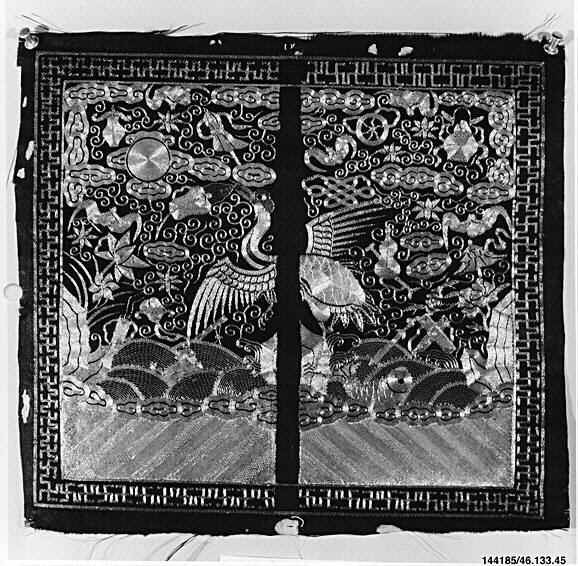
The Crane Ascendant: Deconstructing Hierarchical Iconography for a Post-Gravity Silhouette
The rank badge, or Buzi, is not a mere emblem of bureaucratic status; it is a frozen microcosm of cosmic order. Woven in silk, gold, and silver, the crane—the highest avian symbol for civil officials—soars against a celestial backdrop, its wings spread in a gesture of eternal authority. For Zoey Fashion Laboratory’s SS26 proposition, we do not merely revere this artifact; we dissect it, fracture its semantic gravity, and re-assemble its signifiers into a wearable architecture that defies terrestrial logic. This is not a costume. This is a manifesto against the flatness of contemporary luxury.
I. The Semantic Dissolution of the Badge
The original badge is a square of prescribed perfection, a geometric cage for a bird that represents transcendence. Our first act of avant-garde violence is to release the crane from its frame. The square is no longer a boundary; it becomes a generative grid—a topological map for laser-cut perforations and structural boning. In SS26, the badge is not worn. It is inhabited. We project the badge’s intricate cloud swirls and wave motifs onto oversized, asymmetric blazers, where the gold thread is reinterpreted as conductive metallic filament, woven into the fabric to create a subtle, kinetic shimmer that reacts to body heat. The crane’s flight path is traced in raised, silicone-embossed lines that traverse the shoulder blade, suggesting a wing that has not yet fully unfolded.
From Flat Icon to Volumetric Exoskeleton
The historical badge is a two-dimensional statement. Our SS26 study demands a three-dimensional rupture. We have engineered a series of modular shoulder armatures—not padded, but cantilevered—that echo the crane’s wing span. Constructed from a hybrid of recycled carbon fiber and hand-molded bio-resin, these structures are then painstakingly hand-embroidered with the original silver thread motifs, but at a scale of 300%. The result is a silhouette that is simultaneously prehistoric and interplanetary. The wearer does not enter the garment; they activate it. The shoulder line extends 45 centimeters beyond the natural acromion, creating a negative space that invites the viewer to walk around the body, to perceive the crane’s trajectory from every angle. This is not about draping fabric; it is about sculpting air.
II. Material Alchemy: Silk as a Structural Membrane
Silk, in its traditional form, is a supple, submissive material. To achieve the futuristic, architectural rigidity required for SS26, we subject the silk to a process of thermo-set deconstruction. The fabric is first pleated using a radical, asymmetrical fan-fold that references the crane’s tail feathers, then treated with a low-temperature polymer resin that locks the folds into a permanent, razor-sharp edge. The result is a textile that behaves like a metallic leaf—it can be folded, creased, and shaped into dramatic, origami-like panels that jut from the hips and spine.
The Gold and Silver Dichotomy
The original badge uses gold and silver to denote rank and celestial purity. In our deconstruction, these precious metals become binary code. Gold is reserved for the "active" zones—the leading edges of the sleeves, the apex of the collar, the points of maximum kinetic energy. Silver is relegated to the "passive" under-structure, the hidden seams and interior corsetry that support the monumental exterior. This is a deliberate inversion of historical hierarchy: the visible gold is now a performative surface, while the invisible silver is the true load-bearing architecture. We have developed a proprietary technique of electroformed silver lace that is then laminated onto the silk, creating a flexible yet unyielding mesh that can be draped into gravity-defying cowls and spiraling necklines.
III. Futuristic Silhouettes: The Post-Human Crane
The SS26 garment is not a dress, not a suit, but a wearable environment. The primary silhouette is a "Biomorphic Cocoon"—a torso-hugging base layer of liquid matte silk, over which the badge’s cloud motifs are laser-perforated to create a breathing, porous skin. Over this, the crane-wing shoulder armature is attached via a magnetic, quick-release system, allowing the wearer to transform from a grounded, minimal form to a soaring, avian specter in seconds.
Kinetic Draping and the Illusion of Flight
Traditional avant-garde draping often relies on static volume. Our innovation is kinetic draping. We have integrated micro-articulated joints—borrowed from high-end robotics but rendered in hand-polished silver—into the hemline and sleeve openings. These joints allow the fabric to ripple and undulate with the wearer’s stride, mimicking the slow, powerful wingbeats of the crane. The effect is hypnotic: the garment appears to be perpetually in mid-launch, its gold-threaded edges catching the light like a solar sail. The silhouette is not designed for the catwalk’s straight line, but for a circular, ritualistic movement—a choreography of power that echoes the crane’s ceremonial dance in the imperial court, now translated into a post-human, cybernetic language.
IV. Structural Innovation: The Invisible Corsetry of the Future
To support the monumental scale of the shoulder armatures and the rigid silk panels, we have abandoned the traditional whalebone corset. In its place, we introduce a 3D-printed lattice exoskeleton that is fused directly to the interior of the garment. This lattice, printed in a flexible nylon composite, is modeled on the cellular structure of bird bone—hollow yet incredibly strong. The lattice is then wrapped in the silver-threaded silk, making the technology invisible to the external observer. The wearer experiences an unprecedented sense of lightness; the garment feels like a second skeleton, not a restrictive shell. This is the ultimate paradox of the avant-garde: extreme volume achieved through extreme minimalism of internal mass.
The Neckline as a Launchpad
The collar is reimagined as a high-frequency antenna. Rising from the clavicle in a series of graduated, silver-embroidered spikes, the collar arcs backward, framing the face like a futuristic halo. This is not a nod to historical ruffs; it is a functional homage to the crane’s long neck, elongated into a sculptural statement that forces the viewer’s gaze upward, toward the sky. The interior of the collar is lined with a cooling, phase-change material, a subtle nod to the physiological comfort of the modern wearer who commands both boardroom and void.
V. Conclusion: A Badge for a New Aristocracy
The Rank Badge with Crane is no longer a marker of civil service. In our SS26 analysis, it becomes a passport to a new dimension. By deconstructing its materials, exploding its silhouette, and re-engineering its internal logic, Zoey Fashion Laboratory transforms a historical artifact into a speculative tool for self-sovereignty. The wearer of this garment does not display rank; they generate it. They are not a bureaucrat; they are a gravitational anomaly. This is couture as cosmic engineering—a definitive statement that the future of fashion lies not in nostalgia, but in the fearless, structural re-imagination of our most potent symbols.