Deconstructing the Panamanian Pectoral: An Avant-Garde Dialogue with the Conte Style
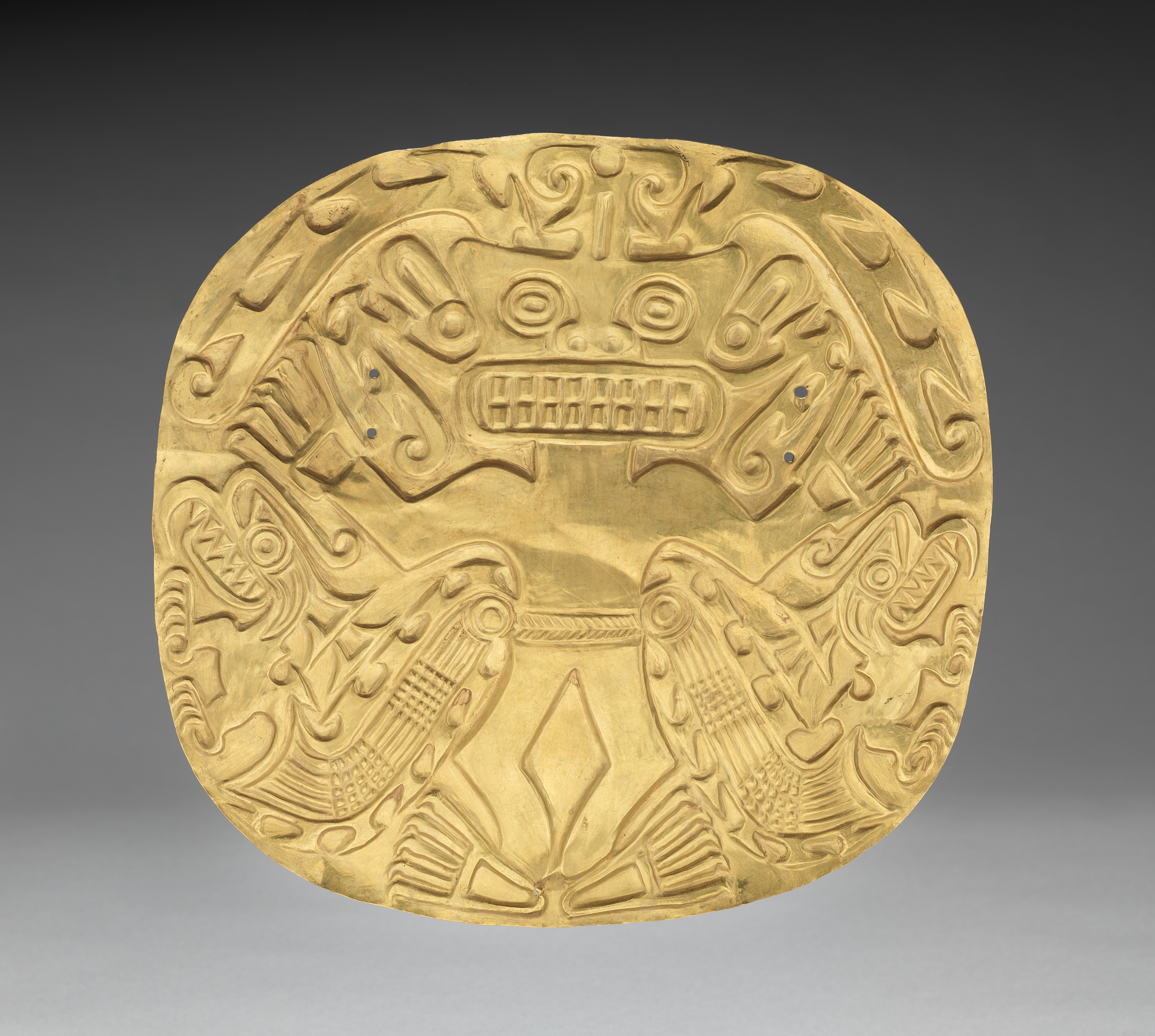
At Zoey Fashion Lab, our mandate transcends mere garment construction. We are fabric deconstructionists, excavating the narratives embedded within materials, forms, and the very act of adornment. The subject of today's analysis is not a textile, but a metallic artifact of profound resonance: a Pectoral (Chest Plaque) from the Intermediate Region of Panama, dating to the 5th-10th Century, executed in the Conte style. This object, a hammered gold alloy plaque, is not a relic to be preserved under glass. It is a living archive, a source code for a radical, avant-garde design language. Our reference, the Archive Resonance, speaks of a duality—a polished silver mirror inlaid with golden palm fronds on one side, and a cold sarcophagus lid narrating life in relief on the other. This is the key to our deconstruction: the pectoral is not a single statement, but a dialectic between reflection and narrative, surface and depth, the fleeting and the eternal.
The Conte Code: Geometry as a Structural Imperative
The Conte style, predating the more flamboyant Veraguas and Chiriquí traditions, is characterized by a rigorous, almost minimalist geometric discipline. The pectoral is not a naturalistic depiction of a chest, but an abstract, symbolic shield for the sternum. Its form is typically a crescent or a rectangular plaque with a central anthropomorphic or zoomorphic figure, rendered through repoussé and embossing. For the avant-garde designer, this translates into a foundational principle: adornment as architectural framing. The pectoral does not merely sit on the body; it creates a new silhouette, a secondary skeleton that defines the space between the collarbones. The gold alloy, often a tumbaga (a copper-gold mix), was chosen not for its purity but for its color and malleability—a deep, warm ochre that speaks of earth and fire, not the sterile gleam of refined bullion.
Our deconstruction begins with this geometric imperative. The pectoral's shape is a study in negative space. It frames the throat and upper chest, creating a visual void that draws the eye inward. In our contemporary practice, this translates to cutouts and structural harnesses that do not cover the body but define its zones. We envision a modern iteration in rigid, yet lightweight, carbon fiber or anodized aluminum, echoing the gold's ochre hue. The central figure, often a crocodilian or a jaguar deity, is reduced to its essential lines—a zigzag for teeth, a spiral for an eye. This is not abstraction for its own sake; it is a compression of mythology into a geometric cipher. Our avant-garde interpretation would deploy these ciphers as jacquard patterns or laser-etched leather panels, turning the pectoral's iconography into a repeatable, wearable code.
The Archive Resonance: The Mirror and the Sarcophagus
The provided reference—the polished silver mirror with gold palm fronds versus the cold sarcophagus lid—is the intellectual engine of this analysis. The pectoral, in its original context, was worn by a high-status individual, likely a cacique or a shaman. It served a dual function: it was a reflective surface, catching the sun and projecting the wearer's power, and it was a narrative surface, a permanent record of their lineage and spiritual mandate. The gold alloy, when polished, acted as a mirror, but its hammered reliefs, the scars of creation, told a story of transformation. This is the tension we exploit: the pectoral is both a looking glass for the observer and a book for the initiated.
In our avant-garde collection, this duality manifests as a play between liquid metallic surfaces and tactile, sculptural reliefs. Imagine a garment where the front panel is a sleek, high-shine PVC or a liquid metal-coated silk, reflecting the environment like the silver mirror. But upon closer inspection, or under a change of light, this surface is interrupted by embossed or quilted sections that rise from the plane, mimicking the sarcophagus relief. The palm fronds of the mirror become a pattern of metallic embroidery that crawls across the reflective base, while the narrative of the sarcophagus is translated into sculptural shoulder pads or a structured collar that tells the story of the wearer's own journey. The garment is not static; it oscillates between being a passive reflector and an active narrator, depending on the viewer's perspective and the ambient light.
From Artifact to Avant-Garde: Material Alchemy and Silhouette
The technical execution of the original pectoral—the hammering, the annealing, the lost-wax casting—is a form of alchemy. The artisan did not just shape metal; they coaxed a spiritual presence into a physical form. Our deconstruction honors this process through a focus on hand-finished techniques in a high-tech context. We propose a series of "pectoral" pieces that are not jewelry but integral components of a garment. These could be 3D-printed polymer plaques that mimic the repoussé texture, coated in a galvanized finish to achieve the gold's depth. They are attached to a base garment of raw, deconstructed denim or heavy, unbleached canvas, creating a jarring contrast between the ancient, sacred object and the modern, utilitarian fabric. This juxtaposition is the essence of the avant-garde: it forces a re-evaluation of both elements.
The silhouette is equally critical. The original pectoral was a chest plaque, worn close to the body. Our modern iteration expands this concept. We propose a cape-like structure that hangs from the shoulders, its front panel echoing the pectoral's crescent shape, but scaled to dramatic proportions. This cape is not draped; it is engineered. It uses internal boning and cantilevered seams to maintain a rigid, architectural form, even as the wearer moves. The back of the cape, however, is fluid, a cascade of fringe or chain mail that recalls the pectoral's hammered texture but adds a kinetic, contemporary element. This creates a garment that is both a shield and a veil, a modern armor that protects not the body but the wearer's identity.
Conclusion: The Pectoral as a Living System
The Panamanian pectoral, in its Conte style, is far more than a historical gold ornament. It is a sophisticated design system that encodes power, spirituality, and identity through geometry and material. For Zoey Fashion Lab, it is a launchpad for a collection that challenges the boundaries between jewelry, garment, and sculpture. By deconstructing its formal language—the geometric discipline, the mirror/relief duality, the alchemical materiality—we create pieces that are not nostalgic but prophetic. They are wearable artifacts for a future that values depth over surface, narrative over fleeting trend. The pectoral teaches us that true adornment is not about covering the body, but about revealing the architecture of the self. Our avant-garde response is to build that architecture anew, using the ancient gold as our blueprint and the modern machine as our hammer. The result is a garment that is a living archive, a mirror that reflects not just our image, but our potential.