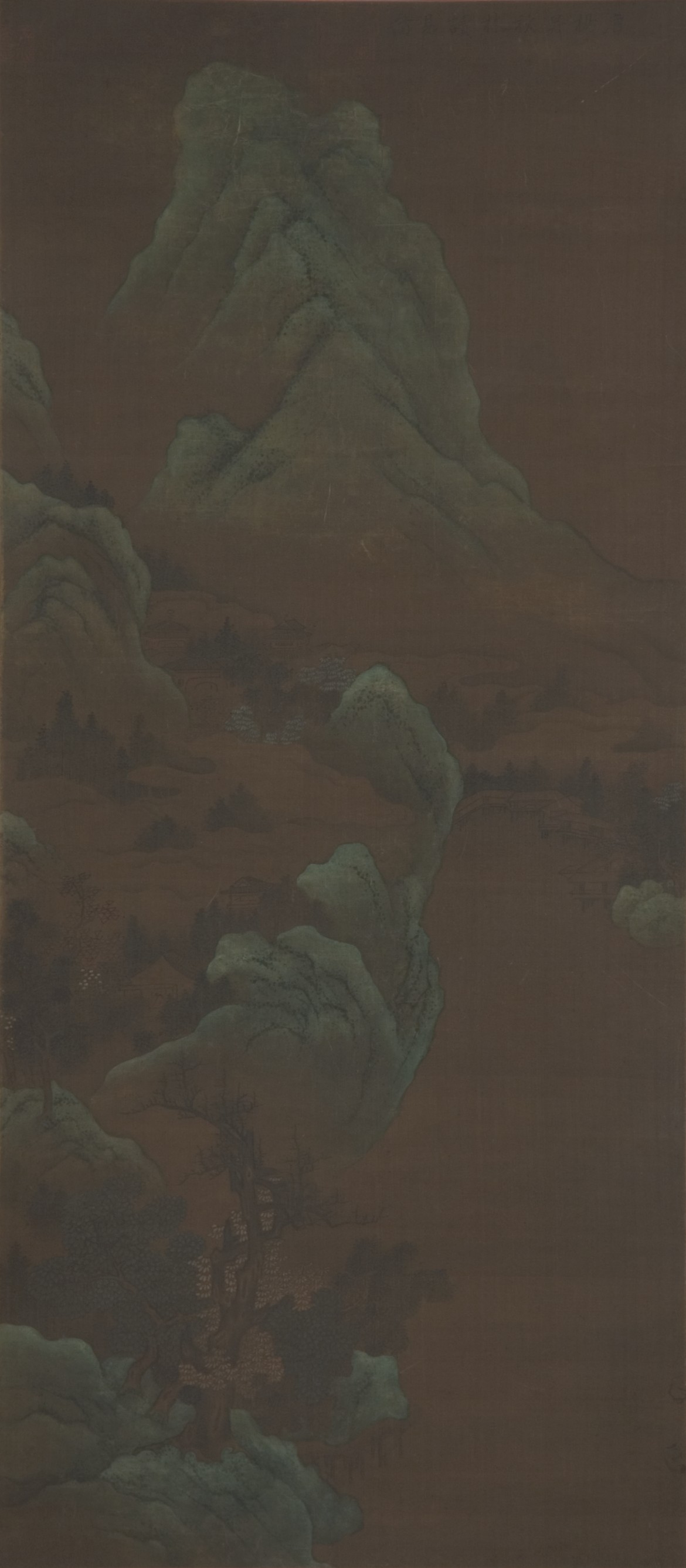
The Topography of Silence: Deconstructing Mountain Scenery for SS26
The classical Chinese hanging scroll, particularly its rendering of mountain scenery, is rarely understood as a blueprint for temporal dislocation. Yet, for Zoey Fashion Laboratory’s SS26 avant-garde study, this ancient medium—ink and color on silk—becomes a radical proposition: a wearable thesis on the erasure of gravity, the fragmentation of perspective, and the construction of a new epidermal geography. The scroll is not a backdrop; it is a surgical diagram. We extract its core principles—verticality, atmospheric perspective, and the deliberate void—and re-engineer them into silhouettes that defy the body’s static logic.
Verticality as Structural Dystopia
The hanging scroll’s format is inherently anti-corporeal. It demands a vertical read, a slow ascent from misty foothills to jagged peaks. Traditional fashion responds to the horizontal plane—shoulders, hips, stride. Our SS26 proposition inverts this. We introduce asymmetric tensile columns: garments that anchor at the nape and cascade forward in a single, unbroken line, mimicking the scroll’s central axis. Think of a bonded neoprene sheath, cut on a severe bias, with internal boning that curves away from the spine, creating a silhouette that appears to be perpetually ascending. The hem is not finished; it is deliberately frayed into micro-ribbons, evoking the erosion of ink where the brush lifts from silk. This is not a dress; it is a geological core sample worn against the skin.
Further, we propose the “Ink Fall” jacket—a zero-waste construction where the pattern pieces are derived from the negative spaces between mountain ridges. The garment’s shoulder line is dissolved, replaced by a cantilevered collar that extends upward and backward, like a cliff overhang. The sleeves are cut away from the torso, connected only by a single, hand-stitched silk cord, allowing the fabric to float a full centimeter off the arm. This is not deconstruction for its own sake; it is a study in negative volume, where the absence of fabric becomes as structurally significant as its presence.
Atmospheric Perspective and the Fabricated Void
Chinese landscape painting operates on three depths: the near, the middle, and the far. The far is always veiled, rendered in paler washes. Our material research translates this into gradated opacity. We have developed a proprietary silk organza that is digitally printed with a micro-pixelated ink gradient—dense and black at the hem, dissolving to a translucent, almost invisible white at the shoulder. When layered over a second skin of matte technical jersey, the garment produces a live moiré effect, shifting with every breath. The wearer becomes a walking atmospheric event, their silhouette perpetually in a state of meteorological flux.
This leads to our signature piece: the “Misty Pass” bodysuit. Constructed from laser-cut, heat-sealed panels of recycled polyester, it features a series of horizontal slits that follow the contour of the ribs. Through these apertures, we thread a hand-dyed silk ribbon, dyed in a gradient from indigo to pale celadon. The ribbons are not tied; they are left to trail, echoing the painter’s calligraphic strokes. The effect is a garment that is simultaneously armor and air—a structural exoskeleton that reveals the body’s internal landscape. The strategic void at the sternum, which we term the “cloud gap,” is a deliberate absence, allowing the skin to function as the final layer of the painting.
The Brushstroke as a Futuristic Seam
The ink line in a hanging scroll is not a contour; it is an event. It carries energy, hesitation, and force. Our seam construction for SS26 borrows this logic. We reject the invisible seam. Instead, we celebrate the exposed, top-stitched stroke, executed in a high-tensile, phosphorescent thread that glows faintly in low light. These seams do not follow the body’s natural curves; they carve new ones. A single, sweeping seam runs from the right hip, across the diaphragm, and terminates at the left clavicle, effectively re-drawing the wearer’s torso. These lines are not decorative; they are functional tension members, pulling the fabric into a permanent, sculptural drape.
For outerwear, we introduce the “Rock Face” trench. Its surface is a technical jacquard woven with a three-dimensional relief pattern, mimicking the texture of granite cliffs. But the innovation lies in its modularity. The garment is composed of seven independent panels, each connected by a magnetic closure system hidden within the fabric’s weave. The wearer can remove the left sleeve, the back panel, or the entire lower section, reconfiguring the silhouette in seconds. This is not a garment; it is a modular architectural system, responding to the environment as a painter responds to changing light.
The Void as a New Silhouette
The most radical departure in this study is the “Absent Peak” gown. The silhouette is defined by what is missing. The gown’s front is a solid, high-necked column of matte black silk. The back, however, is entirely removed—from the shoulder blades to the sacrum—leaving a massive, geometric void. This void is framed by a rigid, carbon-fiber-reinforced edge, which flares outward slightly, creating a cantilevered frame. The effect is of a mountain that has been cleaved in two, revealing a valley of skin. This is not about exposure; it is about spatial redefinition. The body becomes the negative space of the mountain, and the garment becomes the cliff face that frames it.
Our accessories follow suit. We propose the “Scroll” cuff: a rigid, cylindrical bracelet of brushed titanium, engraved with a continuous topographic line that wraps around the wrist seven times. And the “Mist” veil: a single, 4-meter length of undyed silk organza, printed with a faint, almost imperceptible mountain range, meant to be draped over the head and shoulders, not as a covering, but as a temporal distortion—a fragment of the scroll’s atmosphere brought into the third dimension.
Conclusion: Beyond Representation
This is not a costume of a landscape. It is a transubstantiation of pictorial principles into kinetic architecture. The mountain scenery scroll, in its original form, is a meditation on permanence and impermanence. Our SS26 collection translates that meditation into a wardrobe of ephemeral structures—garments that are never the same twice, that respond to the wearer’s movement, and that ultimately dissolve the boundary between the painted world and the living one. The future of couture does not lie in new fabrics alone, but in new ways of seeing the body as a canvas for structural and conceptual innovation. This is our answer to the mountain: not a depiction, but a becoming.