Deconstructing the Loom: The Silk Fragment as a Proto-Futurist Blueprint
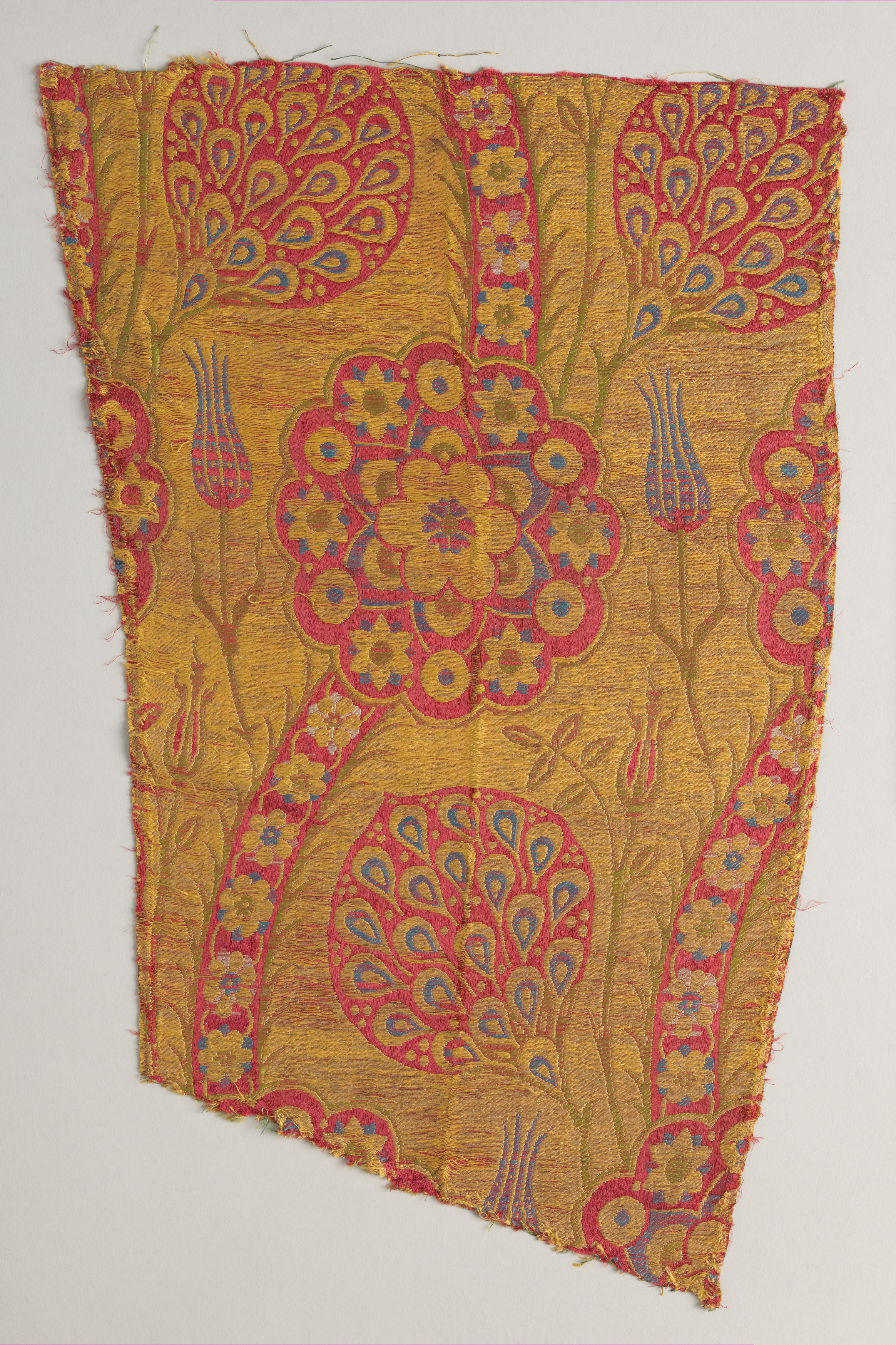
In the rarefied atmosphere of Zoey Fashion Laboratory, we do not merely observe historical artifacts; we dissect them, extracting their latent kinetic energy and re-engineering their structural DNA for the coming season. The subject of this definitive analysis—a silk fragment bearing a wavy-vine pattern on a verdant green ground, executed in lampas (kemha) with metal-wrapped thread—is not a relic. It is a proto-futurist blueprint, a coded message from a pre-industrial frontier that speaks directly to the architectural imperatives of SS26.
At first glance, the piece presents a paradox: a rigid, opulent weave traditionally associated with Ottoman imperial courts, yet rendered with a botanical motif that suggests organic, untamed growth. This tension—between the mathematical precision of the loom and the chaotic vitality of the vine—is precisely the dialectic that defines our new avant-garde direction. We are not interested in nostalgia. We are interested in temporal dislocation, in extracting the weave's inherent logic and re-presenting it as a three-dimensional, wearable structure that defies the body's passive relationship with fabric.
Material Alchemy: The Metal Thread as Conductive Skeleton
The inclusion of metal-wrapped thread is not a decorative afterthought; it is the fragment's primary load-bearing element. In our laboratory, we treat this metallic core as a conductive skeleton, a precursor to the smart textiles of our own era. The wavy-vine pattern, executed in this rigid thread, creates a series of internal stresses and counter-stresses within the fabric's plane. For SS26, we propose to amplify this inherent tension by isolating these metallic pathways and exposing them as external structural struts.
Imagine a garment where the green silk ground is reduced to a translucent, diaphanous membrane—a ghost of its former self—while the wavy-vine motif is extruded, literally lifted off the surface and articulated as a free-standing, coiled exoskeleton. This is not embroidery; this is exo-architecture. The metal thread becomes a biomimetic ribcage, wrapping the torso in a spiral of conductive energy. The silhouette is no longer defined by the cut of cloth but by the flexural rigidity of the metallic vine, which we can now program to stand proud of the body or to collapse and flatten at will, creating a garment that morphs between a sculptural carapace and a fluid second skin.
Chromatic Disruption: The Green Ground as a Virtual Field
The green ground of the fragment is far from passive. It is a dense, chromatic field that vibrates against the metallic shimmer. In our SS26 interpretation, this green is not a color but a virtual environment. We will treat it as a digital backdrop, a canvas for augmented reality integration. The wavy-vine pattern, in its original form, is a two-dimensional representation of growth. In our hands, it becomes a topographical map for laser-cut perforations, creating a matrix of apertures that allow the skin to breathe and the light to penetrate in calculated rhythms.
The green ground is also a study in optical density. By manipulating the lampas weave structure—specifically, by removing the weft yarns in strategic zones—we can create a gradient of transparency, from an opaque, armor-like front panel to a sheer, almost invisible back. This is selective opacity, a technique that allows the designer to control the viewer's gaze, revealing and concealing in equal measure. The silhouette becomes a play of solids and voids, a negative-space architecture that is as much about the absence of fabric as its presence.
Structural Innovation: The Wavy-Vine as a Kinetic Joint System
The most radical departure from conventional couture lies in our treatment of the wavy-vine motif as a kinetic joint system. Historically, the vine was a flat, repetitive pattern. We interpret its undulating form as a series of living hinges, capable of articulation. By cutting the fragment along the vine's sinusoidal axis and re-joining the segments with micro-engineered, flexible linkages—fabricated from recycled metallic alloys—we create a garment that moves with the wearer in a manner that is both alien and intuitive.
Consider a jacket where the sleeves are not set into the armhole but are attached via a continuous, spiral vine that wraps from the shoulder blade, under the armpit, and across the chest. As the arm lifts, the vine uncoils, expanding the garment's volume dynamically. When the arm rests, the vine contracts, snapping the silhouette back to a sharp, tailored line. This is responsive structure, a direct evolution of the fragment's original, static rigidity into a dynamic, performance-ready system. The wearer is not inside a garment; they are in dialogue with a piece of interactive machinery.
Silhouette Futures: From Flat Archive to Volumetric Prophecy
The future silhouette derived from this analysis rejects the naturalism of the human form. Instead, we propose a series of hyper-ellipsoid volumes that are suspended around the body, anchored at only three or four points. The green ground, in its most innovative application, is pleated into a fan-like structure that expands from the waist, creating a bell-jar shape that is both medieval and intergalactic. The metal-wrapped vine is then woven through this pleated structure, not as decoration, but as a tensioning cable, pulling the fabric into unexpected, asymmetrical curves.
For the final piece in this study, we envision a full-length cloak. The back is composed of the original, unaltered lampas fragment—a nod to its provenance, a physical anchor to history. The front, however, is a deconstructed lattice of the same pattern, laser-cut into a honeycomb of wavy-vine cells. This lattice is then mounted on a telescoping carbon-fiber frame, hidden within the seams. With a simple mechanical twist at the clavicle, the frame expands, pushing the lattice outward to create a two-meter-wide canopy. This is not a garment; it is a portable environment, a manifesto of personal space in an increasingly crowded world.
In conclusion, the silk fragment on green ground is not a passive object of study. It is an active agent of transformation. By interrogating its material logic, its chromatic energy, and its structural grammar, we have unlocked a new lexicon for SS26. The wavy-vine is no longer a pattern; it is a programmable structural algorithm. The green ground is no longer a background; it is a dynamic field of possibilities. The metal thread is no longer an accent; it is the nervous system of the future garment. This is the definitive avant-garde analysis—a blueprint for clothing that does not merely cover the body, but fundamentally re-architects its relationship with space, light, and motion.