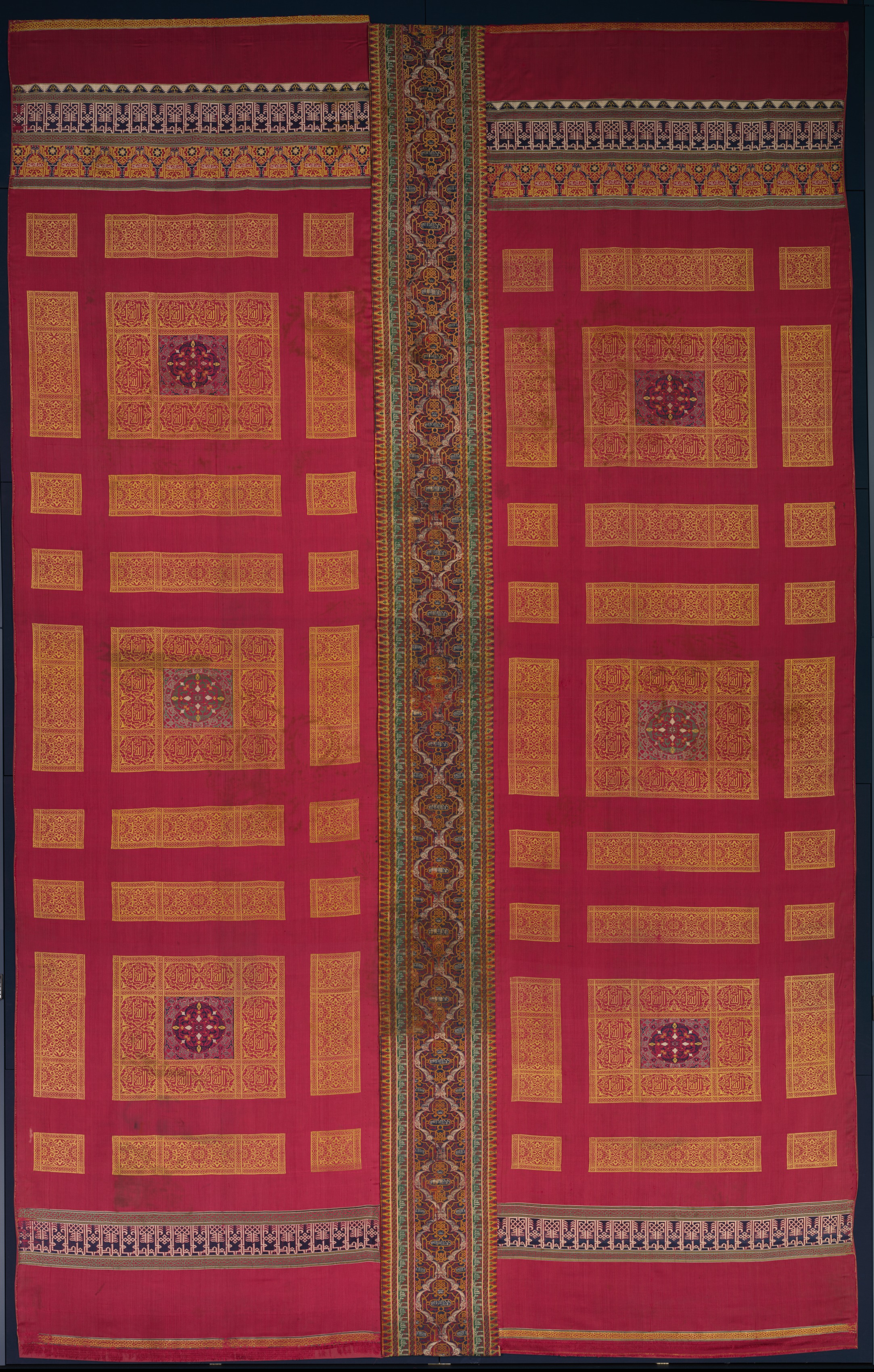
Deconstructing the Alhambra: A Technical and Conceptual Analysis of the Nasrid Silk Curtain
At Zoey Fashion Lab, our mandate extends beyond the mere examination of textiles; we engage in a forensic dialogue with history, extracting the structural and philosophical DNA of artifacts to inform a future-facing aesthetic. The subject of this analysis—a silk curtain fragment from the Alhambra palace, originating in Granada during the Nasrid period (1238–1492)—presents a unique paradox. It is an object of immense historical rigidity, yet its technical construction and decorative logic offer a blueprint for radical, avant-garde reinterpretation. This report deconstructs the curtain’s materiality, weave structure, and cultural resonance to propose a new design paradigm, one where the past is not replicated but re-synthesized into a disruptive, contemporary form.
I. Material and Technical Provenance: The Mechanics of Luxury
The curtain is executed in a compound weave combining lampas and taqueté techniques, utilizing exclusively silk yarns. This is not a simple cloth; it is a hierarchical system of interlacing that creates a dual-faced, polychrome surface. In technical terms, lampas is a figured weave where a pattern weft is bound by a binding warp, while the ground cloth is formed by a separate ground warp and ground weft. Taqueté, a precursor to more complex weaves, involves a main warp and a binding warp, with pattern wefts floating on the surface to create solid color blocks. The combination of these two structures in a single artifact is a testament to the Nasrid weavers’ mastery of the horizontal loom.
From a deconstructionist’s perspective, this weave is a form of binary data storage. Each intersection of warp and weft is a decision point, a 0 or a 1, that collectively encodes geometric and epigraphic patterns. The silk itself—a protein filament with a high refractive index—lends the surface a chameleonic quality, shifting between matte and lustrous states depending on the angle of light. This optical instability is critical. It means the curtain’s visual identity is not static; it is a performance of light and shadow. For Zoey Fashion Lab, this suggests a garment that does not merely reflect light but manipulates it, creating a kinetic, living surface that changes with the wearer’s movement.
II. The Visual Lexicon: Geometry as a Generative Algorithm
The Nasrid decorative system is famously aniconic, avoiding figural representation in favor of an intricate, repetitive geometry. The curtain likely features a lattice of interlacing polygons, eight-pointed stars, and calligraphic bands from the Quran. These are not arbitrary decorations; they are mathematical proofs of infinity and divine order. The eight-pointed star, or khatam, is a central motif, formed by the intersection of two squares rotated 45 degrees. This shape is a fractal generator—it can be infinitely subdivided or expanded, creating a seamless, non-hierarchical field.
For the avant-garde designer, this geometry is a generative algorithm. Instead of treating the pattern as a static print, we can extract its generative logic. The star’s construction—the rotation, intersection, and extension of lines—becomes a parametric rule for pattern-making. We can use computational design tools to mutate this algorithm, introducing controlled asymmetries, scaling variations, and topological distortions. The result is a textile that references the Alhambra’s mathematical purity but subverts its symmetry, producing a chaotic, deconstructed lattice that feels both ancient and extraterrestrial. The calligraphic elements, too, can be abstracted into gestural strokes, losing their linguistic meaning but retaining their rhythmic, flowing energy.
III. Deconstructing the Object: From Curtain to Wearable Architecture
The curtain’s function as a spatial divider is paramount. It was not merely a textile; it was an architectural membrane that controlled light, sound, and sight within the palace. It defined private from public, sacred from profane. To translate this into fashion, we must consider the garment as a portable architecture. The avant-garde silhouette should not conform to the body but instead create a secondary space around it.
We propose a design concept: "The Nasrid Membrane." This is not a dress but a wearable environment. The primary fabric is a high-tenacity silk twill, engineered to hold structural folds. Upon this base, we apply the deconstructed lampas pattern using a combination of laser-cut appliqué and 3D-printed polymer nodes that mimic the binding warp’s function. The garment’s silhouette is asymmetric, with one side echoing the heavy, vertical drape of the original curtain, while the other side is sharply tailored, creating a tension between architectural mass and bodily form. The hem is raw, deliberately frayed, revealing the warp and weft structure—a literal deconstruction that exposes the loom’s logic.
Color is treated as a relic of time. The original curtain’s palette—likely crimson, azure, and gold—has faded and oxidized over centuries. We do not replicate the original vibrancy but rather the patina of age. We use acid-dyeing techniques to create uneven, mottled color transitions, where deep burgundy bleeds into dusty ochre, and muted teal emerges from shadow. This is not nostalgia; it is a conceptual statement on entropy and the passage of time, making the garment a living document of decay.
IV. The "New DNA Strand": A Hybrid of Heritage and Disruption
The reference to a "New DNA Strand" in our brief is apt. The Nasrid curtain provides the historical genetic code, but we must splice it with contemporary mutations. The original silk is delicate and unsuitable for daily wear. Therefore, we propose a hybrid yarn system: a core of recycled, high-strength polyester (for durability and drape) wrapped in a fine filament of organic silk (for surface luster and tactility). This is a bio-technical hybrid, acknowledging the past’s material luxury while embracing modern performance standards.
The construction technique also mutates. While the original used a manual drawloom, we employ a digital jacquard loom controlled by algorithmic pattern files derived from our analysis of the star geometry. This allows for infinite variation within a single garment—no two panels are identical. We can program the loom to introduce "errors," such as dropped threads or shifted wefts, creating a deliberate, glitch-like aesthetic. This is not a flaw; it is a signature of the generative process, a nod to the hand’s imperfection in the original artifact.
V. Styling and Presentation: The Curtain as Performance
In a runway context, this garment must be presented as an artifact in motion. The model should not walk; they should perform a slow, deliberate procession, allowing the fabric to billow and settle, mimicking the curtain’s response to a breeze in a palace courtyard. Styling should be minimal—bare skin, no jewelry—to emphasize the textile’s complexity. The hair should be slicked back, creating a stark, futuristic contrast to the historical fabric. The overall effect is a dissonance: a garment that is simultaneously a relic, a sculpture, and a piece of futuristic armor.
In conclusion, the Alhambra silk curtain is not a museum piece to be copied; it is a source code to be hacked. By deconstructing its weave, abstracting its geometry, and hybridizing its materials, Zoey Fashion Lab transforms a 13th-century artifact into a radical proposition for the future of fashion. The curtain’s original purpose—to divide and conceal—is inverted; our garment reveals and projects, turning the wearer into a living monument of cultural synthesis. This is the essence of avant-garde design: not to destroy the past, but to re-sequence its DNA into a new, unpredictable life form.