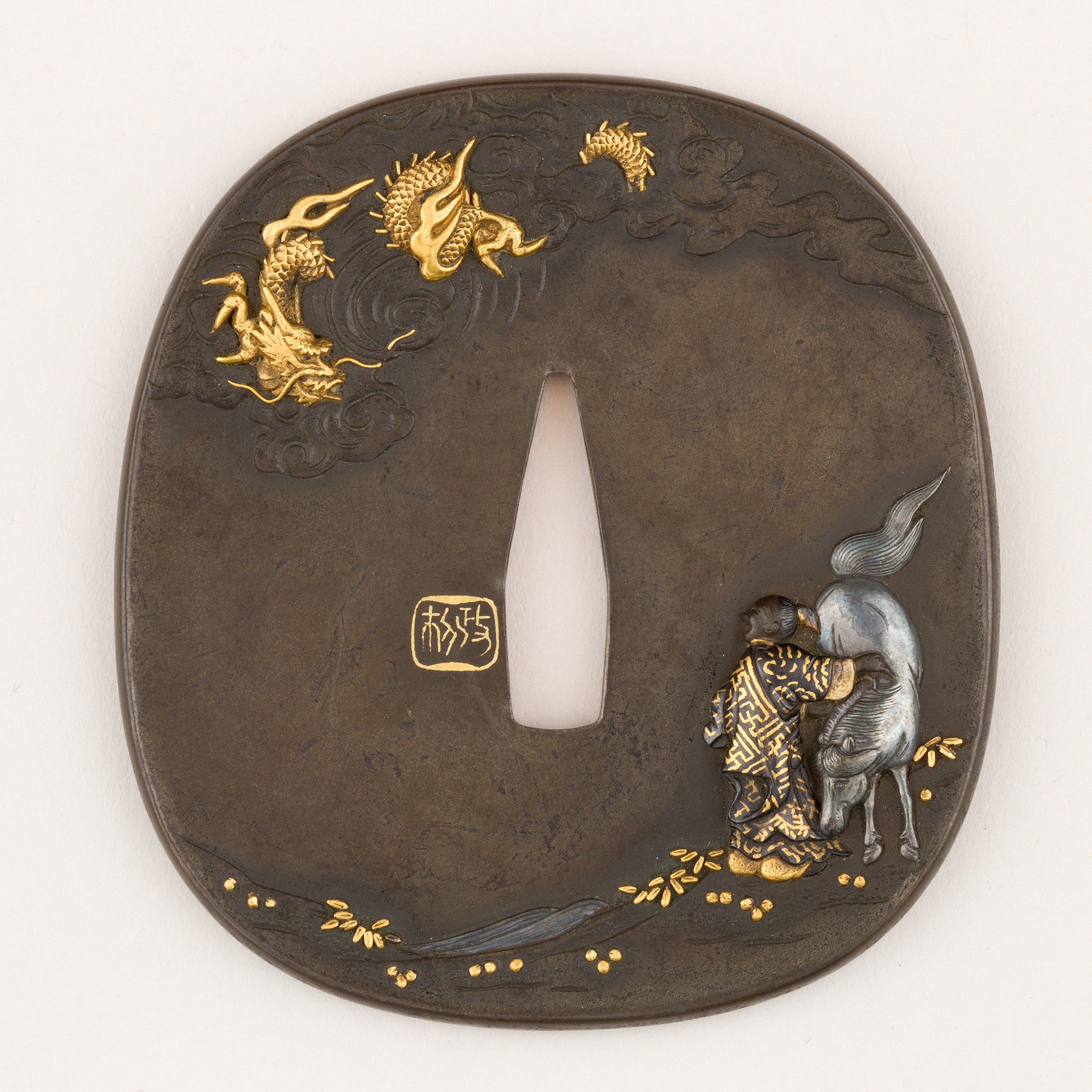
The Tsuba as Proto-Architecture: Deconstructing the Mâshi Húang Narrative
Within the rarefied lexicon of Zoey Fashion Laboratory, the Japanese sword guard—the tsuba—is not an artifact of martial history but a blueprint for radical spatial intervention. The specific piece under examination, the Mâshi Húang-zu tsuba (馬師皇図鐔), depicting the legendary Chinese horse doctor, offers a masterclass in compressed narrative and material alchemy. For SS26, we extract its core principles: the tension between organic vitality and rigid containment, the stratification of precious metals as a metaphor for layered identity, and the perforated void as a generator of silhouette. This is not homage; it is a surgical extraction of structural DNA.
I. Metallurgical Stratigraphy: The New Chromatic Body
The tsuba’s foundation in shibuichi (copper-silver alloy) and shakudō (copper-gold alloy) presents a muted, gunmetal-grey canvas that defies the ostentation of pure gold. In our SS26 directive, this translates to a rejection of high-shine spectacle in favor of oxidized depth. We propose garments constructed from bonded micro-alloyed textiles—thin sheets of vapor-deposited copper on recycled nylon—that mimic the tsuba’s subtle patination. The surface is not flat; it is a topographical map of time. The gold and silver inlay, delineating Mâshi Húang’s acupuncture needles and the horse’s musculature, becomes a system of strategic illumination. Imagine a tailored overcoat where the seams are not sewn but fused with a 24-karat gold filament, tracing the wearer’s own meridian lines. The silhouette is sharp, almost clinical, but the gold interrupts the severity, creating a futuristic chiaroscuro that shifts with the body’s motion.
II. Negative Space as Armor: The Perforated Silhouette
The most avant-garde element of the tsuba is its openwork (sukashi). The negative space around the horse and doctor is not merely background; it is a deliberate architectural void that defines the positive form. For SS26, we translate this into cut-out construction that redefines the human torso. We are abandoning the traditional sleeve and bodice in favor of a modular exoskeleton. A high-collar vest, crafted from rigid, heat-molded shibuichi-toned leather, features laser-cut apertures that mirror the tsuba’s composition. These voids are not decorative. They are functional ventilation ports and attachment points for secondary garments—a detachable train, a floating panel of silk organza. The silhouette becomes a study in interrupted flow. The eye is drawn through the body, not around it. This creates a futuristic, almost cyborgian profile, where the garment’s structure is simultaneously its defense and its vulnerability.
III. The Doctor’s Gaze: Narrative Compression in Garment Architecture
Mâshi Húang is depicted in a moment of profound concentration, diagnosing the ailing horse. This narrative is compressed into a 7-centimeter disc. Our design philosophy extracts this temporal compression and applies it to garment construction. We introduce the concept of the “diagnostic seam.” These are asymmetrical, angled seams that do not follow the body’s natural lines but instead create a visual friction, suggesting a story of intervention and healing. A long, columnar dress in heavy, fluid wool is bisected by a single, sweeping seam that starts at the right shoulder and terminates at the left hip, inlaid with a silver zipper that is intentionally oversized. This seam is the acupuncture needle. It is the moment of action frozen in fabric. The silhouette is deceptively simple—a modern, minimal line—but the structural intervention creates a dynamic tension that is both intellectual and sensual.
IV. Material Hierarchy: From Martial to Ethereal
The tsuba’s hierarchy—iron base, shibuichi field, shakudō accents, gold highlights—is a lesson in material storytelling. For SS26, we propose a radical material hierarchy in apparel. The base layer is a utilitarian, almost brutalist, raw-edge canvas treated with a copper sulfate wash to achieve a verdigris patina. Over this, we layer panels of liquid metal—a composite of recycled aluminum and polymer that can be draped and pleated like fabric but holds a sharp, architectural fold. The final layer is a whisper of silk tulle embroidered with gold thread, not as decoration, but as a structural membrane that holds the heavier panels in place. The result is a garment that feels simultaneously ancient and interstellar. The weight of the metal against the fragility of the tulle creates a disruptive equilibrium, forcing the wearer to move with a new, deliberate posture. This is the futuristic silhouette: not a fantasy of sleekness, but a negotiation of complex, contradictory forces.
V. The Modular Tsuba: Reimagining the Collar and Cuff
Finally, we deconstruct the tsuba’s function as a handguard to reimagine the collar and cuff—the points of transition between body and environment. We introduce the “guardian collar”: a detachable, sculptural piece made from shakudō-finished bronze, worn over the shoulders. It is not a necklace; it is an architectural frame that extends the line of the neck and shoulders, creating a powerful, shielded profile. Similarly, cuffs are re-envisioned as articulated gauntlets of silver and copper, hinged at the wrist to allow for movement. These pieces are not accessories; they are the primary structural elements of the ensemble. The garments beneath them are simplified, reduced to a monochrome base, allowing the metallic guards to become the focal point. This is the ultimate expression of the tsuba’s ethos: protection as a form of avant-garde expression, where the most functional element becomes the most radical statement.
In conclusion, the Mâshi Húang-zu tsuba is not a relic. It is a manifesto for SS26. Its lessons in material economy, negative space, and narrative compression guide our creation of silhouettes that are not merely worn but inhabited. The future of fashion, as we see it, lies in this precise, metallurgical poetry.