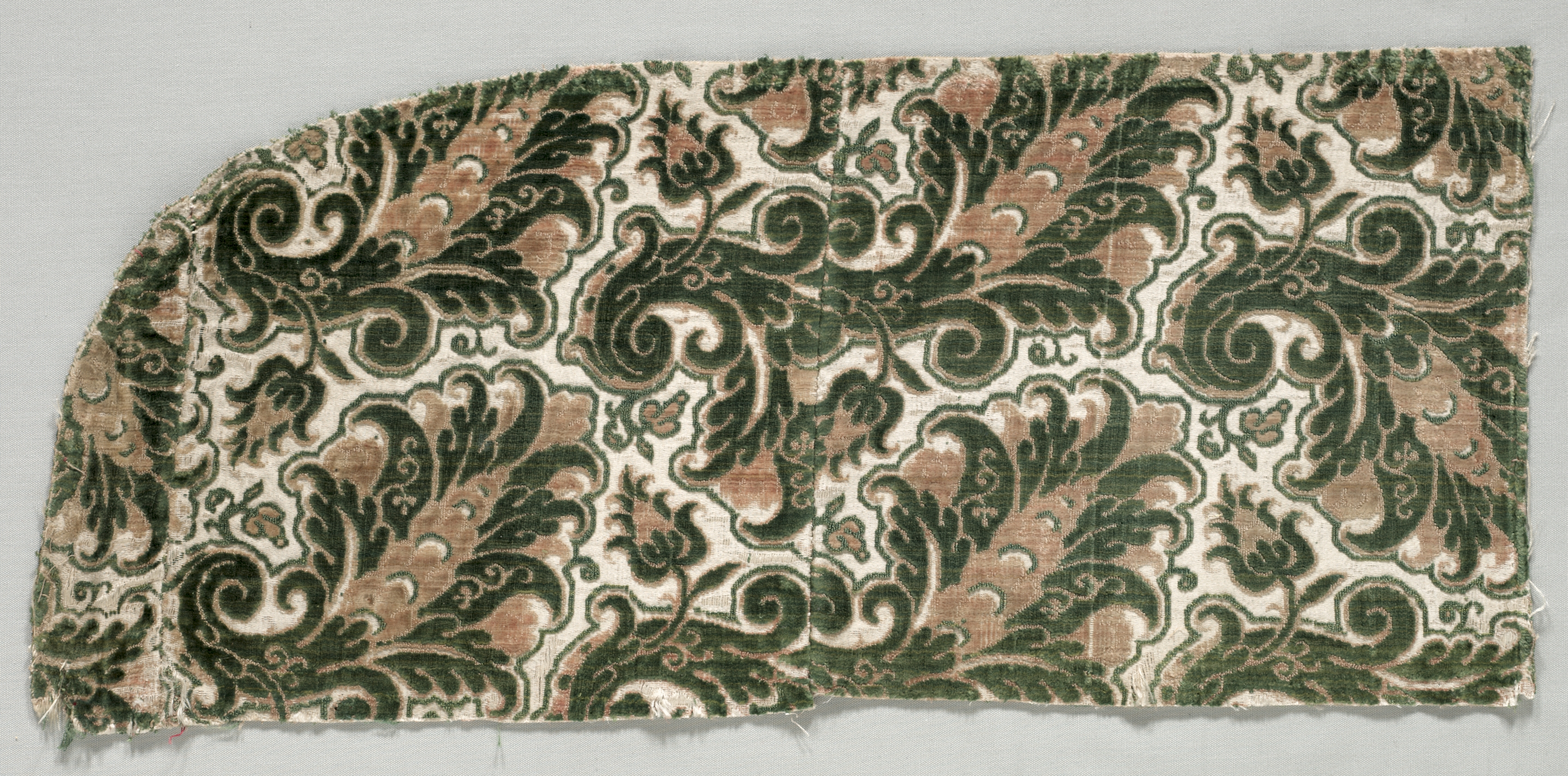
Velvet Re-sequenced: A Technical and Historical Analysis for Zoey Fashion Lab
Velvet, in its most reductive definition, is a woven textile characterized by a dense pile of cut or looped yarns. Yet, for Zoey Fashion Lab, this definition is merely a point of departure. Our analysis of 17th-century Italian velvet—specifically its cut, uncut, and voided constructions—reveals a material of profound structural intelligence. When we filter this historical mastery through our “New DNA Strand” methodology, velvet ceases to be a nostalgic luxury and becomes a radical, avant-garde architectural medium. This report deconstructs the fabric’s technical origins, its three primary construction types, and proposes a blueprint for its subversive reinvention.
I. The Historical Substrate: 17th-Century Italian Mastery
The 17th century marked the apogee of Italian velvet production, particularly in Venice, Genoa, and Florence. This was not merely a craft; it was a sophisticated industrial and artistic endeavor. The looms of the period, often employing complex draw-loom technology, allowed for unprecedented control over pile height, density, and pattern. Velvet was the fabric of absolutist courts and the Catholic Church, signifying wealth, power, and divine right. However, our interest is not in its socio-political symbolism, but in its tectonic logic.
Italian weavers understood that velvet is a dual-plane material: a stable, ground-weave foundation (typically silk) and a volatile, vertical pile. This duality is the fabric’s core paradox. It is simultaneously soft and rigid, light-absorbing and light-reflecting. The 17th-century artisans manipulated this paradox with precision, creating fabrics that were not just surfaces but landscapes of light and shadow. For Zoey Fashion Lab, this historical precision is the “raw data” we seek to re-sequence. We do not copy the floral motifs or baroque scrolls; we extract the underlying structural grammar—the rules of pile formation, the tension between foundation and elevation.
II. Technical Deconstruction: Cut, Uncut, and Voided Velvet
To understand velvet’s potential for avant-garde application, one must differentiate its three primary technical manifestations. Each offers a distinct tactile and visual frequency, a different “signal” in our design DNA.
Cut Velvet (Velluto Cesellato): In this construction, the pile loops are severed after weaving, creating a dense, upright pile of individual filaments. This yields a plush, deeply absorbent surface that feels almost liquid to the touch. The cut pile reflects light diffusely, resulting in a rich, matte depth. Technically, this is the most labor-intensive form, requiring a second set of warp yarns and a cutting blade (or ferro) to be run along the loom’s surface. For our lab, cut velvet represents maximum volume with minimum weight. It is a material that can be carved, sculpted, and compressed, holding its shape like a memory foam but with the luster of silk.
Uncut Velvet (Velluto Riccio): Here, the pile is left as intact loops. This creates a more resilient, springy surface that catches light in a shimmering, iridescent manner. The loops act as micro-lenses, reflecting light back in a crisp, almost metallic sheen. Uncut velvet is more resistant to crushing and has a distinct, granular texture. In our avant-garde framework, uncut velvet offers structural rigidity and bounce. It is the “spring” in a garment’s kinetic system, allowing for volume that returns to its original form after deformation. The contrast between the matte cut pile and the glossy uncut loops is a powerful tool for creating optical illusions and tactile gradients.
Voided Velvet (Velluto Alla Zoppa): This is the most intellectually complex of the three. Voided velvet features areas where the pile is entirely absent, revealing the ground weave (often a contrasting satin or taffeta). This creates a negative-space pattern—a deliberate void within the plush field. In the 17th century, this was used to delineate intricate patterns, with the ground fabric acting as a shadow to the luminous pile. For Zoey Fashion Lab, voided velvet is the key to deconstruction and transparency. The voids allow for strategic exposure of the body or of an under-layer, creating a dialogue between opacity and revelation. It transforms the fabric from a solid surface into a perforated, breathable membrane.
III. The New DNA Strand: From Historical Craft to Avant-Garde System
Our “New DNA Strand” is not a literal genetic code, but a conceptual operating system for material transformation. It involves three stages: Extraction, Mutation, and Recombination. Applying this to 17th-century velvet yields a radical new material language.
Extraction: We extract the core “genes” of historical velvet—the dual-plane structure, the pile density gradient, and the voided negative space. We discard the ornamental iconography. The gene we retain is the relationship between the pile and the ground. This is the fabric’s intelligence.
Mutation: We mutate these genes through modern technology. Instead of silk, we introduce bio-based polymers, recycled metallic threads, or even conductive fibers. We use laser-cutting to create precision voided patterns that are impossible on a 17th-century draw loom. We employ 3D-knitting techniques to create a “velvet” where the pile is not uniform but varies in height across the surface, producing a topographical, almost geologic texture. The mutation is not about making it softer or shinier; it is about making it responsive—to heat, to light, to movement.
Recombination: We recombine the mutated velvet with other materials and structural systems. Imagine a coat where the body is cut velvet for warmth, the sleeves are uncut velvet for structural volume, and the seams are laser-voided to create a skeleton-like lattice, revealing a sheer, iridescent underlayer. This is not a garment; it is a wearable architectural model. The voided areas become structural hinges, allowing for articulation and movement. The uncut pile acts as a shock absorber, while the cut pile provides a soft, sculptural shell.
IV. Avant-Garde Application: The Velvet Exoskeleton
In our avant-garde collection, velvet is no longer a passive covering. It is an active agent. Consider a full ensemble: a bodice constructed from rigid, uncut velvet, engineered with a high-density pile that stands away from the body like a carapace. This is not draped; it is built. The skirt, in contrast, uses cut velvet that is digitally printed with a gradient of voided patterns, transitioning from solid at the waist to fully perforated at the hem. This creates a diaphanous, ethereal effect, defying velvet’s traditional weightiness.
Furthermore, we introduce the concept of “kinetic pile.” By using a base fabric with shape-memory alloys, the velvet pile can be programmed to lie flat or stand erect in response to body heat or electrical current. This is a direct evolution of the 17th-century weaver’s control over the pile, but now the control is dynamic and interactive. The garment becomes a living surface, shifting from matte to glossy, from opaque to translucent, as the wearer moves. This is the ultimate deconstruction: we have not destroyed velvet; we have re-sequenced its DNA to express a new, futuristic language of form, light, and motion.
In conclusion, the 17th-century Italian velvet provides a foundational grammar of pile, void, and ground. By applying our New DNA Strand methodology, we transform this historical luxury into a medium of radical innovation. The result is not a homage, but a mutation—a velvet that is structurally intelligent, visually dynamic, and conceptually avant-garde, ready for the future of fashion.