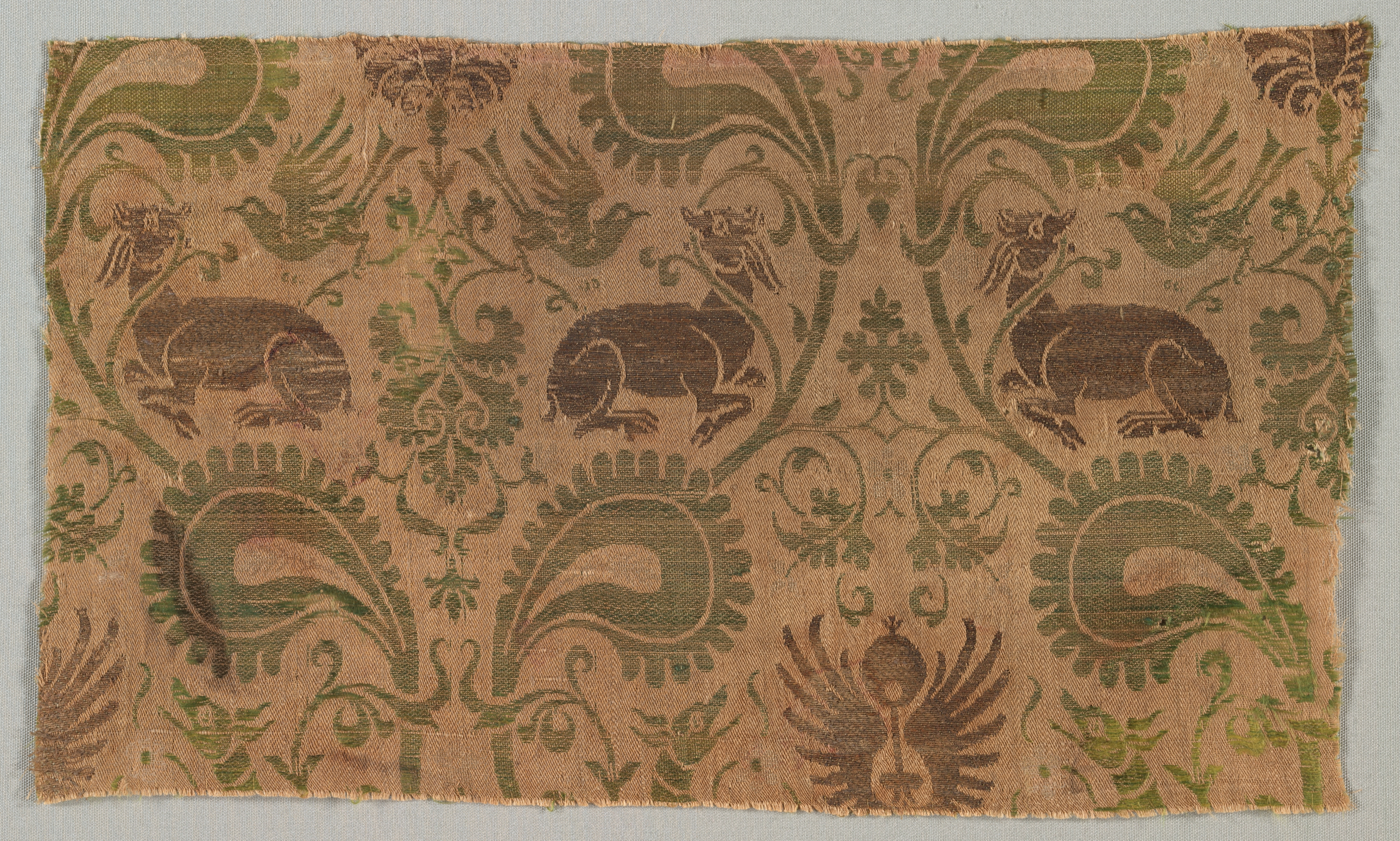
Deconstructing the Renaissance Genome: Silk with Dogs and Birds amid Vines
At Zoey Fashion Lab, our mandate is not merely to preserve historical textiles but to extract their latent genetic code—the structural, chromatic, and symbolic DNA—and re-sequence it for contemporary avant-garde expression. The subject of this analysis, a fragment of Italian silk from the second half of the 14th century, depicting dogs and birds amid vines, is not a relic. It is a proto-digital matrix, a woven algorithm of medieval power, natural philosophy, and technical virtuosity. Our deconstruction reveals a fabric that operates on three distinct strata: the material genome (the weave architecture), the iconographic transcript (the symbolic narrative), and the temporal translation (how this 700-year-old object can mutate into a new DNA strand for 21st-century fashion).
I. The Material Genome: A Binary of Twill and Plain
The technical foundation of this silk is a masterpiece of proto-computational logic. The fabric is a lampas, a compound weave that employs two separate warp and weft systems. This is not a single, homogeneous structure but a dialogue between two distinct weaving voices. The ground is a 2/1 twill, which provides a dense, diagonal, and subtly lustrous field. The pattern, in contrast, is executed in a plain weave (tabby) using supplementary gold thread. This dichotomy is critical. The twill ground acts as a matte, absorbing substrate, while the plain-weave pattern elements, shot through with gold, rise from the surface as luminous, crisp pixels.
From a deconstructionist perspective, this is a binary system: 1 (pattern) and 0 (ground). The 2/1 twill creates a rhythm of three—two threads over, one under—generating a subtle, kinetic shimmer. The plain weave, with its strict over-under alternation, offers maximal structural stability for the metallic thread, preventing the gold from slipping and ensuring the clarity of the dog’s ear or the bird’s wing. The gold itself is not a solid wire but a gilded membrane—typically a thin strip of animal gut or leather coated with gold leaf, wound around a silk core. This means the "gold" is not inert metal; it is a composite, a hybrid of organic and inorganic matter, which explains its extraordinary ability to catch light at different angles, creating a living, breathing surface that changes with the viewer’s movement.
For the Zoey Fashion Lab, this binary is our starting point. We do not replicate the lampas; we extract its principle. Our avant-garde interpretation will employ differential warp tensions and contrasting yarn densities to recreate the same optical push-pull. Instead of silk and gold, we propose a base of high-tech recycled nylon (for the matte twill ground) and a pattern weft of thermochromic liquid crystal filaments (for the plain-weave figures). The binary remains—ground vs. figure—but the "gold" now responds to body heat, shifting from a metallic vermilion to a cool cerulean, making the dogs and birds appear to move, not by mechanical thread, but by thermal energy.
II. The Iconographic Transcript: Hunting, Loyalty, and the Ornamental Wild
The imagery—dogs and birds amid vines—is not random decoration. In the 14th century, this was a sophisticated heraldic and courtly language. The dog, particularly the hound, symbolized fidelity, nobility, and the disciplined hunt. The bird, often a falcon or a songbird, represented the soul, the aspiration toward the heavens, and the refined art of falconry—a pastime reserved for the aristocracy. The vine, with its intertwining tendrils, was a symbol of eternal life, resurrection, and the interconnectedness of all things. Together, they form a microcosm of the medieval court: order (the hunt), grace (the bird), and growth (the vine).
However, our deconstruction reveals a subversive undercurrent. The vine is not a passive frame; it is an aggressive, generative force. It wraps around the animals, not merely as a trellis, but as a digestive system. The dogs and birds are not static emblems; they are caught in a state of dynamic tension—mid-pounce, mid-flight, forever frozen in a chase that never concludes. This is the medieval anxiety of the wild: the fear that the ordered hunt may become the hunted, that the vine may swallow the hunter.
For our avant-garde translation, we will not reproduce the dog or bird literally. Instead, we will abstract their kinetic silhouettes. Using a CAD program, we will trace the negative space between the animal and the vine, isolating the moments of intersection. These "collision zones" will become the new pattern. The dog’s ear becomes a sharp, angular chevron; the bird’s wing becomes a fractal, feathered fan; the vine’s tendril becomes a continuous, unbroken sine wave. We will then print these abstracted forms onto a biodegradable cellulose-based fabric using a zero-waste digital sublimation process. The result is not a pastoral scene but a geometric explosion of predatory energy—a visual scream of the hunt, stripped of its heraldic politeness.
III. The Temporal Translation: Re-Sequencing the DNA Strand
The reference to a "New DNA Strand" in our brief is apt. A DNA strand is a sequence of base pairs—adenine, thymine, cytosine, guanine—that code for life. This silk is a sequence of structural pairs: twill/plain, silk/gold, dog/vine, bird/ground. Our task is to mutate this sequence without losing its original information. We propose a three-part collection, "Caccia Mutante" (Mutant Hunt), that re-sequences the medieval genome.
Phase One: The Dehydrated Hunt. We will create a tailored, oversized coat using a jacquard-woven fabric that replicates the lampas structure but replaces the gold with a matte, black-coated stainless steel thread. The dogs and birds will be rendered in a monochromatic, high-contrast graphic style, but the vine will be embossed into the fabric’s surface via a heat-press, creating a topographical relief. The coat will be cut with severe, architectural shoulders—a nod to the rigid formality of the medieval court—but the hem will be raw, frayed, and unfinished, suggesting the vine’s relentless growth and the decay of the aristocratic order.
Phase Two: The Symbiotic Aviary. This will be a draped, bias-cut gown where the bird motif is exaggerated to the point of abstraction. The birds’ wings will be deconstructed and re-embroidered as 3D, sculptural frills using a combination of silk organza and recycled plastic filaments. The gown’s surface will be a double-faced weave: one side showing the original twill ground, the other side revealing the plain-weave pattern in reverse, creating a ghostly, x-ray effect. The wearer becomes both the hunter and the hunted, the fabric’s interior and exterior perpetually in conflict.
Phase Three: The Viral Vine. The final piece is a modular, transformable garment—a series of interconnected panels that can be worn as a skirt, a cape, or a full-body cocoon. The vine pattern will be laser-cut into a leather-like mycelium composite, a sustainable, lab-grown material. The cut-out tendrils will be left open, allowing the skin to show through, while the dogs and birds will be printed on a transparent, iridescent film that is loosely attached to the interior. As the wearer moves, the film shifts, making the animals appear to dart behind the vine lattice. This garment is not a static object; it is a living, breathing system, a direct descendant of the 14th-century lampas but mutated for a world of augmented reality and metabolic fashion.
Conclusion: The Fabric as a Living Archive
The Italian silk of the 14th century is not a dead artifact. It is a living archive of technical intelligence and cultural anxiety. By deconstructing its weave, decoding its iconography, and re-sequencing its material DNA, Zoey Fashion Lab transforms it from a museum specimen into a propulsive force for avant-garde design. Our "Caccia Mutante" collection does not imitate the past; it enters into a dialogue with it, arguing that the tension between order and chaos, between the animal and the ornamental, is as relevant today as it was in the age of the Medici. The dogs still chase, the birds still flee, and the vine still grows—but now they do so in thermochromic color, on mycelium leather, and in the restless silhouette of a future that has finally caught up with the medieval imagination.