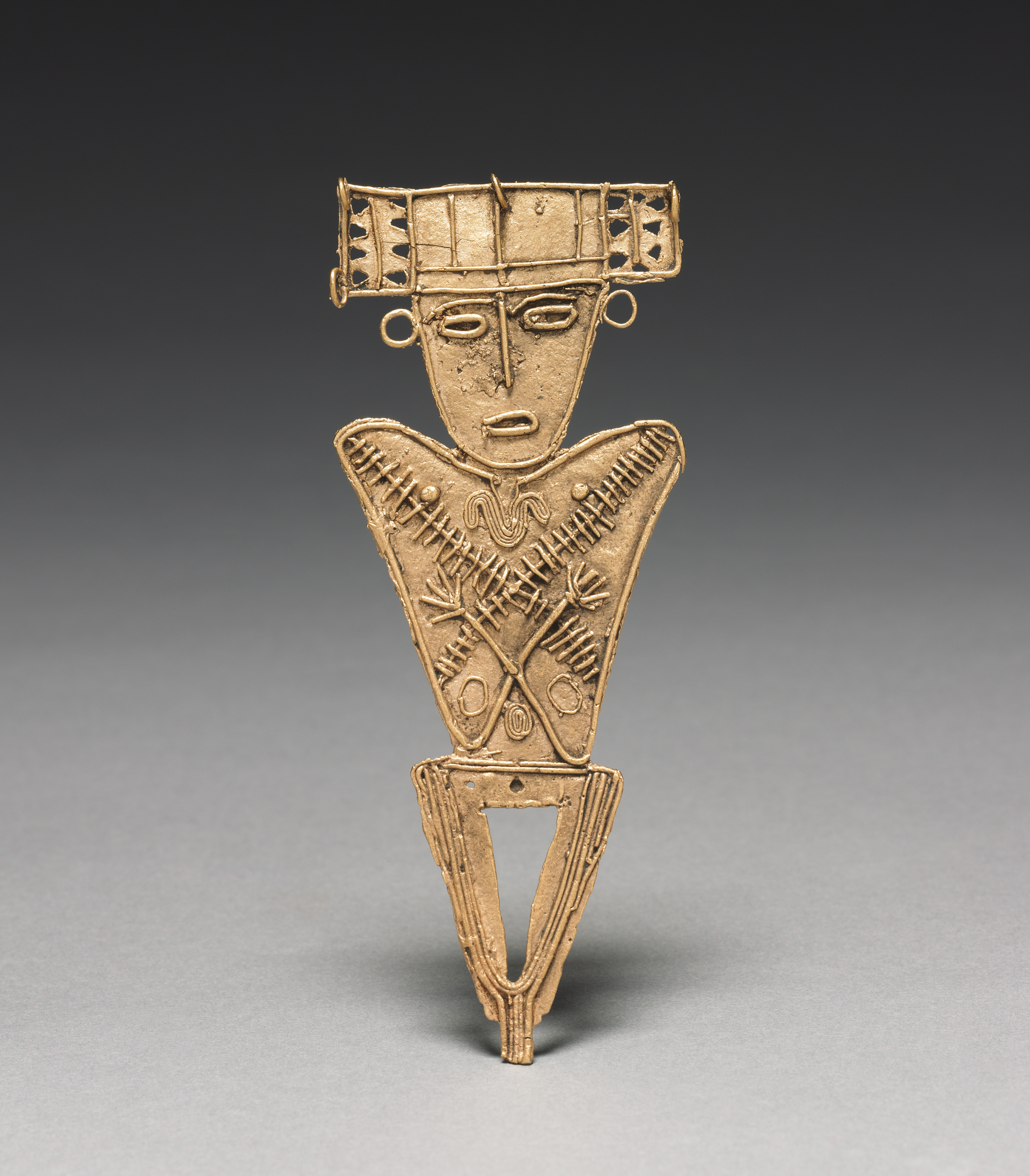
Deconstructing the Votive: Tunjos as Avant-Garde Precedent
At Zoey Fashion Lab, our mandate is not merely to observe historical artifacts but to interrogate their material grammar, extracting the syntax of form that can be re-articulated for contemporary expression. The Tunjo, a votive offering figurine from the Muisca culture of pre-Columbian Colombia, presents a particularly potent case study. Cast in gold, these small-scale figures are not static relics; they are dense repositories of ritual intent, metallurgical mastery, and a radical abstraction of the human form that resonates profoundly with avant-garde principles. This analysis deconstructs the Tunjo across three critical axes: Material Alchemy, Formal Distortion, and Conceptual Resonance, drawing a parallel to the archive’s reference to the “Mirror with Split-Leaf” – a juxtaposition of reflective surface and narrative relief that mirrors the Tunjo’s dual nature as both object and offering.
I. Material Alchemy: The Politics of Gold and the Anti-Precious
The Tunjo’s technical execution—lost-wax casting in gold—immediately establishes a dialogue of contradictions. In Western fashion, gold is the ultimate signifier of permanence, luxury, and untouchable value. The Muisca, however, deployed gold not for adornment of the living but for ritual deposition. These figurines were cast to be offered, often thrown into the sacred Lake Guatavita, a practice that culminated in the legend of El Dorado. This act of deliberate disposal inverts the contemporary logic of material accumulation. The Tunjo’s gold is not a store of wealth but a medium of transaction with the cosmic order.
For Zoey Fashion Lab, this redefines the use of metallic textiles and hardware. The avant-garde implication is to treat gold not as a finish but as a processual element. Imagine a garment where gold lamé is not sewn in for permanence but designed to be torn, oxidized, or even dissolved upon a specific environmental trigger—a performance piece where the garment’s destruction is its ultimate function. The Tunjo teaches us that preciousness is a function of intent, not material. The rough, often unpolished surfaces of the cast gold, with their visible texture from the lost-wax mold, challenge the high-polish standard of luxury. This suggests a design language of visible process—seams left raw, metallic threads deliberately frayed, and surfaces that bear the trace of their making, akin to the “cold stone sarcophagus” relief mentioned in the archive reference. The Tunjo’s gold is a skin that records its own genesis.
II. Formal Distortion: The Body as Abstract Symbol
Anatomically, Tunjos are rarely naturalistic. They exhibit elongated torsos, exaggerated facial features, and simplified, almost geometric limbs. This is not a failure of skill but a deliberate hieratic abstraction. The Muisca were not interested in portraiture; they were interested in typology. The figure is reduced to its essential signifiers—a head, a staff, a posture of supplication—to become a generic vessel for the offering. This aligns perfectly with avant-garde fashion’s rejection of the body as a biological given, instead treating it as a canvas for conceptual projection.
Consider the avant-garde silhouettes of designers who distort proportion—the exaggerated shoulders of a Rei Kawakubo, the padded hips of a Thierry Mugler. The Tunjo prefigures this by presenting the body as a symbolic architecture. The elongated neck becomes a column; the flattened torso becomes a plaque for incised decoration. In our lab, we translate this into pattern-cutting that prioritizes symbolic gesture over anatomical fit. A garment inspired by the Tunjo would not drape the body; it would frame it as a relic. The “split-leaf” motif from the mirror reference—a complex, organic pattern—can be reinterpreted as surface topology on a garment, where the fabric’s print or embroidery operates like the incised details on the gold figurine, telling a narrative not through silhouette but through tactile relief.
Furthermore, the scale of Tunjos is crucial. They are small, intimate objects meant for the hand, not the gaze of a crowd. This challenges the monumental scale of contemporary fashion shows. An avant-garde response might be to create micro-garments—not miniature clothing, but garments with extreme interior detailing, hidden pockets, and secret linings that only the wearer can access, turning the act of dressing into a private ritual of self-offering. The garment becomes a personal votive to one’s own identity.
III. Conceptual Resonance: The Archive’s Echo and the Temporal Pause
The archive reference—a mirror with gold-encrusted palm leaves on one side and a sarcophagus relief on the other—provides a critical lens. The Tunjo occupies a similar liminal space. It is an object of reflection (the mirror) and a record of death/transition (the sarcophagus). The gold of the Tunjo is not meant to reflect the viewer’s vanity but to absorb and transmit prayer. This is the antithesis of the fashion mirror, which is designed for self-congratulation.
For Zoey Fashion Lab, the Tunjo inspires a shift from reflective to projective design. We propose collections that are not about the wearer’s external image but about their internal state of offering. This manifests in garments with detachable elements meant to be given away, or textiles embedded with text or symbols that are only legible upon close inspection—a secret language for the initiated. The “palm leaf” motif, often associated with victory and peace, when rendered in gold on a mirror, becomes a frozen moment of triumph. The Tunjo, by contrast, is a frozen moment of plea. The avant-garde fashion gesture here is to design for the pause, the moment of vulnerability, rather than the moment of display.
In conclusion, the Tunjo is not a primitive artifact but a sophisticated philosophical tool made manifest in metal. Its avant-garde relevance lies in its subversion of material value, its abstracted corporeality, and its function as a conduit for the immaterial. Zoey Fashion Lab’s deconstruction of the Tunjo yields a design philosophy that embraces impermanence, prioritizes symbolic form over anatomical mimicry, and treats the wearer not as a spectacle but as a participant in a larger, silent ritual. The golden figurine, cast in silence and thrown into the abyss, teaches us that the most powerful statement in fashion is not the loudest, but the one that is offered, held, and ultimately released.