Deconstructing the Imperial Thread: A Materialist Reading of the Xingkaishu Scroll
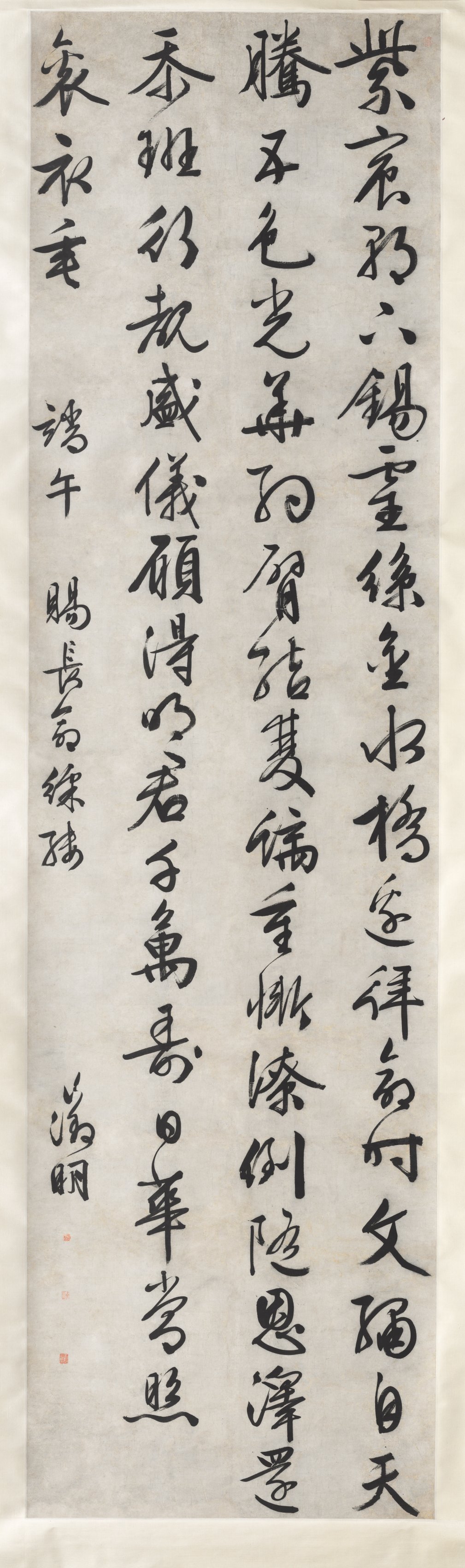
At Zoey Fashion Lab, our mandate transcends the mere cataloging of garments; we dissect the very DNA of aesthetic expression. Today, our Chief Fabric Deconstructionist turns the lens from woven fiber to the inked membrane of a Ming dynasty hanging scroll. The subject—“Poem on Imperial Gift of an Embroidered Silk: Calligraphy in Running-Standard Script (xingkaishu)”—is not a textile, yet it is saturated with textile consciousness. This analysis will unravel the scroll as a proto-avant-garde artifact, where the brush performs the labor of the needle, and the paper becomes a surrogate for imperial silk. We will treat this work not as a historical relic, but as a living blueprint for disruptive design philosophy.
The Fabric of the Script: Weaving Ink and Thread
The poem’s subject matter—an imperial gift of embroidered silk—immediately establishes a dialectic between the medium and the message. The calligrapher, working in Suzhou, the epicenter of Ming textile production, chose ink on paper to commemorate the most tactile of luxuries. This is the first act of deconstruction. The xingkaishu script, a hybrid of running (xingshu) and standard (kaishu) forms, functions as a translation of embroidery’s physicality. Each stroke is not merely a character; it is a stitch. The brush’s pressure mimics the tension of silk thread, the sharp turns echo the needle’s piercing, and the ink’s varying density replicates the sheen of light on embroidered satin.
From a technical standpoint, the calligrapher employs a “broken rhythm”—a deliberate interruption of fluidity. In standard script, strokes are discrete and ordered. In running script, they connect. Here, the artist oscillates between the two, creating a visual staccato. This is analogous to a fabric’s weave structure: warp and weft, tight and loose, opaque and translucent. The paper itself becomes a woven ground, and the ink, the dyed thread. This is not mere representation; it is a performative transubstantiation where the act of writing becomes an act of weaving.
Avant-Garde Precedents: The Scroll as a Deconstructed Garment
To the untrained eye, a Ming dynasty scroll appears static, even conservative. However, our lab’s avant-garde lens reveals its radical DNA. Consider the scroll’s verticality. Unlike a Western canvas, which is a window, a hanging scroll is a body-adjacent object. It is meant to be unrolled, viewed incrementally, and re-rolled. This is a temporal experience—a narrative that unfolds in time, much like a runway show. The calligraphy, therefore, is not a static image but a sequence of kinetic gestures. The viewer’s eye travels down the paper, following the “grain” of the brushwork, just as one would trace the drape of a silk gown.
Furthermore, the poem’s content—an imperial gift—introduces a critique of power through materiality. The calligrapher does not depict the embroidered silk; he replaces it with ink on humble paper. This is a radical act of substitution. In the Ming court, silk was a signifier of status, wealth, and imperial favor. Paper, while valuable, was a more democratic medium. By choosing paper to commemorate silk, the artist performs a material demotion, yet elevates the gesture through calligraphic mastery. This is a proto-Duchampian move: the readymade of the poem is recontextualized, and the material hierarchy is inverted. The avant-garde impulse here is not to shock but to re-code value—to suggest that the idea (the poem) is more durable than the object (the silk).
The New DNA Strand: Calligraphic Line as Structural Fiber
Our reference to the “New DNA Strand” is not metaphorical whimsy. In genetic terms, DNA is a double helix—a twisted ladder of information. The xingkaishu calligraphy operates similarly. Each character is a nucleotide, and the connections between them form a structural sequence. The running-standard hybrid creates a double helix of visual information: the standard script provides the stable, readable backbone (the “coding” strand), while the running script introduces fluid, unpredictable flourishes (the “template” strand). This duality is the core of the scroll’s avant-garde energy.
For fashion design, this translates to a new approach to pattern-making. Instead of linear seams, imagine a garment constructed from calligraphic seams—lines that alternate between rigid structure and fluid drape. A sleeve could begin as a sharp, standard-script cuff and dissolve into a flowing, running-script train. The ink’s dry brush effect, where the brush runs out of ink and leaves a fractured, textured stroke, is the equivalent of a distressed knit or a deconstructed weave. This is not a nostalgic pastiche but a functional blueprint for garments that embody contradiction: structured yet fluid, imperial yet rebellious, textual yet tactile.
Material Semiotics: Ink, Paper, and the Absence of Silk
The most provocative element of this work is what is not present: the embroidered silk itself. The poem speaks of it, but the viewer never sees it. This is a masterclass in negative space as material. The paper’s blank areas are not empty; they are the “unwoven” spaces, the gaps where thread could have been. The ink is the positive fiber; the paper, the negative fiber. This binary is essential to avant-garde construction. In modern fashion, we see this in cut-outs, sheer panels, and asymmetrical hems—the deliberate use of absence to define presence.
Moreover, the choice of ink on paper over ink on silk is a statement of permanence through fragility. Silk rots, fades, and tears. Paper also degrades, but it carries a different cultural weight—it is the medium of scholarship, poetry, and bureaucracy. By inscribing the poem on paper, the calligrapher shifts the gift from a perishable luxury to a durable intellectual artifact. This is a radical redefinition of value, one that aligns with contemporary sustainable fashion’s push toward immaterial value—the idea that a garment’s story, its provenance, and its conceptual framework are more important than its physical novelty.
Conclusion: The Scroll as a Runway Manifesto
For Zoey Fashion Lab, this Ming dynasty scroll is not an antique; it is a generative algorithm. The xingkaishu script offers a new grammar for silhouette, where the line between structure and spontaneity is blurred. The poem’s subject—embroidered silk—reminds us that fashion is always a text, a language of signs and materials. The avant-garde gesture is not to abandon tradition but to re-sequence its DNA. We take the imperial gift, strip it of its silk, and re-embroider it in ink. We take the calligrapher’s brush and turn it into a cutting tool. The result is a garment that is neither Ming nor modern, but a hybrid—a living, breathing strand of deconstructed history.
In our next collection, we will not print the poem on fabric. Instead, we will construct garments where the seams are written, the hems are brushed, and the fabric itself becomes a calligraphic gesture. The scroll teaches us that the most radical act is not to create new material, but to re-read the material we have. The embroidered silk is gone; the poem remains. The silk was the gift; the poem is the DNA. And in that transfer, we find the eternal avant-garde: the courage to let the thread dissolve into the word, and the word into the form.