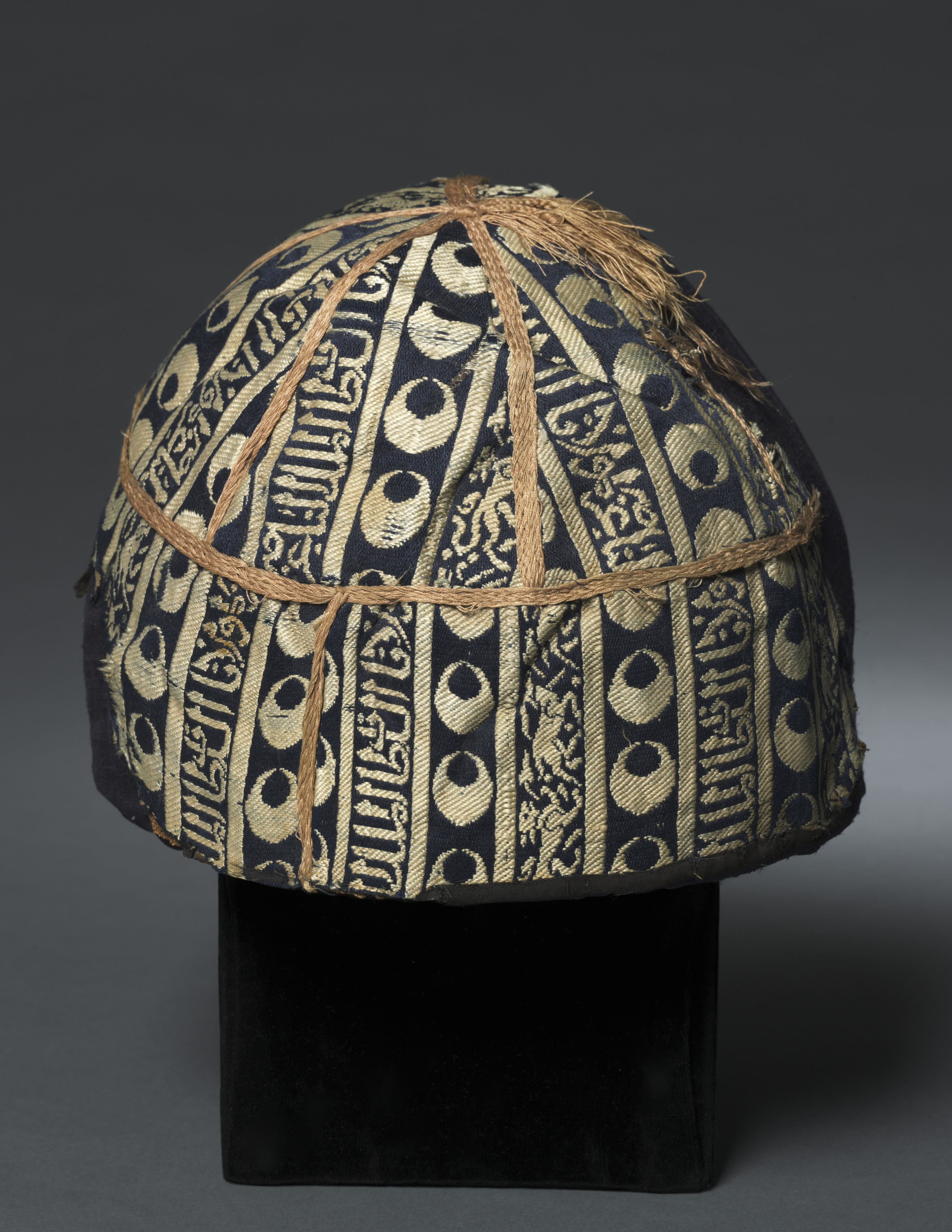
Deconstructing the Mamluk Cap: A New DNA Strand for Avant-Garde Expression
At Zoey Fashion Lab, we do not merely study garments; we extract their genetic code. The subject of this analysis—a cap with striped inscribed silk from the Mamluk Sultanate (Egypt or Syria, circa 13th–15th century)—presents a remarkable paradox. It is a relic of profound historical rigidity, yet its technical DNA holds the blueprint for radical, avant-garde innovation. This is not a reproduction project. This is a genetic splicing. We are isolating the structural and symbolic chromosomes of this Mamluk artifact and re-encoding them into a contemporary fashion language that challenges the very notion of headwear, ornament, and cultural memory.
I. Historical & Cultural Genome: The Mamluk Ethos of Power and Piety
The Mamluk Sultanate was a regime built on military aristocracy and conspicuous patronage. Its textile industry was arguably the most sophisticated in the medieval Islamic world. The cap with striped inscribed silk is not a casual accessory; it is a document of status. The striped silk, often in polychrome bands, was a hallmark of tiraz workshops—royal factories that produced fabrics with woven inscriptions. These inscriptions were not decorative afterthoughts; they were often Qur’anic verses, blessings, or the Sultan’s name, functioning as a portable declaration of sovereignty and divine favor.
For the avant-garde designer, this historical context is not a constraint but a conceptual springboard. The cap’s original function was to signal obedience to a hierarchical order. Our task is to invert this. We deconstruct the authoritarian semiotics of the inscription and re-purpose it as a tool for individualistic, subversive expression. The Mamluk cap was a closed system of meaning; our new strand opens that system to infinite, chaotic reinterpretation.
II. Technical Autopsy: The Silk’s Structural Paradox
Technically, the cap presents a fascinating study in material tension. The striped inscribed silk is typically a compound weave—often lampas or taqueté—where a ground weave (usually silk) supports a supplementary patterning weft that creates the inscription. The stripes are not printed; they are integral to the weave structure. This creates a fabric that is simultaneously rigid in its geometry (the stripes and script are precise, mathematical) yet fluid in its drape (silk’s natural luster and suppleness).
From a deconstructionist standpoint, this is a goldmine. The technical precision of the Mamluk weaver is a form of mechanical constraint. To create an avant-garde piece, we must break this constraint. We propose the following technical interventions:
- Dislocated Weave: Instead of preserving the cap’s original circular form, we will slice the silk along the warp and weft at irregular intervals, creating a fringe that mimics the frayed ends of a genetic strand. This destroys the original silhouette but liberates the silk’s raw fiber energy.
- Inverted Inscription: The woven Arabic script will be digitally scanned and then re-embroidered onto the deconstructed cap in a mirrored, reversed, or fragmented manner. This is not a sign of disrespect but a semantic rupture—the sacred text becomes a visual noise, a static interference in the fabric of history.
- Hybrid Materiality: We will pair the historical silk with contemporary technical fibers—recycled metallic threads, bio-based nylon, or even conductive yarns. This creates a dialogue between the 14th century’s organic luxury and the 21st century’s synthetic functionality. The result is a fabric that is neither wholly ancient nor wholly modern, but a mutant hybrid.
The key technical insight is that the Mamluk cap’s strength lay in its unbroken surface. The stripes and inscriptions formed a continuous, unassailable visual field. Our avant-garde strategy is to perforate, slash, and re-stitch this field, allowing the negative space to become as expressive as the positive form.
III. Avant-Garde Interpretation: The Cap as a Cognitive Artifact
In the Zoey Fashion Lab lexicon, the new DNA strand is not about nostalgia. It is about cognitive dissonance. We propose three distinct avant-garde manifestations derived from the Mamluk cap:
1. The "Archival Ghost" Cap: This piece retains the cap’s foundational shape but is constructed from a double layer. The inner layer is a modern, sheer organza printed with a faded, pixelated version of the original inscription. The outer layer is the historical silk, but it has been laser-cut to create a lattice pattern, revealing the ghostly text beneath. The wearer becomes a living palimpsest—history is visible but not legible, present but not authoritative.
2. The "Sovereignty Disrupted" Helmet: Here, the cap is radically re-scaled and re-purposed. We take the striped silk and mold it into a sculptural, helmet-like form using heat-setting and resin. The stripes are allowed to bulge and warp, creating a topographic map of distortion. The inscription is re-embroidered in a chaotic, free-form stitch that breaks the original calligraphic line. This piece is a critique of power—the Mamluk Sultan’s authority is literally deformed into a new, anarchic silhouette.
3. The "Genetic Cascade" Veil: This is the most radical departure. We deconstruct the cap entirely, unraveling the silk into individual yarns. These yarns are then re-woven into a long, flowing veil that trails behind the wearer like a comet’s tail. The stripes become longitudinal streaks; the inscriptions become fragmented, floating glyphs. This transforms a small, compact object of headgear into a monumental, performative textile. The veil is not a covering but an extension of the body’s movement—a kinetic sculpture that whispers of forgotten empires while screaming of futuristic freedom.
IV. Material Ethics and the New Strand
We must address the ethical dimension. Using historical silk is a delicate matter. Zoey Fashion Lab does not advocate for the destruction of museum-grade artifacts. Instead, we propose a synthetic reconstruction. We will commission weavers to recreate the Mamluk striped silk using historical techniques but with contemporary, sustainable fibers—such as peace silk or lab-grown silk. The inscription will be recreated via digital weaving. This ensures that the genetic information of the original is preserved, but the physical material is new. This is not forgery; it is genetic replication with mutation.
The new strand is thus a philosophical construct. It asks: What does it mean to wear a symbol of authority in an era of fluid identity? What does it mean to inscribe a text when language is fragmented? The Mamluk cap gives us the grammar; we supply the syntax of rupture.
V. Conclusion: From Relic to Reagent
The cap with striped inscribed silk is not a dead object. It is a reagent—a chemical substance that, when introduced to a new environment, triggers a reaction. In the Zoey Fashion Lab, that environment is the avant-garde. We have extracted its technical DNA: the precision of the weave, the authority of the inscription, the geometry of the stripe. We have then spliced this DNA with the chaotic, expressive, and technologically fluid strands of contemporary fashion.
The result is not a homage. It is a new species. A cap that is no longer a cap, but a cognitive instrument. A silk that is no longer a fabric, but a field of contested meanings. This is the future of fashion—not the reproduction of history, but the deconstruction and re-encoding of its most potent symbols. The Mamluk cap has been analyzed, dissected, and reborn. It is now ready to walk the runway as a testament to the power of material memory, transformed by the relentless logic of the avant-garde.