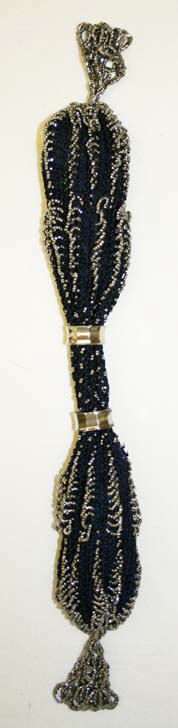
The Miser’s Purse: A Study in Negative Volume and Post-Scarcity Silhouette
In the pantheon of fashion archaeology, few objects are as deceptively inert as the British miser’s purse. A slender, silk tube, cinched at both ends with metal rings, it was designed for a single, pragmatic purpose: to hold coins while preventing their casual escape. To the uninitiated, it is a relic of Victorian thrift—a quaint, if obsolete, accessory. To the avant-garde eye of Zoey Fashion Laboratory, however, the miser’s purse is a radical blueprint for SS26, a manifesto of negative space, tension, and the eroticism of concealment. Its construction—two distinct compartments separated by a central slit—offers a structural vocabulary that challenges the very notion of the garment as a continuous, enclosing surface.
Our analysis rejects the sentimental reading of this object as mere nostalgia. Instead, we deconstruct its architecture to reveal a system of discontinuous containment. The purse does not wrap; it bifurcates. It does not hold; it suspends between two terminal points. This is the core thesis for our forthcoming collection: Post-Scarcity Tension, where the body is not dressed but traversed by lines of force, and fabric operates as a series of independent, load-bearing membranes rather than a unified shell.
Deconstructing the Silhouette: From Cylinder to Cantilever
The traditional miser’s purse is a cylinder, but its functional logic is not cylindrical. The central slit is the fulcrum—a void that separates two pressurized chambers. For SS26, we translate this into a radical reconfiguration of the female torso. Imagine a silk gazar bodice that is not seamed at the waist but instead split horizontally at the sternum, with each half anchored by a rigid, boned ring at the clavicle and the iliac crest. The space between—a literal void of exposed skin—becomes the garment’s most potent element. This is not a cutout; it is a structural negative, a deliberate absence that generates the silhouette’s tension.
The rings of the purse are our primary hardware vocabulary. We supersize them into elliptical, carbon-fiber frames that orbit the body without ever fully encircling it. A jacket, for instance, is reduced to two independent sleeves, each terminating in a large, hollow ring at the shoulder and wrist, connected by a single, taut silk strap that crosses the back diagonally. The garment does not cover; it catalogs the body’s potential energy. The wearer becomes a living diagram of force vectors, with the silk acting as a tensile membrane stretched between rigid points. This is the futurist silhouette: not a shape, but a system of intervals.
Material Alchemy: Silk as a Non-Newtonian Fluid
Our material focus is not the precious, lustrous silk of the Victorian original, but a technical silk—a hybrid of 40-denier silk organza laminated with a micro-thin layer of thermoplastic polyurethane. This composite behaves as a non-Newtonian fluid: fluid in repose, rigid under sudden stress. When a wearer moves, the fabric momentarily stiffens, creating a fleeting architectural fold that collapses back into a liquid drape. This dynamic state change is the ultimate expression of the miser’s purse paradox—a container that is both soft and unyielding, passive and reactive.
We further manipulate the silk through a process of laser-perforated micro-cinching. The fabric is not gathered by thread but by a grid of microscopic burns that cause the silk to contract along predetermined lines. The result is a fabric that self-folds into a series of permanent, parallel ridges, reminiscent of the purse’s central slit but scaled to a molecular level. This is not pleating; it is programmatic deformation. The garment’s surface becomes a topographical map of its own construction, a visible record of the tension that holds it together.
Structural Innovation: The Wearable Purse as Exoskeleton
The most provocative innovation for SS26 is the inverted miser’s purse—a garment that is worn inside the body’s silhouette rather than over it. Consider a floor-length column dress made of double-faced silk. The internal layer is a series of independent, sealed pouches, each filled with a small amount of ferrofluid. The external layer is left unsewn, hanging as a sheer, translucent veil. When a magnetic field is applied—via a discreet, wearable device at the hip—the ferrofluid migrates, causing the internal pouches to swell and push against the outer silk, creating a sudden, temporary protrusion at the hip or shoulder. The silhouette is not static; it is mutable in real-time, a living sculpture that responds to the wearer’s proximity to metal or the activation of a magnetic clasp.
This is the ultimate redefinition of the purse’s function. The original was a container for coins; ours is a container for kinetic potential. The garment does not hold objects; it holds the possibility of its own transformation. The central slit of the original is reinterpreted as a full-length, zippered seam that runs from the nape of the neck to the hem. When unzipped, the dress bifurcates into two independent panels, each ending in a heavy, silk-wrapped weight. The wearer can then swing these panels as extensions of their arms, creating a cape-like silhouette that is simultaneously a weapon, a shield, and a statement of radical autonomy.
Philosophical Implications: Thrift as Futurism
Why does this Victorian relic resonate so profoundly with a futuristic vision? Because the miser’s purse embodies a post-scarcity ethic—not the hoarding of resources, but the intelligent distribution of energy. Its dual compartments are a metaphor for the bifurcated self: public and private, digital and physical, static and kinetic. In SS26, we do not design garments; we design interfaces between these states.
The silk is no longer a symbol of luxury but of sustainable intelligence. Its tensile strength, its ability to be programmed and deformed, its capacity to hold shape without internal structure—these are the properties of a material that respects both the body and the environment. The miser’s purse, with its emphasis on containment and prevention of loss, becomes a blueprint for zero-waste construction. Every seam, every ring, every void is intentional. There is no excess; there is only necessary tension.
As we finalize the SS26 collection, we invite the fashion world to discard its obsession with volume and coverage. The future is not in adding more fabric; it is in subtracting to reveal the architecture of the body’s own energy. The miser’s purse, in its humble British silk, has shown us that the most radical statement is not a new shape, but a new relationship between the body and the void. Our garments are not worn; they are activated. They are not designed; they are engineered. And in that engineering, we find the true, avant-garde liberation of the silhouette—a liberation that begins with a slit, a ring, and the audacity to leave the rest empty.