Technical Deconstruction: The Goryeo Celadon Bottle as a Material Archive
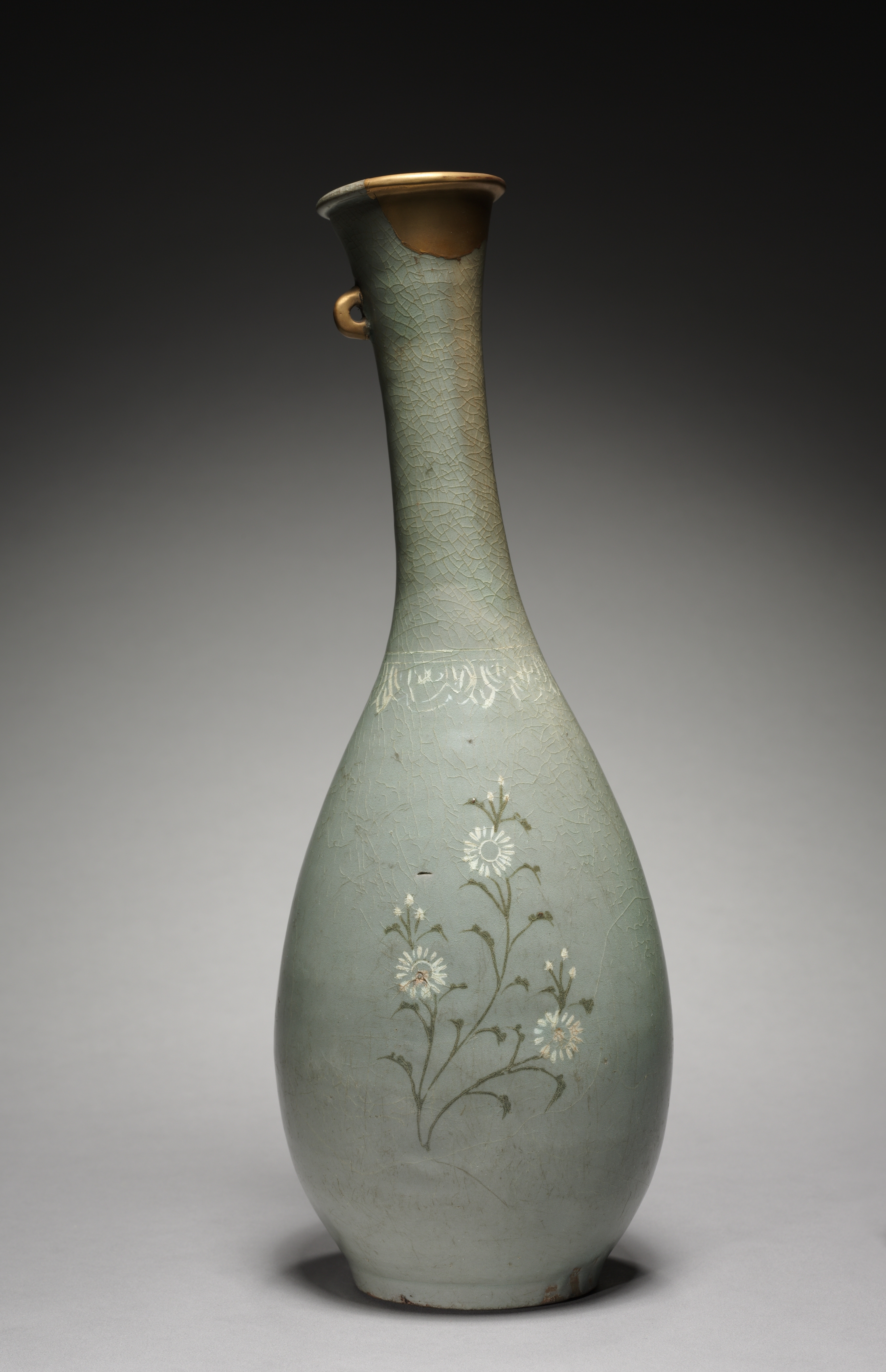
The subject, a Goryeo celadon bottle with inlaid chrysanthemum design, is not merely a vessel but a complex material palimpsest. Its primary substrate is the famed Goryeo celadon body—a silica-rich clay fired to a precise, resonant state. The celadon glaze itself is an act of chemical haute couture; iron oxide in an oxygen-reduced kiln atmosphere yields not a flat green, but that revered, nuanced gray-green jade tone, a luminous, mineral skin that seems to hold light within its matrix. This forms our foundational "fabric": a surface of profound depth and cool serenity.
The decorative technique, *sanggam* (inlay), is where the narrative of deconstruction truly begins. Artisans engraved the chrysanthemum motifs into the leather-hard bisque, then forcibly implanted these negative spaces with contrasting materials: white slip (kaolin) and black slip (iron-oxide-rich clay). This is not surface application but subdermal embellishment. The subsequent scraping and glazing processes submerged these inlays, making them integral to the body’s structure. The design thus exists within the wall of the vessel, a hidden layer revealed only through the translucent glaze. It is a perfect metaphor for embedded memory and concealed narrative, mirroring the referenced artifact’s duality: one side a mirror’s overt, gilded spectacle, the other a stone coffin’s carved, somber story.
Form & Function: The Architecture of Contained Space
The bottle’s form—a full-bodied, gently swelling volume tapering to a modest neck—prioritizes containment and poised release. It is an architecture of potential, designed to hold liquid, scent, or perhaps simply the idea of preciousness. In avant-garde fashion, this translates to silhouette as vessel. Consider voluminous, sculptural draping that contains the body’s form, punctuated by precise, tailored apertures (necklines, armholes) that control revelation. The bottle’s elegant stability suggests garments built on foundational, rounded shapes—a cocoon coat, a balloon sleeve—where the body moves within a defined, ceramic-like space.
Avant-Garde Translation: The Chrysanthemum Codex
The chrysanthemum, a symbol of longevity and nobility in East Asian art, is here rendered through a rigorous, almost modular inlay process. Its repetitive, radial symmetry is not freely drawn but systematically excavated and in-filled. This presents a potent directive: pattern as archaeological imprint. An avant-garde collection inspired by this would reject printed florals. Instead, the chrysanthemum motif would be achieved through negative-space techniques: laser-cut filigree bonded over contrasting underlays, intarsia knits where the pattern is structurally woven from different colored yarns, or quilted seams that create raised, linear pathways defining the floral form.
The color palette is directly dictated by the artifact: the dominant, cool celadon field (a spectrum from mist gray to seafoam green), punctuated by the stark graphic contrast of inlaid white and iron-black. This is not a palette of warmth but of luminous austerity. Fabrics would be selected for their similar depth and luster—heavy silk duchess satin, technical neoprene with a pearlescent coating, double-faced wool with a subtle sheen. The black and white would appear not as prints, but as structural interruptions: stark white seam binding revealed on open seams, black ceramic zipper tracks, or panels of matte jersey inset into glossy grounds.
Textural Narrative & "Archive Resonance"
The referenced "Archive Resonance" speaks to duality: the mirror’s reflective, decorative spectacle versus the coffin’s tactile, narrative gravity. Our bottle holds this same tension. The celadon surface is specular and illusionistic (like the mirror), a smooth plane that reflects and distorts. The inlaid design is tactile and archival (like the coffin carving), a story physically cut into the structure.
This mandates a collection rich in textural dichotomy. Imagine garments that present a flawless, glassy facade from one angle—achieved via liquid latex coatings or polished thermoplastic panels. When the wearer moves, the garment reveals its subdermal narrative: reverse sides showing the raw architecture of seams and inlays, fabric manipulated to look like engraved lines, or pockets of texture that mimic the feel of filled clay. Fastenings could be asymmetric, referencing the "split-leaf" motif: one side of a jacket closed with gilded, ornate clasps (the mirror), the other with stark, utilitarian straps or rock-like ceramic toggles (the coffin).
Collection Manifesto: *Sanggam*
For Zoey Fashion Lab, this analysis proposes a collection titled *Sanggam*, named for the inlay technique. It is a philosophy of embedded construction.
Key Silhouettes: Architecturally rounded volumes and structured, vessel-like forms that taper into precise, controlled openings. Asymmetric hemlines that suggest broken yet repaired pottery.
Material Innovation: Development of a "celadon glaze" textile finish—a heat-transfer process creating a variable, depth-rich patina on technical fabrics. Experimentation with bi-resin inlays for accessories, where colored resins are set into channels carved into handbags or footwear, then polished flush.
Narrative Duality: Each look embodies the artifact’s dual nature. A dress may have a sleek, reflective celadon-colored front, while the back is a corseted structure of stark white and black straps, mapping a chrysanthemum pattern across the body like an anatomical drawing. Outerwear features panels that can be reversed or removed, transforming from a monolithic, glossy coat to a segmented, textured garment revealing its inlaid history.
In conclusion, the Goryeo bottle is a masterclass in restrained complexity. It teaches that the most profound beauty lies not on the surface, but in the layered, embedded stories beneath a serene facade. For Zoey, it provides a blueprint to move beyond appliqué and into the realm of structural storytelling, where every decorative element is an integral, load-bearing part of the design’s architecture, creating a modern, avant-garde language of depth, resonance, and enduring elegance.