Deconstructing the Botanical Grid: A Study in Rhythmic Disruption
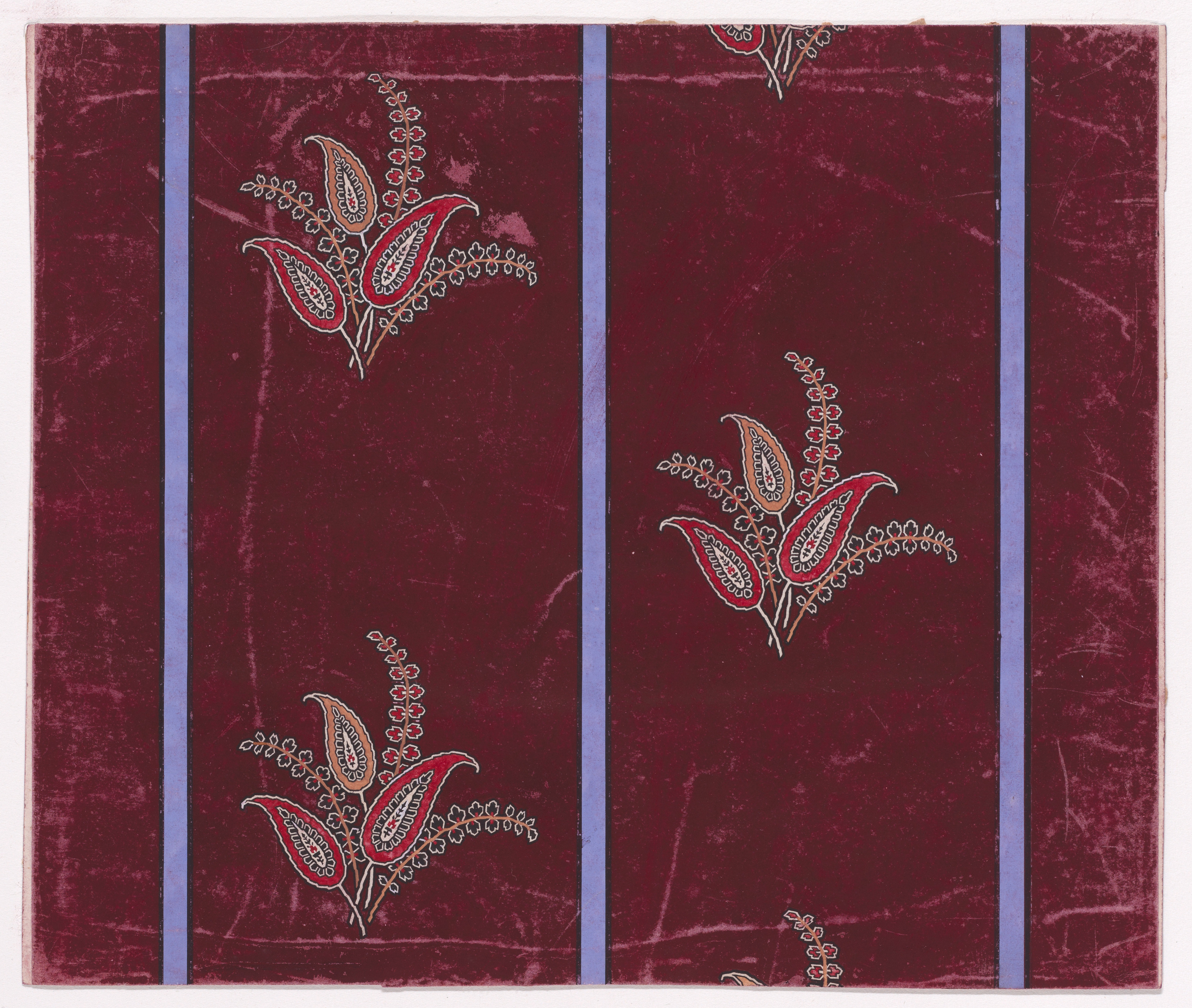
The textile presented for this avant-garde analysis—a gouache study originating from the Global Frontier—is not merely a surface pattern. It is a manifesto. At first glance, the composition adheres to a classical rhythm: alternating vertical rows of densely packed, large Paisley-inspired leaves and branches, juxtaposed against slender columns of paired stylized leaves, all separated by stark vertical stripes. Yet, within this seemingly ordered framework lies a profound subversion. For Zoey Fashion Laboratory’s SS26 directive, this design is not a print to be draped; it is a blueprint for architectural volume, a catalyst for kinetic garment construction, and a meditation on the tension between organic growth and industrial precision. The true innovation lies not in the motif’s heritage, but in its radical translation into three-dimensional, futuristic form.
From Flat Chromatic Field to Structural Topography
The gouache medium itself dictates a specific textural language—one of opacity, layering, and deliberate, unblended strokes. This inherent flatness is a deceptive starting point. Our laboratory’s methodology rejects passive application. Instead, we propose a process of topographic extrusion, where each painted cluster of Paisley leaves is reimagined as a topographical peak on a garment’s surface. The vertical stripes, rendered in the original as hard-edged separators, become negative-space channels, or structural crenellations, that physically divide the body’s landscape. This is not print-on-fabric; it is fabric-as-terrain.
The alternating density—the heavy, bunched foliage versus the airy, paired leaves—offers a binary code for construction. The dense rows translate into zones of maximal volume, perhaps through meticulously engineered crinoline understructures or upcycled PET filament weaves that mimic the gouache’s opacity. Conversely, the pairs of stylized leaves, separated by their own internal logic, become zones of transparency and breathability, realized through laser-cut perforations or bio-fabricated cellulose films. The garment becomes a living map of contrasting material densities, a direct transcription of the artist’s brushwork into wearable architecture.
Silhouette Engineering: The Asymmetrical Column
The strict verticality of the design’s composition initially suggests a neo-classical column. However, the avant-garde imperative demands distortion. We propose a silhouette that honors the vertical axis while violently disrupting its symmetry. Imagine a floor-length, sheath-like tunic where the left side is constructed from the “bunched leaves” motif, creating a solid, almost armored expanse. This side is engineered with internal cantilevered supports—thin, memory-metal ribs—that push the fabric outwards, creating a pronounced, sculptural bulge at the hip and shoulder, echoing the visual weight of the painted clusters. The right side, featuring the “paired leaves” and vertical stripes, is deconstructed into a series of independent, floating panels that hang from a minimal, high-necked yoke. These panels, separated by deliberate gaps, reveal glimpses of the body or an underlayer of iridescent, liquid-metal jersey, creating a dynamic interplay between concealment and revelation. The hemline is not straight; it is a scalloped, asymmetric cascade, with the lowest point falling on the dense side, anchoring the garment to the earth, while the lighter side lifts, suggesting an upward, botanical growth.
Material Alchemy: Translating Gouache to Garmology
The materiality of gouache—its creamy, matte finish and its capacity for layering—is the key to our textile innovation. We reject the literal reproduction of the design via digital printing. Instead, we employ a technique of multi-layered flocking and resin bonding. The “bunched” areas are built up using a high-pile, recycled mohair flock, applied in thick, painterly strokes that mimic the impasto of the gouache. This creates a tactile, plush surface that invites touch, yet its density makes it almost armor-like. In contrast, the “paired leaves” are rendered through a process of chemical embossing on a sheer, technical silk organza. The leaves are not printed but are raised, giving them a sculptural, cameo-like quality. The vertical stripes are the most critical element: they are constructed from rigid, sculpted polyurethane rods, coated in a matte, charcoal-black finish. These rods are not merely decorative; they act as the garment’s skeletal system, providing structure and ensuring that the silhouette holds its architectural form even in motion.
Kinetic Disruption: Movement as a Design Element
Static architecture is insufficient for SS26. Our garment must perform. The alternating rows of dense and light motifs are engineered to create a kinetic counterpoint. As the wearer moves, the dense, flocked panels sway with a heavy, pendulous motion, while the lighter, embossed organza panels flutter and catch the air. The rigid polyurethane rods, strategically hinged at the shoulder and waist, allow for a controlled articulation, transforming the garment from a static column into a living, breathing organism. The visual rhythm of the textile—the alternation of heavy and light—is thus translated into a physical rhythm of movement, a choreography of mass and air. This is not about clothing the body; it is about creating an extension of the body’s own kinetic energy, a wearable sculpture that is in a constant state of becoming.
Conclusion: A Synthesis of Frontier and Future
This gouache study, rooted in a global, nomadic aesthetic, is a perfect progenitor for the next wave of couture. The Paisley motif, historically a symbol of cross-cultural exchange and adaptation, is here stripped of its traditional context and reborn as a geometric abstraction of organic growth. The vertical stripes, once mere separators, become load-bearing elements of a new structural language. For Zoey Fashion Laboratory, this design is not a nostalgic homage but a starting point for radical experimentation. By deconstructing the flat image and rebuilding it as a topographical, kinetic, and deeply material garment, we honor the design’s inherent rhythm while propelling it into a future where fashion is not just worn, but inhabited and performed. The result is a definitive statement for SS26: a fusion of the hand-painted past with the engineered, avant-garde future, where every leaf, branch, and stripe is a deliberate act of architectural defiance. The garment is not a canvas; it is a constructed reality.