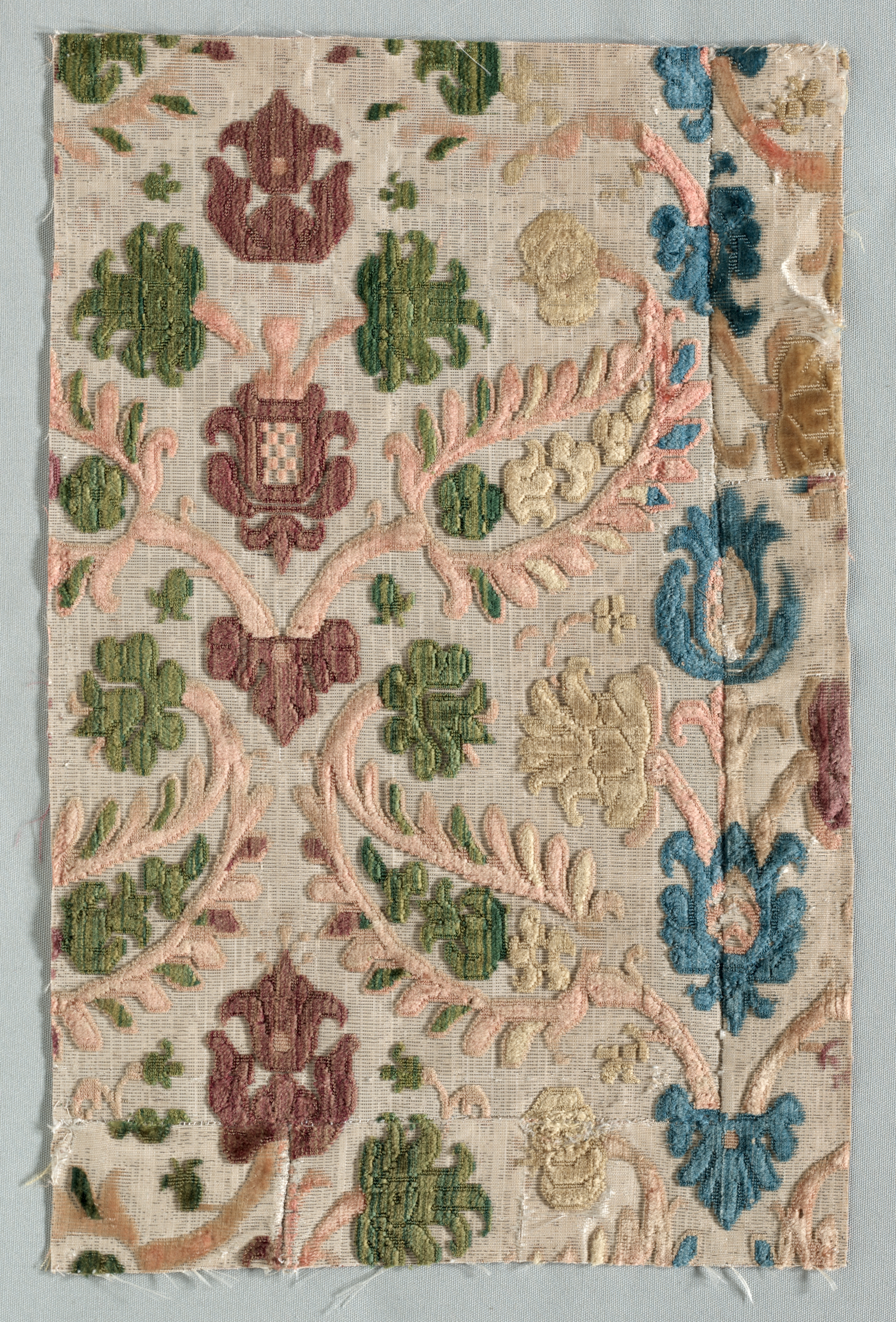
Deconstructing the Past: The Velvet Fragment as a New DNA Strand for Avant-Garde Expression
At Zoey Fashion Lab, our mandate transcends mere garment construction. We engage in a form of material archaeology, unearthing historical textiles not as relics to be preserved, but as living organisms to be reanimated. The subject of this analysis—a 17th-century Italian velvet fragment—presents a particularly potent case study. Often dismissed as a decorative remnant of Baroque opulence, this piece, when viewed through the lens of our "New DNA Strand" methodology, reveals itself as a blueprint for radical, avant-garde design. It is not a fragment of the past; it is a progenitor of the future, a genetic code waiting to be spliced with contemporary innovation.
I. The Material Genome: Decoding the 17th-Century Velvet
To understand the fragment's avant-garde potential, we must first decode its physical and cultural DNA. This is not a simple analysis of fiber content; it is an examination of the technological, economic, and aesthetic pressures that forged its very structure.
Technical Provenance and Construction
Originating from Italy in the 17th century, this velvet is a product of the country's unparalleled silk-weaving industry, specifically the renowned workshops of Genoa, Florence, or Venice. The technical construction is characteristic of the period: a warp pile velvet, where additional warp threads are lifted over small rods or wires to create a looped pile, which is then cut to produce the dense, plush surface we associate with the fabric. The ground weave is typically a silk taffeta or twill, providing structural integrity, while the pile is often a higher-twist silk, creating a lustrous, light-refracting surface. The fragment's color—likely a deep, ecclesiastical crimson, a rich aubergine, or a somber ecclesiastical black—would have been achieved through complex dyeing processes using kermes or cochineal, signifying immense wealth and status.
This technical foundation is our first "genetic marker." The very act of cutting the pile—a deliberate destruction to create depth—is a metaphor we will revisit. The fragment is not a flat surface; it is a topographical landscape of light and shadow, a three-dimensional architecture in miniature. This inherent dimensionality is the first point of departure for avant-garde application, challenging the modern preference for flat, minimalist textiles.
Cultural and Symbolic Load
The 17th century was the zenith of the Baroque, a period defined by drama, movement, and theatrical excess. This velvet fragment was not merely a textile; it was a statement of power, often used in ecclesiastical vestments, aristocratic court dress, and sumptuous interior furnishings. Its weight, its tactile richness, and its visual density were designed to command reverence and assert authority. The patterns woven into the silk—often large-scale pomegranates, thistles, or stylized acanthus leaves—were not arbitrary. They were symbols of eternity, resurrection, and royal lineage, loaded with political and religious meaning.
For the avant-garde designer, this symbolic weight is not a constraint but a rich, subversive material. We can appropriate this language of power and re-contextualize it. The fragment's historical voice—one of absolute authority—can be used to question contemporary notions of status, identity, and ornamentation. It is a dialogue with the past that allows us to critique the present.
II. The New DNA Strand: A Methodology of Mutation
The "New DNA Strand" is our laboratory's core philosophy. It posits that historical textiles are not static objects but dynamic sources of genetic information. Our process involves isolating specific "genes"—be it a structural technique, a color palette, a symbolic motif, or a textural quality—and then recombining them with alien, contemporary elements. The result is not a pastiche or a reproduction, but a mutation: a new organism that carries the memory of its ancestor while possessing a radically different form and function.
Gene Splicing: Structural and Tactile Transmutation
The most immediate genetic material from our velvet fragment is its tactile density. In an era of athleisure and breathable microfibers, the heavy, plush, and insulating nature of 17th-century velvet is a defiant anachronism. Our first mutation involves extracting this tactile gene and splicing it with a modern, technical substrate. Imagine a garment where the velvet pile is not woven from silk but grown as a bio-fabricated cellulose on a 3D-printed, flexible lattice. The visual opulence of the Baroque remains, but the structure is now lightweight, breathable, and responsive to body heat—a high-performance material that retains the soul of the original. This is not a rejection of the past; it is an evolution.
Furthermore, we can isolate the cut-pile technique as a genetic marker for controlled deconstruction. The original weavers cut loops to create pattern and depth. Our avant-garde mutation will take this to an extreme: we will use laser-cutting and ultrasonic technology to selectively ablate the pile in a controlled, algorithmic pattern. The result would be a garment that appears to be decaying or dissolving in a precise, digital pattern, revealing the structural "bones" of the garment beneath. This is a commentary on the fragility of history and the transience of material culture, transforming the velvet from a symbol of permanence into an emblem of entropy.
Recombinant Symbolism: From Authority to Ambiguity
The original fragment’s symbolic DNA—its association with power and religious authority—is perhaps its most potent, yet dangerous, gene. To use it directly would be to create costume drama. Instead, we must perform a recombinant mutation. We will extract the scale and rhythm of the Baroque pattern, but strip it of its original iconography. The pomegranate and acanthus motifs will be abstracted into oversized, pixelated or glitch-art distortions, printed onto the velvet using a high-definition, reactive dye that changes color with body heat or UV light.
The wearer of this garment would not project static authority; they would embody a shifting, unstable identity. The garment becomes a living screen, displaying a mercurial state that challenges the viewer’s perception. The historical "power suit" is thus mutated into a "power organism" that questions the very nature of control and presence. The velvet is no longer a backdrop for power; it is a protagonist in a performance of ambiguity.
III. Avant-Garde Application: The Collection's Conceptual Framework
This analysis culminates in a proposed collection: "Regime of Decay." The collection will not feature a single piece of 17th-century velvet. Instead, it will be a series of garments that are the *descendants* of that fragment, each one a distinct mutation.
Silhouette and Form: Weightless Monumentality
The traditional velvet silhouette is heavy, structured, and voluminous, echoing the architecture of the Baroque. Our avant-garde approach will invert this. We will use the velvet's visual weight to create an illusion of weightless monumentality. By constructing garments with internal, carbon-fiber support structures and cutting the velvet in bias-cut, aerodynamic panels, we will create forms that are vast and imposing, yet appear to float and billow as if caught in a zero-gravity environment. A floor-length, opera-coat silhouette will be re-engineered to have a liquid, mercury-like drape, moving not with the wearer’s steps but with an independent, ethereal fluidity.
Color and Light: The New Chromatic Aberration
We will abandon the historical, deep, monochromatic palette. Instead, we will treat the velvet pile as a canvas for chromatic aberration. Through a process of selective over-dyeing and discharge printing, we will create gradients that shift from a deep, archival burgundy at the hem to a shocking, neon chartreuse at the collar. The fabric will be treated with a metallic, iridescent finish that only becomes visible under direct light, creating a hidden, futuristic shimmer within the matte, historical texture. This is not about rejecting the past’s color, but about revealing the colors that were latent within its dye chemistry, pushing them to a futuristic extreme.
Conclusion: The Fragment as a Living Progenitor
The 17th-century Italian velvet fragment is far more than a historical artifact. For Zoey Fashion Lab, it is a progenitor organism, a source of complex genetic data that, when properly decoded and recombined, gives rise to entirely new species of fashion. By isolating its structural genes—the cut pile, the dense tactility—and its symbolic genes—the language of power—and then splicing them with contemporary technology and subversive aesthetics, we create garments that are not nostalgic but prophetic. They are new DNA strands that carry the memory of their origin while possessing the potential for a radically different future. The fragment is not the end of a story; it is the beginning of a new one, written in the language of avant-garde design.