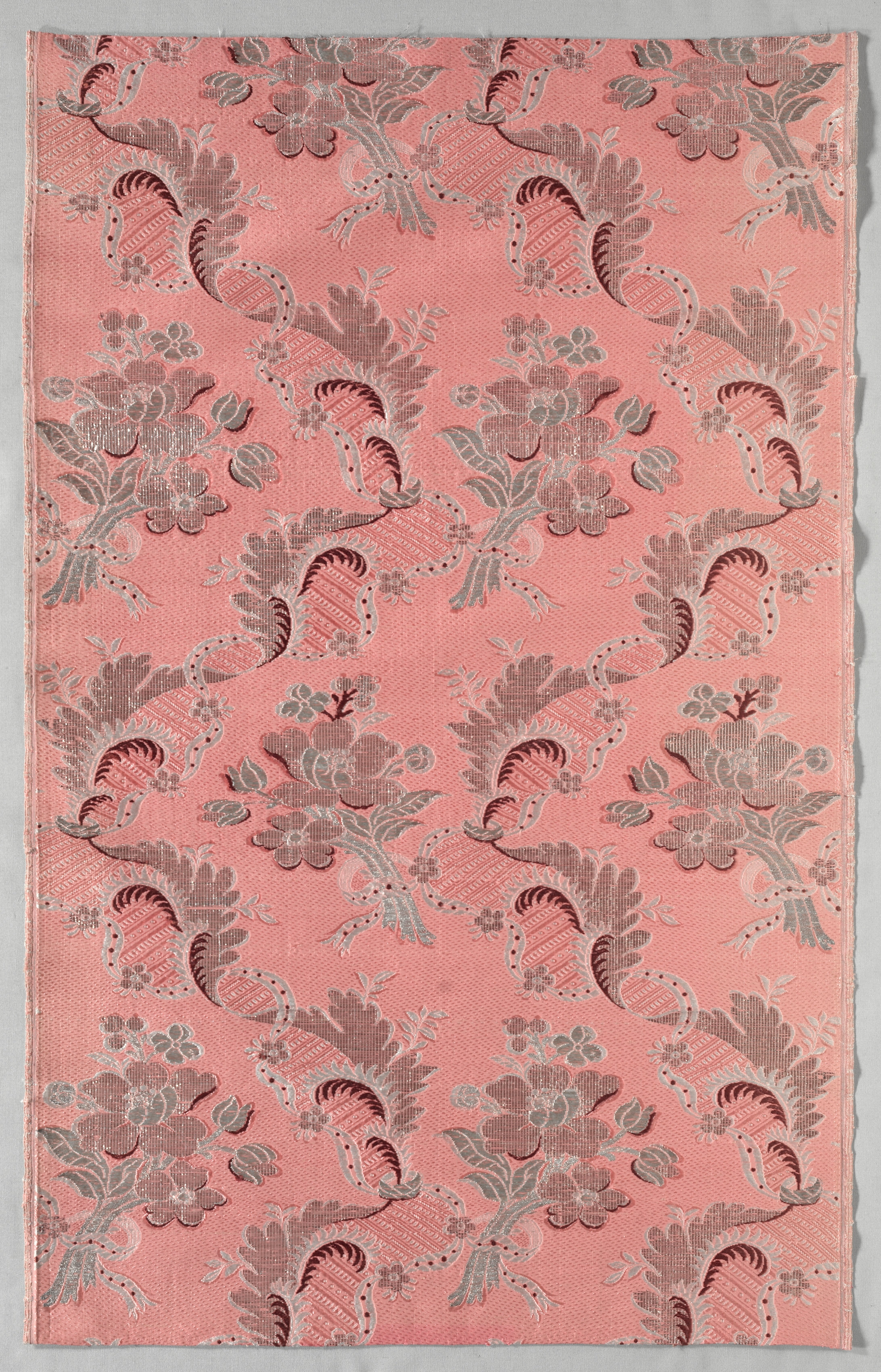
Deconstructing the Metric: A Length of Textile from the Louis XV Era
At Zoey Fashion Lab, our mandate transcends the mere cataloguing of historical artifacts. We engage in a process of fabric deconstruction, not only of fibers and weaves, but of the socio-cultural and temporal codes embedded within them. Today’s subject—a length of brocaded silk and metal from 18th-century France, specifically the reign of Louis XV—presents a paradoxical challenge. On the surface, it is the epitome of Rococo opulence, a relic of aristocratic excess. Yet, beneath its shimmering surface lies a complex grammar of power, labor, and nascent industrial change. Our analysis will dissect this artifact not as a finished garment, but as a proto-industrial document, a 'textile' in the truest sense—a woven text that speaks in the language of the loom.
The Physical Provenance: A Technical Autopsy
Our first procedure is a technical autopsy. The textile is a brocade, a weave distinguished by its discontinuous supplementary weft threads. Unlike simpler damasks or lampas, the brocade technique allows for the introduction of pattern elements that are not structurally integral to the ground fabric. This is a critical point: the pattern is an addition, a luxurious afterthought that floats on the surface. The ground, typically a fine silk taffeta or satin, provides a smooth, lustrous canvas. The supplementary weft, here composed of gilded metal thread—often silver gilt over a silk core—is introduced only where needed, creating a relief-like, tactile pattern.
This technical choice is not merely decorative. It is a deliberate statement of material excess. The metal thread is not woven throughout, but strategically placed to catch light, creating a chiaroscuro effect that shifts with the viewer's movement. The ground silk, likely a vibrant color—now faded to a subtle patina—would have provided a stark contrast to the metallic sheen. The pattern itself, typical of the Louis XV period, would feature asymmetrical rocaille motifs, sinuous acanthus leaves, and fragmented floral elements. These are not the static, symmetrical patterns of the Baroque; they are dynamic, organic, and almost chaotic in their elegance, reflecting the roving, restless spirit of the Rococo.
From a deconstructionist standpoint, the technical structure reveals a paradox. The brocade is a highly labor-intensive process, requiring a drawboy and a sophisticated system of harness cords to control the individual warp threads. This is a pre-industrial technique, reliant on human memory and manual dexterity. Yet, the precision and repeatability of the pattern hint at the proto-industrialization that was brewing in Lyon, the center of French silk weaving. The pattern is not a one-off artistic creation; it is a repeatable unit, designed for a specific width and length, suggesting a move toward standardized production, even within the luxury sector.
Cultural Resonance: The Archive as a Mirror
The provided reference, Archive Resonance, speaks of the 16th and 17th centuries as a period of cultural collision and aesthetic fusion. This is a crucial lens through which to view our 18th-century subject. The Louis XV period is often seen as the apex of French cultural dominance, yet this dominance was built on a foundation of appropriation and synthesis. The Rococo style, with its emphasis on the exotic and the natural, drew heavily from Chinese and Japanese aesthetics—the chinoiserie and japonisme that were flooding European markets. The sinuous curves and asymmetrical balance are not purely European inventions; they are a European re-interpretation of Asian design principles.
This length of textile is, therefore, not a pure 'French' object. It is a cultural hybrid, a material manifestation of global trade routes and colonial exchange. The silk itself may have originated from China or the Levant, the silver from the New World mines of Potosí, and the design vocabulary from a complex dialogue between Parisian designers and imported Asian textiles. The archive resonance is not a distant echo; it is a living current that flows through the very threads of this artifact. The 'collision' is not a past event; it is a permanent condition of the object's existence.
Furthermore, the textile's function within the court of Louis XV is deeply political. It was used for court dress, upholstery, and wall hangings—all designed to project an image of absolute, divinely ordained power. The shimmering metal threads were not just beautiful; they were a form of frozen wealth, a literal display of the kingdom's ability to extract and transform precious resources. The wearer or the inhabitant of a room adorned with this fabric was not just a person; they were a walking, breathing billboard for the state's economic and artistic supremacy. The textile is a tool of soft power, a weapon of aesthetic intimidation.
Avant-Garde Recontextualization: The Deconstructionist's Act
As a Chief Fabric Deconstructionist, my final act is not to preserve this artifact in a museum case, but to interrogate its relevance for contemporary avant-garde fashion. The traditional approach would be to treat this as a historical reference, a source of motifs to be copied or adapted. Our approach is different. We must violate the textile's original intent to release its latent potential.
Consider the following avant-garde interventions:
- Subversion of Materiality: We might take this brocade and deconstruct its weave, pulling the metal threads from the silk ground. The resulting chaos—a tangle of precious metal and fragile silk—would be a powerful commentary on the fragility of power and the transience of beauty. We could then re-embed these raw elements into a modern, utilitarian fabric like technical neoprene or recycled polyester, creating a collision of temporalities.
- Scale and Proportion: The original pattern is designed for a human body of the 18th century. We could blow up the motif to a monumental scale, abstracting it into a purely graphic, almost brutalist pattern. The delicate rocaille curves would become aggressive, overwhelming forms, challenging the viewer's perception of the 'delicate' Rococo.
- Functional Inversion: The original textile is decorative, non-functional beyond its aesthetic role. We could re-engineer it for a new purpose, perhaps as a structural element in a garment—a corset made of laser-cut brocade, or a coat where the metal threads are used as conductive elements for integrated technology. This would transform a symbol of passive luxury into an active, functional component.
This is the essence of the avant-garde act: not to destroy, but to deconstruct and reconstruct. By severing the textile from its historical context, we allow it to speak a new language. The length of fabric becomes a raw material for future narratives, not a relic of a past one. It is no longer a document of the Louis XV era, but a generator of new meaning in the 21st century. The archive is not a tomb; it is a womb of potential. Our task is to perform the Caesarean section.
Conclusion: The Fabric of Time
This length of brocaded silk and metal is far more than a piece of cloth. It is a compressed data set, containing information about 18th-century trade, technology, aesthetics, and politics. Through our deconstructionist analysis, we have unpacked its technical structure, its cultural resonance, and its potential for avant-garde recontextualization. We have seen that it is a hybrid object, a political tool, and a technical marvel. The final, most radical act is to recognize that the textile's true value lies not in its preservation, but in its transformation. By treating it as a dynamic system rather than a static artifact, we honor its legacy not through imitation, but through continuous, disruptive innovation. The fabric of time is not a straight line; it is a weave, and we are the weavers of its next iteration.