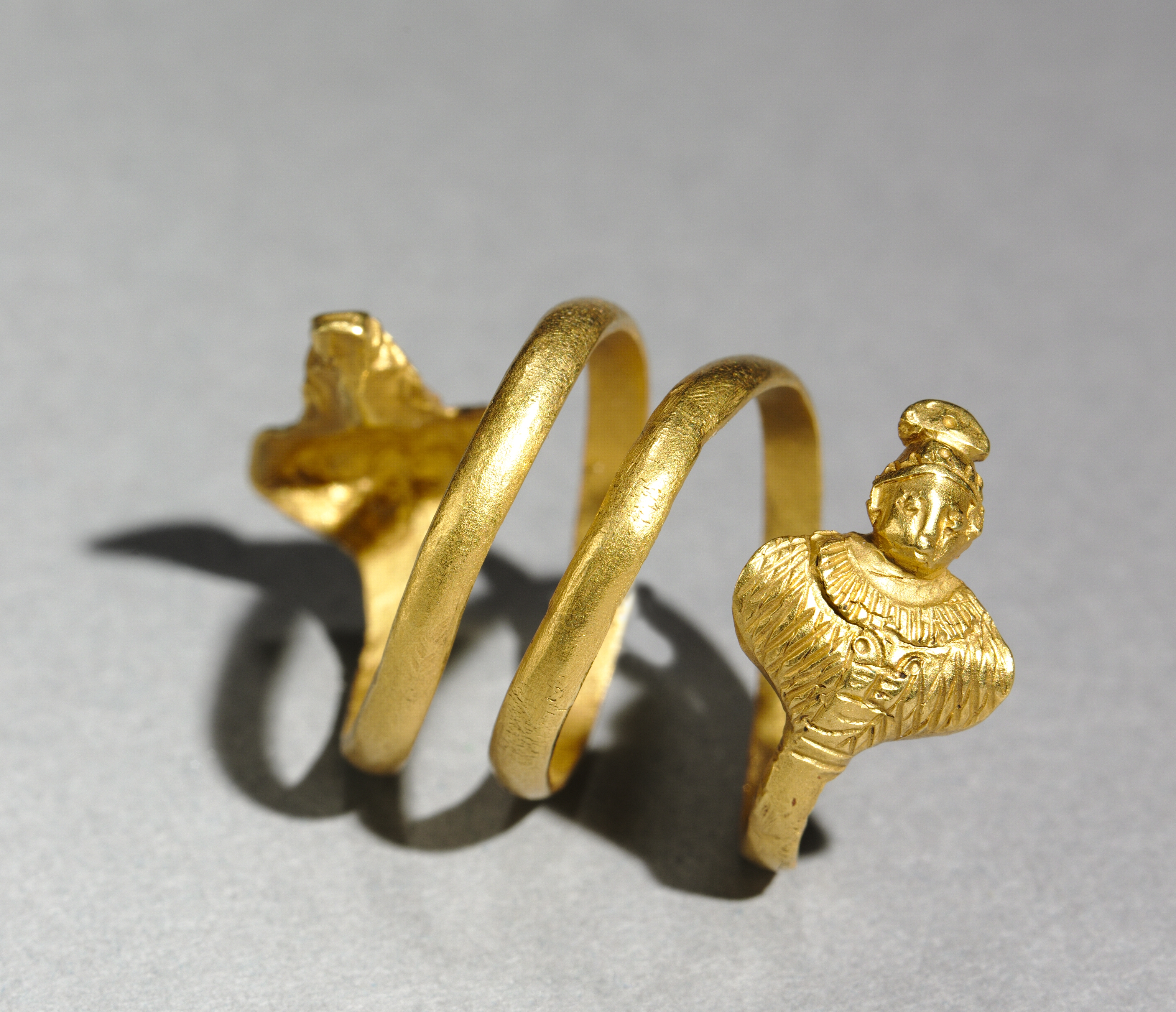
Deconstructing the Spiral Ring: An Avant-Garde Reading of Isis and Serapis
At Zoey Fashion Lab, we do not merely examine artifacts; we interrogate them. We strip away the patina of historical reverence to expose the raw, structural DNA that binds ancient craftsmanship to contemporary avant-garde expression. The subject of this analysis—a gold spiral ring bearing the syncretic deities Isis and Serapis, attributed to Greece or Italy (Rome)—presents a paradox of form and meaning. Technically executed in hammered and coiled gold, this piece is not a simple ornament. It is a topological puzzle, a wearable manifesto that prefigures the deconstructionist ethos by two millennia. Our reference point, the Mirror with Split-Leaf, offers a crucial dialectic: one surface reflects, the other narrates. This ring, in its coiled, serpentine energy, collapses that dialectic into a single, continuous gesture.
Material Theology: Gold as a Conductive Narrative
The choice of gold is not incidental; it is a deliberate act of semantic loading. In the context of the Roman Imperial period, gold was the metal of the aeternitas—the eternal, unchanging divine order. Yet, the technical execution here subverts that very eternity. The ring is not a static cast form but a dynamic, coiled construction. This is our first point of avant-garde resonance: the use of a precious, "eternal" material to create a form that is inherently kinetic, restless, and unfinished. The spiral is a symbol of becoming, not being. It is the visual equivalent of a continuous line drawing in three-dimensional space, a precursor to the modernist fascination with the gesture as the primary carrier of meaning.
From a fabric deconstructionist's perspective, we can read the gold as a "fiber" of immense tensile strength. The coiling technique—likely involving a wire drawn and then wrapped around a mandrel—creates a structure that is simultaneously rigid and flexible. This is the structural paradox of the avant-garde: the creation of a form that appears to be in a state of perpetual tension, holding its shape only through the force of its own internal logic. The spiral is not a closed circle; it is an open system, inviting the eye to follow its trajectory indefinitely. This mirrors the avant-garde rejection of the framed, the bordered, and the finite.
The Syncretic Code: Isis and Serapis as Deconstructed Archetypes
Our analysis must move beyond the material to the iconographic program. The presence of Isis and Serapis is not a simple nod to religious piety. It is a masterclass in syncretic deconstruction. Serapis was a deliberately invented deity—a composite of Osiris and Apis, fused with Hellenistic Zeus and Hades. He was a constructed god, designed for political and cultural unification. Isis, in her Roman form, was similarly expanded, absorbing attributes from Demeter, Aphrodite, and Fortuna. This is not the preservation of a pure, original myth; it is the active, conscious recombination of existing symbolic vocabularies to create a new, hybrid reality.
For the avant-garde, this is the ultimate precedent. The spiral ring does not present Isis and Serapis as static, hieratic figures. Instead, their images—likely engraved or chased onto the flattened surfaces of the coil—are subsumed into the spiral's continuous flow. The deities are not the centerpiece; they are passages within a larger, abstract composition. This is a radical act of iconographic leveling. The divine is no longer a focal point but a texture, a rhythm within the metal. This aligns with the reference to the Mirror with Split-Leaf: the polished silver side offers a fragmented, reflective surface, while the stone coffin lid presents a linear, narrative relief. The spiral ring fuses these two modes—the reflective and the narrative—into a single, unbroken coil. The images of the gods become fleeting reflections caught in the metal's momentum, not fixed stories.
Chronopolitics: Wearing Time as a Spiral
The attribution of this ring to "Greece or Italy (Rome)" is not a geographic uncertainty but a temporal collapse. The spiral form itself is a chronometric device. It suggests a cyclical, non-linear conception of time, which is fundamentally at odds with the linear, progressive historiography of the modern era. In wearing this ring, the ancient subject was not merely adorning themselves; they were encoding a specific philosophical stance onto their body. The spiral is the symbol of eternal return, of the cyclical nature of life, death, and rebirth—a concept central to the mystery cults of Isis and Serapis.
In our contemporary avant-garde context, this is profoundly resonant. The fashion of the 21st century is obsessed with the archive—with the retrieval and recontextualization of historical fragments. But this ring teaches us that the archive is not a linear timeline. It is a spiral. We do not access the past in a straight line; we circle it, approaching it from different angles with each revolution. The spiral ring is a wearable argument against the tyranny of the new. It posits that true innovation is not the creation of something from nothing, but the re-coiling of existing energies into a new configuration. The Mirror with Split-Leaf reference—with its juxtaposition of a gleaming surface and a funerary narrative—perfectly encapsulates this. The spiral ring is the mirror that does not merely reflect the present but also contains the coiled narrative of the past, ready to spring forward.
Structural Analysis: The Spiral as a Seamless Garment
Let us now examine the ring's construction as if it were a garment seam. A traditional ring is a closed loop, akin to a finished hem. The spiral ring, however, is a seam that refuses to be closed. It is a continuous, open-ended seam that wraps around the finger, creating a sense of in-betweenness—neither fully on nor fully off the body. This is the essence of avant-garde fashion's obsession with the unfinished.
We can identify three distinct structural zones in this spiral:
- The Initiation Point: The inner end of the coil, which presses against the palm. This is the hidden, private zone—the secret origin of the gesture.
- The Narrative Surface: The flattened, outer face of the coil where the deities are depicted. This is the public, communicative zone, analogous to the relief on the sarcophagus lid.
- The Terminal Vortex: The outer, flaring end of the spiral. This is the point of pure potential, the unfinished edge that implies continuation beyond the object itself.
This tripartite structure transforms the ring from a simple object into a micro-architectural event on the hand. It is not a decoration; it is a structural intervention into the body's silhouette. The finger is no longer a passive support but an active participant in the object's meaning, its curvature defining the spiral's tension.
Conclusion: The Ring as a Proto-Avant-Garde Manifesto
In conclusion, the Spiral Ring with Isis and Serapis is not a relic of a distant past but a prophetic object. It contains within its golden coils the fundamental principles that would define the avant-garde movements of the 20th and 21st centuries: the deconstruction of narrative into abstract gesture, the use of precious materials to express kinetic instability, and the radical recombination of cultural symbols. Its syncretic theology is a blueprint for our contemporary practice of cultural sampling. Its spiral form is a direct ancestor of the modernist line, the surrealist curve, and the postmodern fragment.
At Zoey Fashion Lab, we do not seek to restore this ring to its original context. We seek to uncoil its latent energy, to extract its structural principles and re-apply them to contemporary textiles and garments. The ring teaches us that the most radical act is not to create a new form, but to re-spiral an ancient one, allowing its inherent tension to generate a new future. The Mirror with Split-Leaf asked us to look and to read simultaneously. This ring asks us to wear the spiral of time itself, to embody the paradox of a world that is eternally returning, yet perpetually new. It is not an ornament; it is an argument. And it is an argument we are still, two thousand years later, learning to articulate.