Deconstructing the Ornament: A Speculative Archaeology of the Arabesque
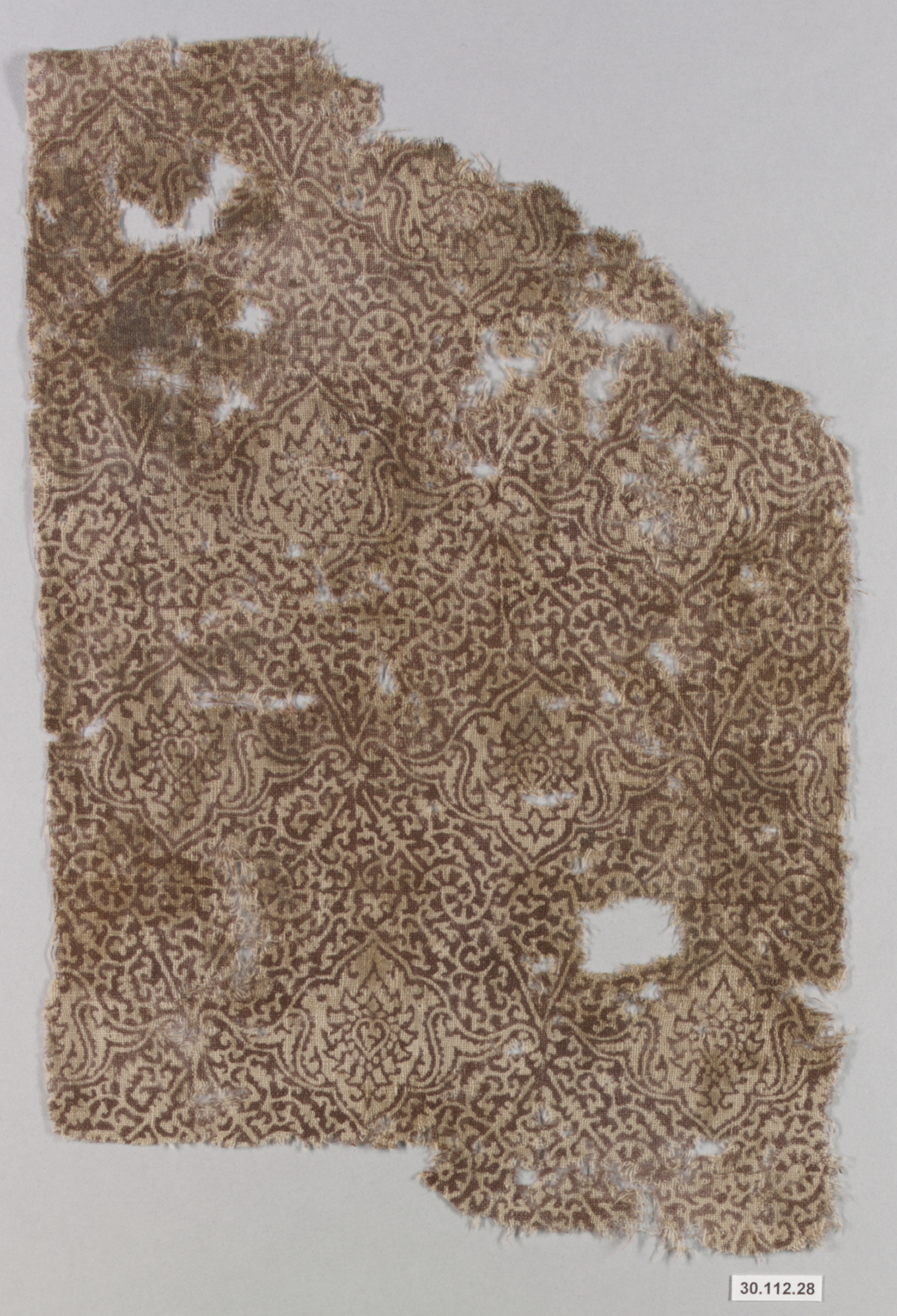
The textile under examination—a cotton plain weave, block-printed and mordant dyed, bearing the eternal arabesque and palmette—presents not a relic, but a blueprint. For Zoey Fashion Laboratory’s SS26 directive, this artifact is less a surface to be draped and more a structural algorithm to be decoded. The arabesque, with its infinite, self-generating spirals, and the palmette, a fan of radial symmetry, are not mere decoration. They are pre-industrial parametric systems, encoding principles of growth, entropy, and controlled chaos. Our task is to strip them of their historical nostalgia and re-engineer them as load-bearing, three-dimensional architecture for the human form.
We begin by rejecting the colonial gaze that views this textile as “ethnic” or “traditional.” Instead, we position it within a Global Frontier—a placeless, timeless zone where craft intelligence meets computational design. The mordant-dyed indigo and madder tones, once fixed by metallic salts, become our palette of bio-mimetic gradients. The block-printed irregularities—the slight misregistrations, the pressure variations—are not flaws. They are tectonic faults, offering opportunities for deliberate, engineered asymmetry in silhouette.
From Flat Pattern to Fractal Armature
The first stage of our transformative process is to translate the two-dimensional repeat into a three-dimensional lattice. We treat each palmette not as a flower, but as a stress-distribution node. In an SS26 garment, this manifests as a sculpted bodice where the palmette’s radiating fronds become darting vectors that pull fabric from the spine to the sternum, creating a corseted effect without boning. The arabesque’s continuous line is reimagined as a seamless spiral seam, wrapping the torso in a helix that visually elongates and structurally supports.
Consider the “Fractal Cuirass”: a jacket constructed from panels cut so that the palmette’s central axis aligns with the wearer’s scapula. The block-printed motifs are not preserved; they are digitally distorted during pattern cutting, so that the print stretches and compresses across the body’s contours. The result is a garment that appears to be grown, not sewn—a second skin of organic, geometric armor. The cotton’s plain weave, typically associated with softness, is stiffened with a bio-resin in select zones, creating rigid, petal-like protrusions that echo the palmette’s fan, while leaving other areas fluid for movement. This is not appliqué; it is material zoning.
Silhouette as a Temporal Collision
For SS26, we propose a silhouette that is neither nostalgic nor purely futuristic, but a temporal collision. The arabesque’s infinite loop suggests a Möbius-like garment—one that has no definitive front or back, no beginning or end. We achieve this through a circular cut, where the fabric is draped in a continuous ring, and the palmette motifs are placed at the points of maximum torsion. The wearer becomes a living sculpture, their movement causing the print to phase-shift—the palmette appearing to bloom and retract with each stride.
Structural innovation lies in the negative space. By laser-cutting away the background of the arabesque, leaving only the palmette’s skeletal outline, we create a perforated mesh that is both breathable and architectural. This mesh is then layered over a solid, mordant-dyed underlayer, creating a moiré effect as the two layers shift against each other. The garment becomes a dynamic optical instrument, where the historical pattern is deconstructed into pure light and shadow. This is not decoration; it is environmental interaction, responding to the wearer’s kinetic energy.
Deconstructive Tailoring and the Unstitched Seam
Our deconstructive methodology challenges the very notion of the seam. Instead of joining panels with thread, we employ fused edges, where heat and pressure bond the cotton to a thin, flexible thermoplastic film. The seam becomes a visible, raised ridge, mimicking the relief of the block print. In places, we leave the seam deliberately unstitched, allowing raw edges to fray and curl, echoing the organic decay of the arabesque’s line. This is a deliberate subversion of couture finish, a statement that impermanence is a structural feature.
Consider the “Palmette Parachute” sleeve: a voluminous, three-quarter-length sleeve that is pleated along the lines of the palmette’s fronds. The pleats are not pressed but sculpted with steam, creating a permanent, undulating wave that catches air and gives the sleeve a buoyant, almost weightless quality. The cuff is a rigid, laser-sintered polymer ring, printed with a micro-version of the arabesque, functioning as a functional clasp that can be opened or closed to alter the sleeve’s volume.
Material Alchemy: Cotton as a Futuristic Substrate
The choice of cotton is a deliberate provocation against the dominance of synthetics in avant-garde fashion. We treat this humble, plain-weave fabric as a high-performance substrate. Through a process of mercerization and compressive shrinking, we enhance its tensile strength and lustre, transforming it into a material that drapes with the fluidity of silk but holds the structure of a technical textile. The mordant dyes, typically used for colorfastness, are now conductive inks—we overlay the printed pattern with a circuit of silver nanoparticles, allowing the garment to harvest kinetic energy from movement and power embedded micro-LEDs. The palmette’s center becomes a glowing node, the arabesque’s line a luminous pathway.
This is not a costume; it is a wearable instrument. The garment’s color shifts with body heat, the mordant acting as a thermochromic agent. The result is a living textile that documents the wearer’s physiological state, turning the historical pattern into a real-time data visualization.
Conclusion: The Arabesque as a Manifesto
In conclusion, the arabesque and palmette textile, sourced from the Global Frontier, is not a passive object of study. It is a generative grammar for SS26. By deconstructing its visual logic and reconstructing it as a system of structural, kinetic, and electronic possibilities, we honor its origins not through imitation, but through radical reinterpretation. The cotton is no longer a canvas; it is a computational membrane. The block print is no longer a pattern; it is a topological map. The silhouette is no longer a shape; it is a temporal event. This is the definitive avant-garde reading: a textile that refuses to be merely worn, and instead, thinks, moves, and illuminates. The future is not a blank slate; it is a palimpsest, and we are rewriting it with every spiral and every frond.