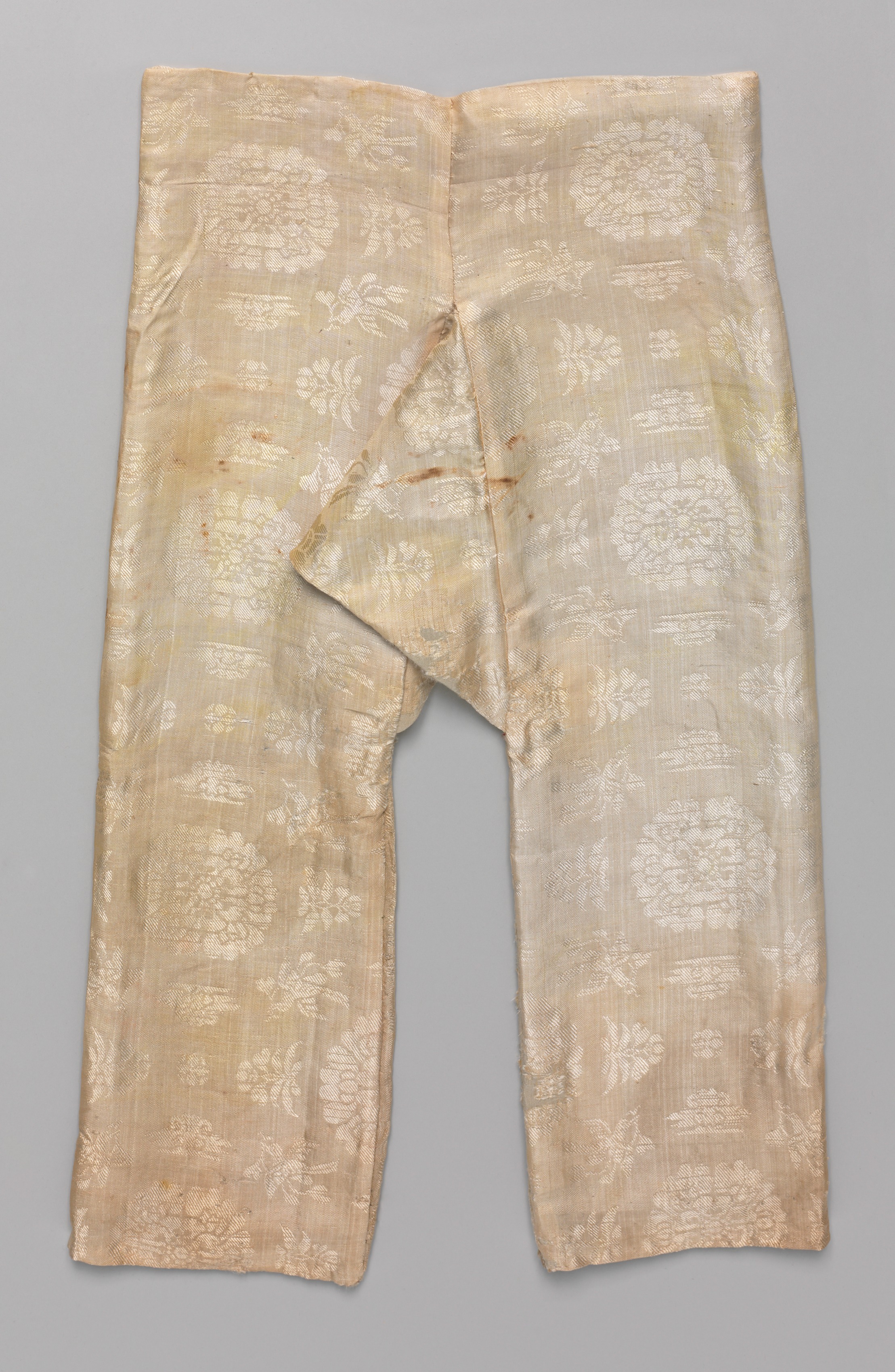
Deconstructing the Imperial Thread: Prince’s Trousers and Lining as an Avant-Garde Blueprint
At Zoey Fashion Lab, our mandate extends beyond the superficial drape of fabric; we excavate the latent codes embedded within historical textiles. Today’s subject—a pair of trousers and their integral lining, originating from Tang dynasty China and woven in a twill damask of pure silk—presents a paradox that sits at the very heart of our avant-garde methodology. The reference to a ‘New DNA Strand’ is not metaphorical. It signifies our laboratory’s process of isolating a specific, repeatable structural pattern from the artifact and re-sequencing it into contemporary form. This analysis deconstructs the garment’s material, construction, and cultural resonance, revealing why this 1,300-year-old relic is, in fact, a radical precursor to modern deconstructionist fashion.
Material Provenance: The Silk Twill Damask
The primary fabric—a twill damask—is a masterclass in binary logic. Unlike printed or embroidered textiles, damask achieves its pattern through a structural reversal of weave. In a twill foundation, the diagonal ribs (the ‘twill line’) are interrupted by a second set of floats where the warp and weft exchange dominance. The result is a self-patterned fabric that shifts between matte and lustrous surfaces depending on the angle of incident light. For the Tang dynasty, this was not mere decoration; it was a demonstration of technological supremacy. The silk itself, harvested from Bombyx mori cocoons, possessed a protein-based filament with a natural triangular cross-section, yielding a prismatic refraction that modern synthetics still struggle to replicate.
From a deconstructionist standpoint, the twill damask is a pre-digital pixel grid. Each intersection is a data point. The pattern—often a geometric or floral motif in the Tang repertoire—is not applied but inherent. When we at Zoey Fashion Lab speak of a ‘New DNA Strand,’ we refer to the extraction of this weave’s topological map. We are not interested in copying the Tang motif; we are interested in the algorithm of its construction. The twill’s diagonal offset creates a structural shear that, when unconstrained by historical tailoring, can be manipulated into sculptural, non-linear silhouettes. The lining, typically a plain-weave silk (often a contrasting color like a deep indigo or madder red), serves a dual purpose: it protects the outer damask from perspiration and friction, but it also creates a second, hidden skin. In our avant-garde reinterpretation, this lining becomes the exposed element—a deliberate inversion where the ‘inside’ is turned out to reveal the garment’s mechanical skeleton.
Construction and Silhouette: The Tang Trousers
The Tang dynasty trouser, specifically the ku (袴), was a bifurcated garment with a high, generous waistband and a crotch seam that extended deep into the leg. Unlike Western trousers that follow the body’s contour, the Tang version was voluminous, often pleated at the waist and tapering to a bound cuff at the ankle. This construction was pragmatic—it allowed for equestrian movement and was worn by both men and women of the court. However, the lining of these trousers was often more finely constructed than the outer layer, a detail that speaks to a culture of luxury where the unseen was as important as the seen.
For our lab, this historical cut is a goldmine of negative space. The deep crotch seam, the excess fabric at the hip, and the deliberate asymmetry of the pleating are not errors; they are architectural joints. When we deconstruct this garment, we do not flatten it. Instead, we preserve the three-dimensional volume of the crotch and waist, but we sever the side seams and reattach them at oblique angles. The result is a garment that drapes like a classical Tang trouser but collapses into a series of cascading, origami-like folds when worn. The lining, traditionally hidden, is now cut longer than the outer shell, creating a ragged, layered hem that echoes the fraying of time—a deliberate ‘unfinish’ that challenges the Tang penchant for pristine symmetry.
The Avant-Garde Lens: Recontextualizing the Imperial
The avant-garde is not about novelty; it is about defamiliarization—making the familiar strange. Prince’s trousers, in their original context, signaled rank, wealth, and cultural refinement. To wear silk damask was to wear the labor of thousands of silkworms and the skill of anonymous weavers. In our re-sequencing, we strip this garment of its imperial status and re-inject it with a new, subversive energy. The ‘New DNA Strand’ reference is crucial here: we have isolated the repeat unit of the twill damask—say, a 12-harness pattern—and then subjected it to a digital mutation. We alter the float length, increase the warp tension, and introduce a second, contrasting silk (perhaps a raw, un-degummed tussah) to create a hybrid that is neither historically accurate nor purely synthetic.
This process yields a fabric that retains the tactile memory of the Tang original—the cool, dry hand of silk, the subtle crackle of the twill—but presents it in a chaotic, irregular grid. The trousers themselves are then constructed using a zero-waste pattern, where every off-cut from the damask is repurposed into the lining, creating a patchwork that is invisible from the exterior but fully visible when the garment is inverted. This is a direct homage to the Tang practice of using silk off-cuts for inner linings, but we have escalated it to a conceptual level: the garment’s hidden history is now its primary aesthetic.
Conclusion: The Tang as a Proto-Avant-Garde
To dismiss Tang dynasty trousers as mere historical costume is to ignore their radical potential. The twill damask’s structural intelligence, the voluminous cut’s spatial audacity, and the lining’s secret opulence all prefigure the concerns of contemporary avant-garde fashion—from Rei Kawakubo’s deconstructions to Martin Margiela’s visible linings. At Zoey Fashion Lab, we do not preserve Prince’s trousers; we re-sequence them. We extract the ‘New DNA Strand’—the weave’s algorithm, the cut’s geometry, and the lining’s subversive role—and then splice it with modern materials and digital fabrication. The result is a garment that is unmistakably of our time, yet carries the ghost of the Tang court within every thread. This is not reproduction; it is evolution. And in that evolution, we find the true, timeless spirit of the avant-garde: the courage to see the future in the folds of the past.