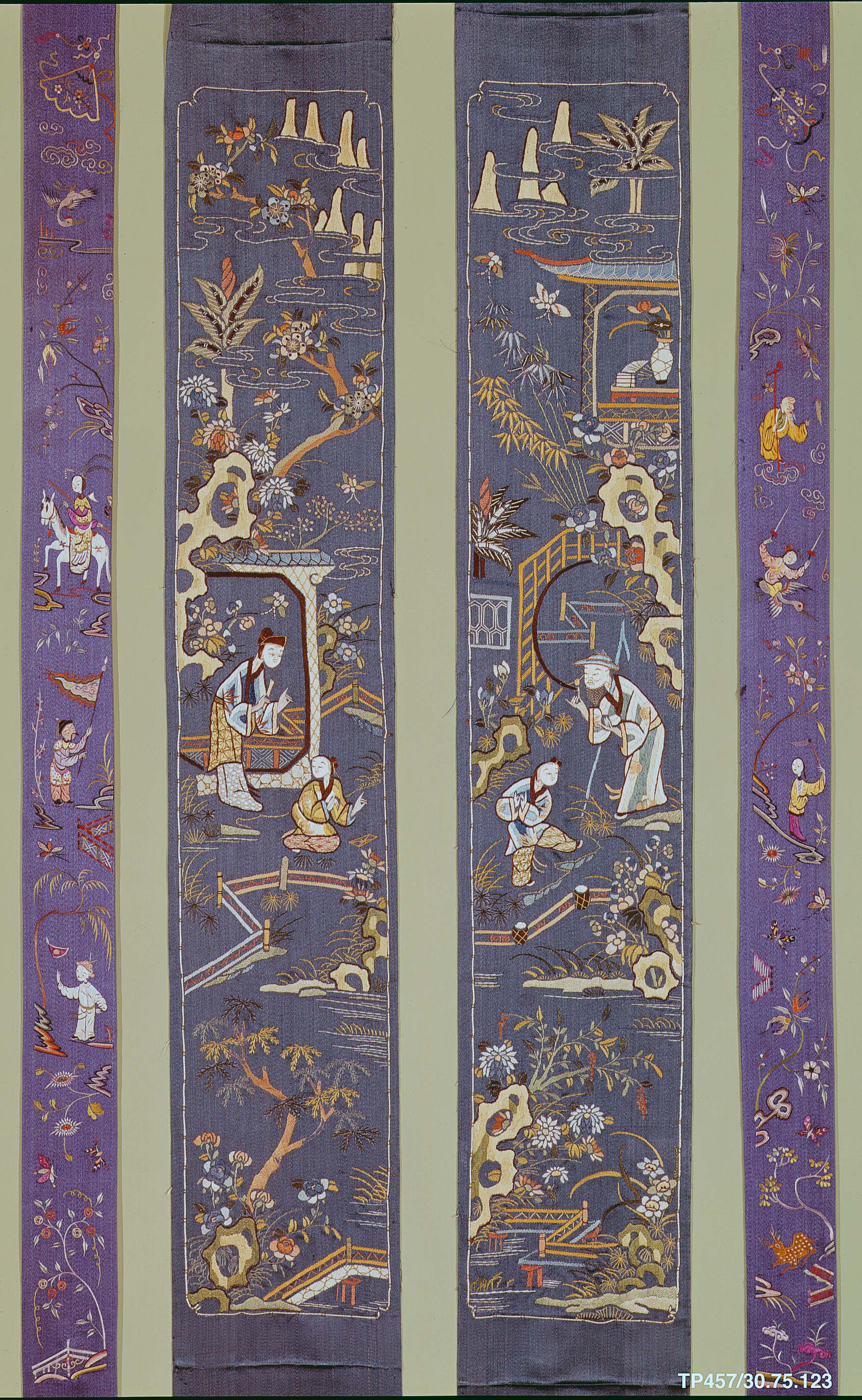
The Sleeve Band Reconfigured: A Study in Structural Ephemerality for SS26
The sleeve band—historically a humble, functional restraint, a whisper of tailoring meant to gather, secure, or define the boundary between body and fabric—undergoes a radical ontological shift in Zoey Fashion Laboratory’s SS26 avant-garde analysis. This is not a study of ornamentation, but a dissection of the band as a primary architectural element, a fulcrum upon which the entire silhouette pivots. Sourced from China, where silk has been the lingua franca of luxury for millennia, this specific iteration—silk on silk—demands a re-reading not as decoration, but as a load-bearing joint in a futuristic garment system. We are not looking at a trim; we are looking at a structural nexus.
Deconstructing the Band: From Constraint to Cantilever
In conventional couture, the sleeve band is a terminus—it concludes the sleeve’s journey at the wrist, often cinching to create a balloon or puff effect. For SS26, we propose the inverse: the band becomes a launching point. The silk-on-silk construction, where a denser, bias-cut silk band is fused or stitched onto a sheer, fluid silk ground, creates a differential in tension. This disparity is not a flaw but a generative force. The band no longer merely holds; it projects. By rotating the band 45 degrees off the true bias and extending it beyond the sleeve’s anatomical end, we create a cantilevered fin, a blade of silk that catches air and light, transforming the arm into a dynamic, sculptural appendage. The future silhouette is no longer defined by the torso, but by the negative space carved out by these extended, banded extremities.
The Chinese provenance is critical here. This is not a nostalgic nod to imperial cuffs, but a re-appropriation of the technical precision found in traditional qipao closures and xiu (sleeve) constructions. The band, in this new context, acts as a tension membrane, analogous to the structural ribs of a futuristic exoskeleton. It is the point where the garment ceases to be a second skin and becomes a habitable architecture. The silk-on-silk layering, when manipulated with heat-set pleating or selective resin treatments (invisible to the touch but transformative in form), allows the band to stand away from the arm, creating a 3D relief that redefines the wearer’s spatial presence.
Material Dialectics: The Politics of Silk-on-Silk
Silk, in its purest form, is a material of extreme fluidity and drape. To place silk upon silk is to create a dialogue between two states of the same substance. The upper band, perhaps a raw, undyed tussah silk with a matte, papery hand, is contrasted against a high-lustre, habotai ground. This is not a clash, but a tectonic collision—a visible seam where two geological plates of texture meet. In our SS26 analysis, this seam is left raw, deliberately frayed at the edges, to emphasize the band’s role as an unfinished, evolving system. The band is not a finish; it is a process.
Technically, the innovation lies in the negative ease of the band. Unlike a traditional cuff that hugs the wrist, our band is cut with a zero-ease or even negative allowance, yet is applied to a sleeve with positive ease. The result is a controlled, deliberate buckling—a micro-architectural fold that creates a series of repeating, rhythmic ridges along the forearm. This is not accidental drapery; it is engineered chaos. Each fold is a data point, a pleat that speaks to the wearer’s movement, reconfiguring the silhouette in real-time. The band becomes a kinetic sculpture, its form shifting from a sharp, linear blade at rest to a spiraling helix in motion.
Futuristic Silhouettes: The Band as a Gyroscopic Axis
For SS26, we envision the sleeve band not as a horizontal strip, but as a gyroscopic ring that can articulate around the arm’s vertical axis. By inserting a hidden, semi-rigid spiral of recycled polymer (encased within the silk fold) into the band, the designer can torque the band to any angle. This allows for a silhouette that is perpetually asymmetrical—one shoulder can carry a sharp, horizontal wing, while the other drops into a vertical, columnar cascade. The band, therefore, is the central control mechanism for the entire garment’s geometry. It is the joystick of the future suit.
This structural innovation also challenges the traditional hierarchy of the garment. The bodice, in this paradigm, becomes a mere backdrop, a canvas of negative space. The focus, the raison d’être, is the band’s projection. We are proposing a new canon where the sleeve is not an appendage but the primary volume, and the band is the compression joint that gives it form. Consider a tunic where the sleeves are constructed from multiple, parallel bands, each set at a different angle. The result is a fragmented, cubist silhouette that fractures the human form into a series of intersecting planes—a true avant-garde statement for the post-digital era.
Conclusion: A Band Beyond Binding
The sleeve band, in this standalone study, is liberated from its utilitarian past. It is no longer a restraint but a releaser of form. The silk-on-silk construction, rooted in Chinese material heritage, is leveraged not for its softness but for its structural potential under tension. For SS26, Zoey Fashion Laboratory proposes that the future of couture lies not in larger skirts or wider shoulders, but in the intelligent, articulating joint—the band that thinks, moves, and defines space. It is a micro-element with macro-implications, a testament to the power of re-examining the smallest component to dismantle and rebuild the entire silhouette. The band is no longer a detail; it is the entire thesis.