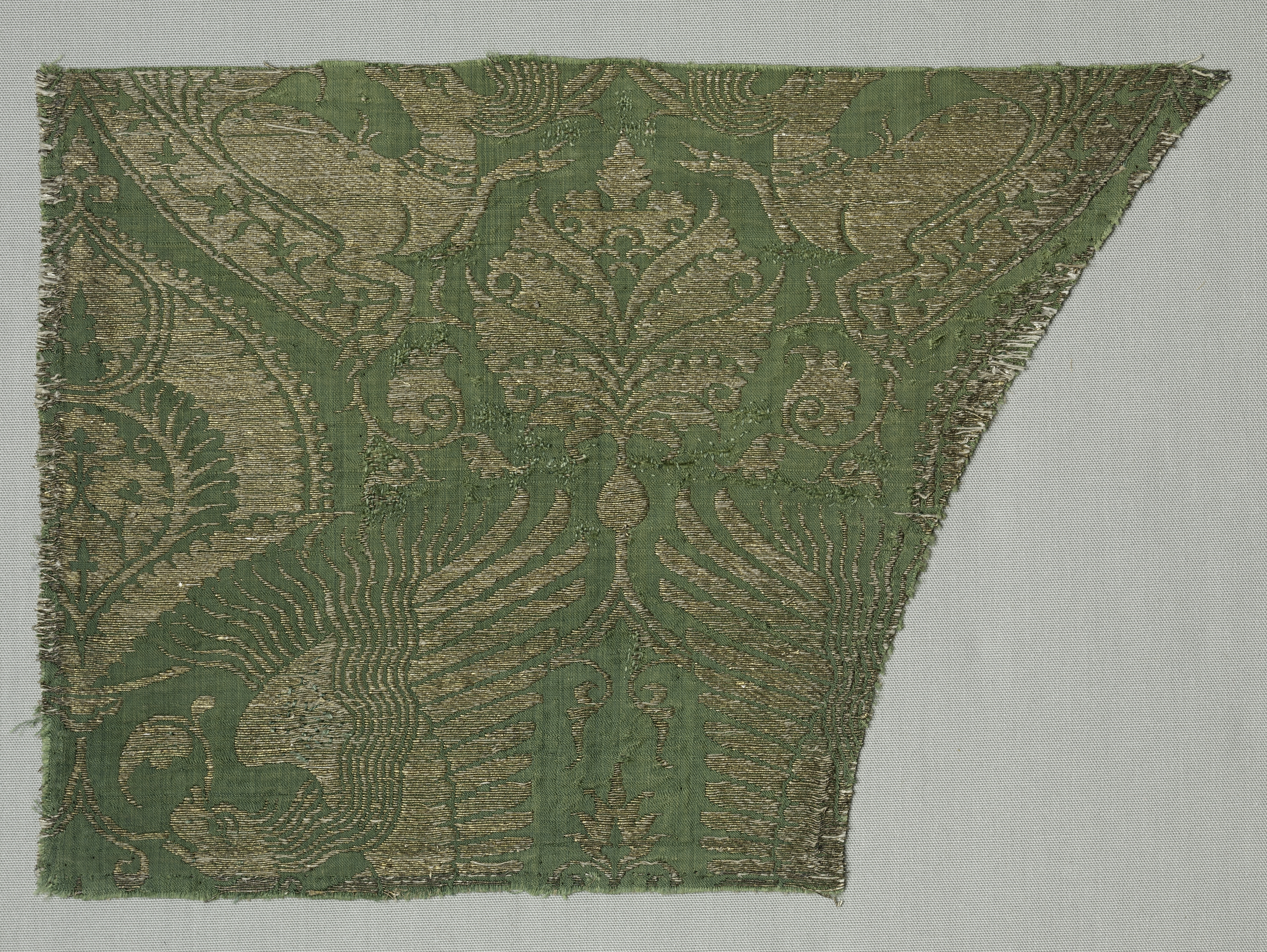
Deconstruction Report: Exotic Gold-Patterned Silk
This report, prepared for the internal archives of Zoey Fashion Lab, presents a comprehensive technical and conceptual deconstruction of a singular textile: an Exotic Gold-patterned Silk originating from Venice, Italy. The analysis moves beyond a simple material inventory to explore the fabric's structural intelligence, its historical resonance, and its potential for avant-garde application. The specimen in question is not merely a cloth; it is a coded artifact, a dialogue between opulent surface and structural depth.
Technical Provenance and Materiality
The fabric’s origin in Venice is not incidental. The Venetian Republic, for centuries a nexus of Eastern and Western trade, perfected the art of the lampas weave. This specimen is a masterclass in that tradition. The ground weave is a robust 2/1 twill, providing a stable, slightly diagonal foundation that catches light with a subtle, matte sheen. Interlaced with this is a supplementary weft system executed in a 1/3 twill, which allows the pattern—the 'exotic gold' motif—to float on the surface with a higher relief and a more pronounced luster. The combination of these two weave structures within a single fabric is the defining characteristic of lampas, creating a binary of texture: a quiet, structured base and a loud, patterned face.
The material dichotomy is equally critical. The warp is a high-twist, degummed silk, offering tensile strength and a crisp hand. The supplementary weft, however, is the star: a gold thread, likely a gilded silver or gold leaf wrapped around a silk core. This is not a metallic filament in the modern sense; it is a composite, a marriage of animal protein and precious metal. The result is a fabric that is surprisingly pliable for its apparent richness, yet possesses a distinct, cool weight. The gold does not merely sit on the surface; it is structurally integral, rising from the twill ground in precise, controlled floats.
Structural Semiotics: The Weave as Narrative
To deconstruct this silk is to read its structural grammar. The 2/1 twill ground functions as the 'prose' of the textile—the connective tissue, the everyday language of the cloth. In contrast, the 1/3 twill supplementary weft acts as the 'poetry'—the elevated, ornamental language that defines the visual identity. This is not a simple figure-ground relationship. The 1/3 twill floats are longer, allowing the gold to catch light in broad, uninterrupted planes. The 2/1 ground, with its shorter floats, creates a micro-texture that scatters light, preventing the overall surface from becoming a garish mirror.
The pattern itself—the 'split-leaf palm' motif—is rendered with a precision that speaks to the Venetian loom's capability. The palm fronds are not static; they appear to fracture and bifurcate, a visual echo of the reference to a 'mirror with split-leaf' ornament. This is a crucial point. The pattern is not a simple botanical reproduction. It is an abstraction, a geometricized interpretation of organic growth. The gold threads trace these split leaves with a sharpness that suggests they were not woven but drawn in metal.
Conceptual Framing: Mirror and Stone
The provided reference—“一面是光洁银镜上以黄金镶嵌的纷繁棕叶纹,另一面是冰冷石棺板上以浮雕诉说的生命叙事” (One side is a smooth silver mirror with intricate palm leaf patterns inlaid in gold; the other is a cold sarcophagus slab where life narratives are told in relief)—is the key to unlocking this fabric's avant-garde potential. The silk embodies this duality within a single plane.
The Mirror: The gold pattern on the silk's surface functions as the mirrored, gilded ornament. It is the face of opulence, the public, performative self. It reflects the viewer's gaze, but the split-leaf pattern disrupts a perfect reflection, forcing a more complex engagement. The gold is not a solid block; it is a series of interruptions, a fragmented mirror that invites the eye to piece together its logic.
The Stone: The 2/1 twill ground, particularly when viewed at an angle, possesses a stony, granular quality. It is the 'sarcophagus slab'—the cold, unadorned substrate that gives the gold its meaning. The twill's diagonal lines are like chisel marks, a record of the weaving process itself. The gold pattern, then, is not merely decoration; it is a relief carved into the stone of the silk. The life narrative is not told in a pictorial scene but in the tension between the rigid, dark ground and the luminous, branching gold.
Avant-Garde Application: The Fabric as Architecture
For Zoey Fashion Lab, this fabric must not be treated as a heritage relic. Its future lies in its structural tension. The avant-garde application is to exploit the dichotomy between the mirror and the stone, the gold and the twill, the surface and the structure.
1. Deconstructed Garment Architecture: The fabric's inherent stiffness and weight allow for radical, sculptural silhouettes. Instead of draping it softly, the designer should consider crimping, folding, or even heat-setting the silk to create permanent, architectural pleats. The gold pattern should be allowed to fracture across these folds, transforming from a continuous surface into a series of broken, glinting shards. This would translate the 'split-leaf' motif from a two-dimensional pattern into a three-dimensional structural principle.
2. Inversion of Value: The 'mirror' side is the obvious, luxurious face. The avant-garde move is to invert this hierarchy. Use the 'stone' side as the primary facing, allowing the 2/1 twill's subtle texture to dominate. The gold pattern then becomes a hidden treasure, revealed only in movement, at the turn of a cuff, or along an interior seam. This creates a garment of quiet subversion, where luxury is not displayed but discovered.
3. Fragmentation and Reconstruction: The fabric can be cut into precise, laser-cut geometric panels that mimic the split-leaf forms. These panels can then be reassembled onto a base of sheer, technical mesh or neoprene. This process of deconstruction and reconstruction echoes the fabric's own lampas construction—a layering of systems. The gold becomes a mosaic, a digital interpretation of an analog weave, pushing the textile into a new, hybrid materiality.
In conclusion, this Exotic Gold-patterned Silk is not a passive material awaiting a pattern. It is an active agent of design. Its value for Zoey Fashion Lab lies not in its historical authenticity, but in its capacity to generate new, provocative silhouettes. It is a fabric that demands a dialogue between its opulent past and a fragmented, avant-garde future. The designer's role is not to tame it, but to orchestrate its inherent contradictions—to let the mirror crack and the stone speak.