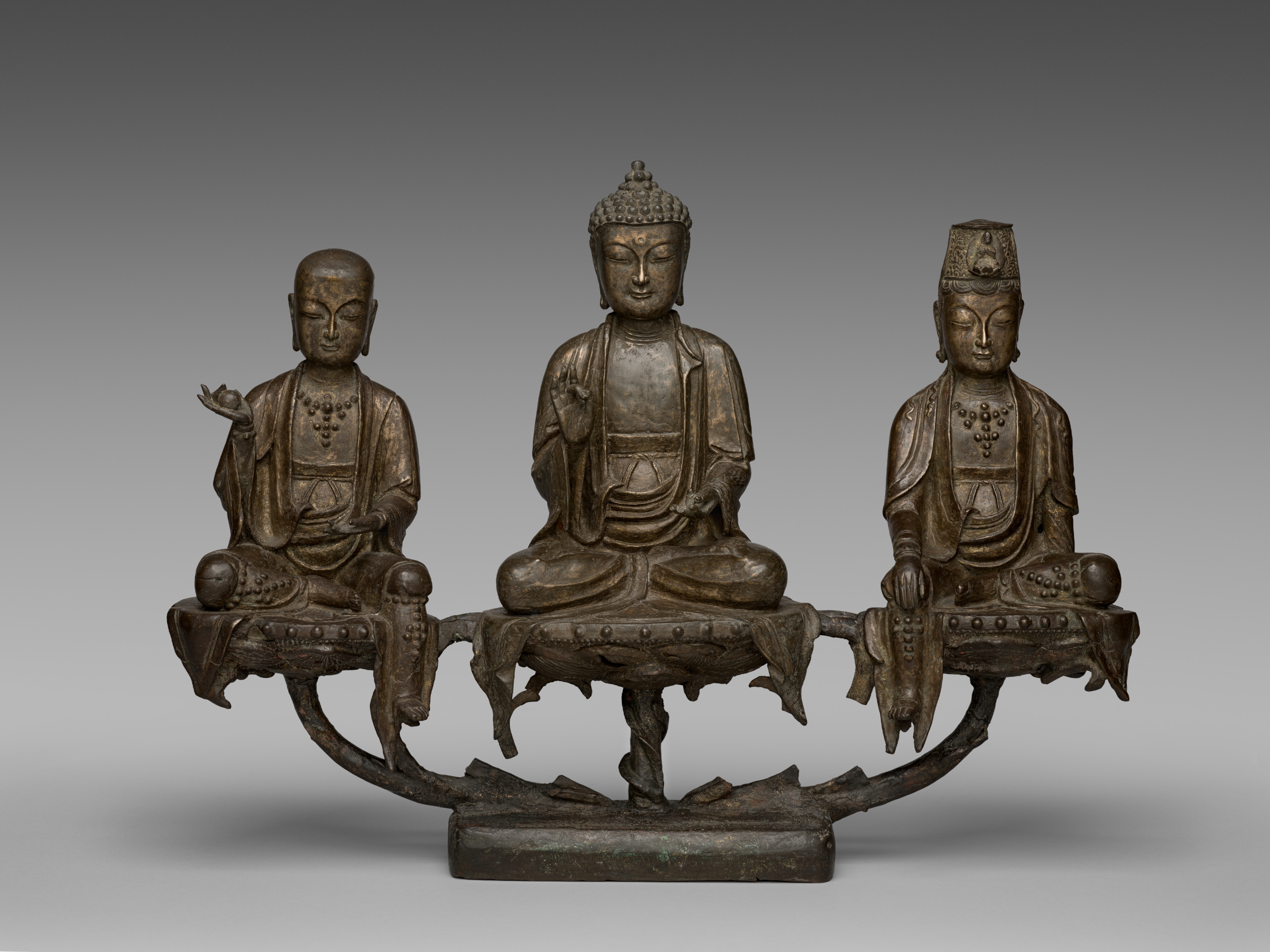
Deconstructing the Divine: The Amitabha Triad as Avant-Garde Architecture
At Zoey Fashion Lab, we do not merely observe artifacts; we dissect their structural integrity, their material grammar, and their temporal resonance. The Amitabha Triad, a bronze sculpture from the Korean Joseon dynasty (1392–1910), presents a paradox that is quintessentially avant-garde: a static object of profound spiritual gravity that nonetheless operates as a dynamic blueprint for modern silhouette, texture, and surface manipulation. Stripped of its purely liturgical context, this triad—comprising the central Amitabha Buddha flanked by two bodhisattvas—becomes a study in verticality, mass, and the tension between opulence and austerity.
Our analysis begins with the material itself: bronze with traces of gilding. This is not a pristine, polished relic. The gilding is residual, a ghost of former radiance. In the language of contemporary fashion, this is the ultimate distressed finish—not manufactured but earned through centuries of oxidation and ritual handling. The avant-garde designer understands that perfection is a lie; the triad’s surface, with its uneven patina and flecks of gold, offers a masterclass in controlled decay as a design principle. We translate this into fabric via metallic thread that is intentionally tarnished, or leather that is treated to mimic the mottled, uneven glow of ancient bronze. The garment is not new; it is becoming.
Structural Silhouette: The Vertical Mandala
The composition of the Amitabha Triad is rigorously hierarchical. The central figure is monumental, his ushnisha (cranial protuberance) elongating the line to an almost unnatural degree. The flanking bodhisattvas are shorter, their bodies curving inward in a subtle, protective arc. This creates a triangular or pyramidal architectonic frame, but one that is not static. The flowing robes of the central Buddha cascade in rhythmic, parallel folds, while the bodhisattvas’ drapery is more fluid, with S-curves that suggest movement within stillness.
For Zoey Fashion Lab, this translates into a deconstructed power suit. Imagine a structured, oversized blazer with exaggerated shoulder padding—the ushnisha—that tapers sharply to a narrow hem. The fabric is a heavyweight wool crepe, but it is cut with razor-thin vertical seams that mimic the bronze’s linear folds. The flanking pieces—perhaps a cape or asymmetric outer layer—are cut on the bias to create that inward, protective curvature. The result is a silhouette that is both defensive and inviting, a wearable mandala that centers the wearer while acknowledging the peripheral. The avant-garde element is the deliberate disruption of the triangle: one sleeve is removed, the hem is asymmetrical, a single panel of sheer organza interrupts the heavy wool, echoing the gaps between the triad figures.
Surface as Narrative: The Gilded Trace
Referencing the archive note—“一面是光洁银镜上以黄金镶嵌的纷繁棕叶纹,另一面是冰冷石棺板上以浮雕诉说的生命叙事” (one side is a smooth silver mirror with intricate palm-leaf patterns inlaid in gold; the other is a cold stone sarcophagus with reliefs narrating life)—we find a direct correlation to the triad’s surface. The bronze is not uniformly smooth. It is a palimpsest of textures: areas of high polish where hands have touched, deep recesses in the drapery where shadow pools, and the rough, granular texture of the casting itself. The gilding is not applied evenly; it highlights the crown, the forehead, and the hands—the points of spiritual energy.
In our avant-garde textile development, we replicate this through laser-cut metallic appliqués that are deliberately placed to catch light only at specific anatomical points: the collarbone, the wrists, the sternum. The base fabric is a matte, almost gritty technical jersey, reminiscent of the raw bronze. The gilding traces are represented by hand-embroidered gold bullion threads that are intentionally loose, some broken, to create that “trace” effect. The palm-leaf motif from the mirror reference is abstracted into a geometric jacquard pattern, woven into the lining of the garment—hidden, like the mirror’s reverse side, only revealed when the garment is turned inside out or when the wearer moves.
Color Palette: The Oxidized Spectrum
We reject the notion of “bronze” as a single color. The triad presents a spectrum: deep umber, verdigris green, charcoal black, and a pale, sickly gold. This is the palette of the avant-garde collection. We propose a color story that begins with a base of ink-black and graphite, representing the shadowed recesses of the drapery. Then, we introduce a verdigris green—not a vibrant emerald, but a muted, chalky green that suggests copper’s slow transformation. This appears in a double-faced wool, where the green is on the inside, bleeding out at the edges through raw, unfinished seams. Finally, the gilding is not “gold” in the traditional sense; it is a tarnished brass, a dull ochre, a champagne that has lost its fizz. This is achieved through pigment-dyed silks that are over-dyed with a smoky black to dull their luminosity.
Draping and Movement: The Static Flow
One of the most challenging aspects of translating this sculpture is the paradox of static flow. The bronze robes appear to move, yet they are frozen. In fashion, we achieve this through heavy, weighted fabrics that are manipulated into permanent pleats. We use a technique of heat-setting accordion pleats into a metallic-coated nylon, then crushing them randomly to break the regularity. The garment is then treated with a resin to add weight, so that when the wearer moves, the fabric does not flutter—it falls, with a leaden, deliberate gravity. This mimics the bronze’s resistance to motion. The hem is weighted with a chain of oxidized metal beads, ensuring that the garment always returns to its sculptural form.
Conclusion: The Wearable Relic
The Amitabha Triad is not a source of inspiration for a costume; it is a structural and philosophical framework for a new kind of clothing—clothing that acknowledges impermanence, that values process over polish, and that uses the body as a plinth. By deconstructing the triad’s verticality, its surface narrative, and its oxidized palette, Zoey Fashion Lab proposes a collection that is not “Korean” or “Buddhist” in any literal sense, but rather universally avant-garde in its embrace of material decay and architectural tension. The wearer of this garment does not wear a sculpture; they wear a fragment of time, a bronze echo of a devotion that has long since passed, yet remains indelibly pressed into the metal. It is fashion as archaeology, style as sediment. The gilding is a memory, and we choose to wear that memory on the outside.