Deconstructing the Sacred Thread: A Fatimid Tiraz in Avant-Garde Context
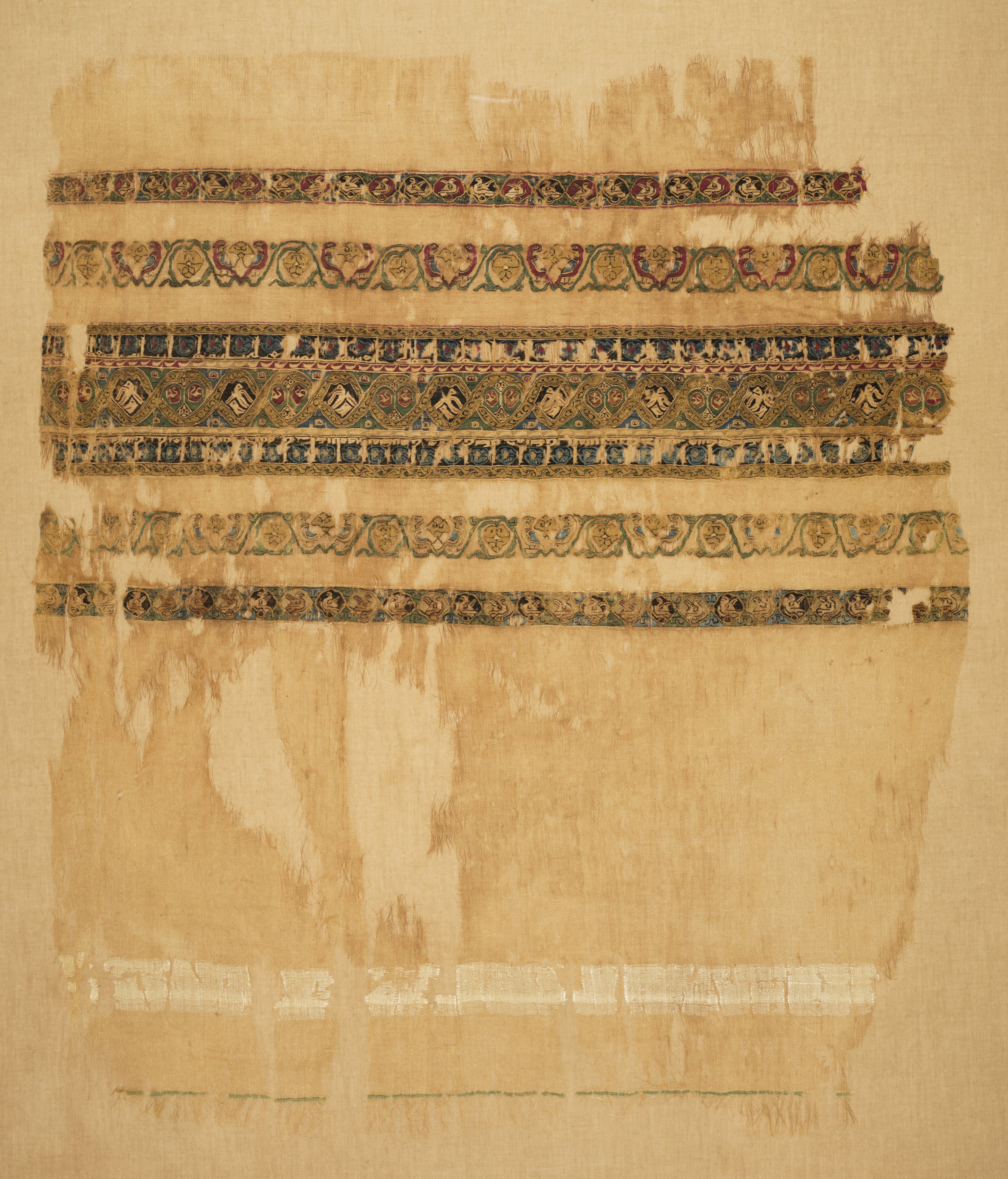
At Zoey Fashion Lab, we do not merely study historical textiles; we interrogate them. We dissect their materiality, their socio-political resonance, and their latent potential to disrupt contemporary fashion paradigms. This analysis focuses on a singular artifact: a turban or shawl end bearing a tiraz inscription, attributed to the Fatimid reign of al-Musta‘lī (1094–1101 CE) in Egypt. Constructed from a plain-weave linen ground with inwoven tapestry-woven silk and gold filé, this fragment is not a relic of the past but a blueprint for an avant-garde future. Our deconstruction reveals a complex interplay of power, faith, and technical virtuosity that challenges the very notion of wearable luxury today.
Materiality as Political Theology
The technical choice of plain weave with inwoven tapestry is deceptively simple. The linen ground—a humble, plant-based fiber—serves as the aniconic, egalitarian canvas. In contrast, the silk and gold filé (gold wrapped around a silk core) are animal and mineral luxuries, reserved for the caliphate’s exclusive workshops (dar al-tiraz). This binary is not aesthetic but ideological. Linen, in Islamic tradition, is associated with purity and burial shrouds, while silk and gold are markers of earthly authority and divine favor. The Fatimid caliph, as both political and religious leader (Imam), used this textile to project a dual sovereignty: the ephemeral and the eternal.
For Zoey Fashion Lab, this material hierarchy is a call to subvert. In our avant-garde reinterpretation, we propose inverting the hierarchy: using recycled industrial linen as the primary surface, but embedding bio-fabricated silk and upcycled metallic waste in the tapestry zones. The result is a garment that questions the source of value. Is luxury inherent in the material, or is it constructed by the system that deploys it? By replacing gold filé with reclaimed copper or anodized aluminum, we retain the visual opulence while stripping it of colonial and extractive connotations. The tiraz becomes a critique of the contemporary gold rush in fast fashion.
The Tiraz Inscription: Calligraphy as Code
The defining feature of this artifact is the tiraz band—an inscription woven directly into the textile. Typically, these bands bore the caliph’s name, titles, and a benediction. In the reign of al-Musta‘lī, the script would have been a flowing, angular Kufic, executed with mathematical precision. The inscription is not merely decorative; it is a legal and spiritual document woven into cloth. It functioned as a royal warrant, a mark of allegiance, and a portable piece of sacred space. The wearer of this turban end was not just adorned; they were inscribed with the state’s ideology.
Our avant-garde strategy is to decontextualize the calligraphy. We propose a digital translation of the Kufic letterforms into a generative algorithm that distorts, fragments, and re-embeds them as a pixelated, glitch-art pattern. This is not disrespect; it is a hermeneutic act. The inscription’s original function—to assert authority—is transformed into a commentary on the instability of digital identity. In a world of deepfakes and algorithmic curation, what does it mean to wear one’s “name” woven into one’s garment? By rendering the tiraz as a code that is simultaneously ancient and futuristic, we create a wearable cryptogram that speaks to the fragmentation of self in the digital age.
Avant-Garde Silhouette: The Turban as Prosthetic
Historically, this textile end would have been wound into a turban or draped over the shoulders as a shawl. The form is inherently sculptural and volumetric. The Fatimid turban was not a simple headwrap; it was a complex architectural structure that could signify rank, profession, and piety. The tiraz end, often left hanging, created a dynamic line of movement, catching light with its gold threads.
Zoey Fashion Lab reimagines this silhouette as a modular, post-human prosthetic. We propose a garment that is neither turban nor shawl, but a hybrid “wrap-structure” with integrated, articulated panels. Using a combination of stiffened linen and flexible, 3D-printed joints, the wearer can reconfigure the garment into multiple states: a full hood, a shoulder mantle, or an asymmetric, wing-like drape. The gold filé is replaced by optical fiber threads that emit a low-level, programmable light, tracing the original tiraz pattern in real-time. This is not costume; it is a functional, interactive interface. The garment becomes a wearable architecture that responds to the wearer’s movement, projecting their “inscription” into space as a luminous aura.
Archive Resonance: A Dialogue with the 16th–17th Century
The reference to “Archive Resonance” and the mention of 16th–17th-century objects in the original brief is not anachronistic. It points to a historical continuum of cross-cultural textile exchange. By the 16th century, Fatimid tiraz fragments were already being collected, copied, and reinterpreted in Ottoman and Safavid courts, and later in European curiosity cabinets. The 17th century saw a massive influx of Islamic textiles into Europe, where they were cut, remounted, and worn as exotic accessories. This history of appropriation and recontextualization is precisely the avant-garde gesture. We are not the first to deconstruct; we are continuing a lineage.
Our analysis posits that the Fatimid tiraz is a proto-avant-garde object because it already contains the seeds of its own subversion. Its inscription asserts a fixed meaning, yet its materiality—the shimmer of gold, the tactile contrast of linen and silk—invites a purely sensory, non-verbal response. This tension between semantic rigidity and sensory excess is the engine of avant-garde fashion. We harness this tension by designing garments that are conceptually dense but viscerally immediate. The wearer does not need to read Kufic to feel the weight of history and the shock of the new.
Conclusion: The Tiraz as a Manifesto
In conclusion, the turban end of al-Musta‘lī is not a static artifact but a manifesto in fiber. It demonstrates that textiles can carry political theology, technical mastery, and aesthetic innovation simultaneously. For Zoey Fashion Lab, this fragment is a challenge: to create fashion that is not merely decorative but inscriptive—garments that write, that argue, that disrupt. By re-engineering its materials, re-coding its calligraphy, and re-forming its silhouette, we transform a thousand-year-old symbol of caliphal power into a tool for contemporary critique.
The avant-garde is not about rejecting history; it is about re-animating it with a different voltage. We take the gold filé and turn it into light; we take the Kufic and turn it into code; we take the turban and turn it into a machine for movement. The result is a garment that honors the original’s technical genius while refusing its authoritarian implications. In this way, the tiraz end becomes a bridge between the Fatimid court and the post-digital runway—a testament to the enduring power of the woven word. This is our resonance: not an echo, but a re-sounding.