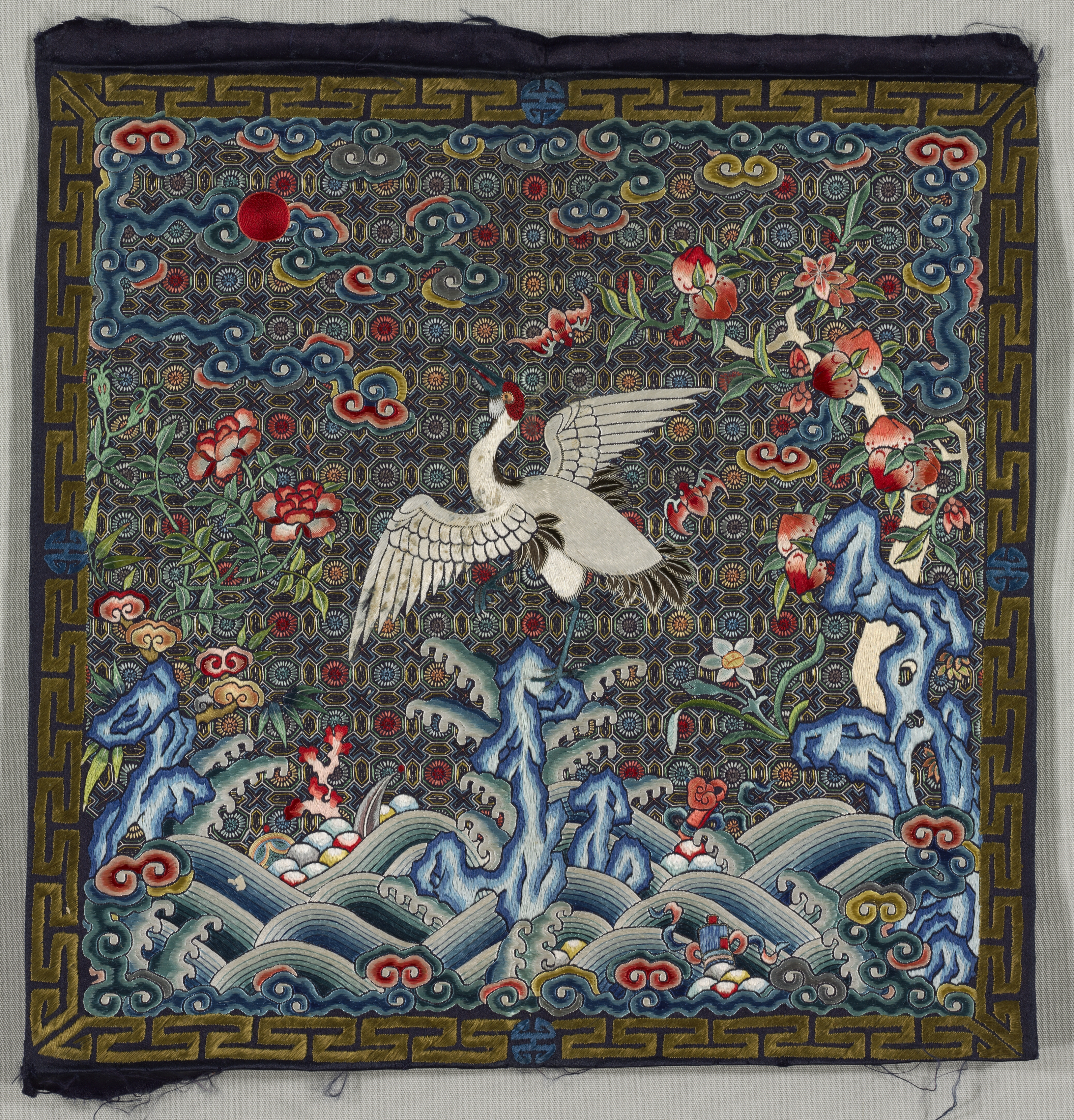
Technical Deconstruction & Material Analysis: The Qing Rank Badge
The provided artifact is a Qing Dynasty rank badge (buzi), a sartorial symbol of immense bureaucratic and social power. Our deconstruction begins not with the motif, but with the foundational matrix. The base is a satin weave in silk. This choice is critical. Unlike a plain weave, the satin structure, with its long floats of warp or weft threads on the surface, creates a luminous, unbroken plane of color and light. It is a fabric engineered for prestige—smooth, reflective, and inherently luxurious. This ground is not a passive canvas; it is the first statement of authority, providing a flawless, gleaming backdrop against which the emblematic narrative is staged.
The embroidery technique further amplifies this intent. The use of silk thread, in likely a combination of satin and seed stitches, translates the imperial iconography into a textural topography. The precision of the stitching to denote feathers, scales, or celestial clouds speaks to a mastery of craft that was, in itself, a regulated commodity. The materials—the specific silk, the dye pigments (often mineral or vegetable-based, yielding distinctive hues)—were as codified as the images they formed. The artifact is, therefore, a layered construct of controlled resources: the weave signifies status, the embroidery specifies rank, and together they form an imperially sanctioned data field.
Conceptual Core: The "DNA Strand" of Imperial Power
The reference to a New DNA Strand is profoundly apt. The buzi functioned as a precise genetic code for social and political identity within the Qing organism. For civil officials, the badge displayed birds (a crane for the first rank); for military officials, beasts (a qilin or lion). Each creature was a fixed node in a hierarchical chain. The badge’s position—square, centered on the chest—placed this code directly over the heart and facing the world, a permanent, non-negotiable identifier. It was a wearable protocol, ensuring that the body of the official was legible as a component of the state machinery.
This code, however, was not merely informational; it was cosmological. The motifs were situated within a universe of symbols: often against a background of auspicious clouds, above rolling waves and a mountain rising from the sea, perhaps flanked by sun and moon. This composition placed the official within a microcosm of the empire itself—connecting his role to the natural and celestial order. The badge was a compact, personal mandala of imperial ideology, stitching the wearer into a vast, pre-ordained system of meaning and power.
Reconstruction Brief: Avant-Garde Translation for Zoey Fashion Lab
The avant-garde directive demands we move beyond pastiche. We do not replicate the badge; we dissect its operational principles and re-engineer them for a contemporary consciousness. The goal is to create a new syntax of status, identity, and connection that resonates with the same potency as the original.
1. De-Coding and Re-Coding: The Digital Genome
The core concept of the DNA Strand must be literalized and abstracted. Imagine garments embedded with interactive, woven LED matrices or organic light-emitting textiles (OLET). Instead of a static embroidered beast, the chest panel displays a dynamic, minimalist pattern—a flowing, abstract visualization of personal data (heart rate, location networks, digital communication flow). This is your modern rank: not your bureaucratic position, but your biometric and digital aura. The "code" becomes personal and mutable, a real-time emission rather than an imposed symbol. The "satin weave" ground is translated into a base of tech-moiré fabrics—synthetic sheaths that shift in iridescence with movement, mimicking the play of light on silk but through 21st-century material science.
2. Structural Iconography: From Embroidery to Architecture
The raised, textural quality of the silk embroidery can be reimagined through radical garment construction. Inspired by the square frame of the buzi, develop detachable, geometric breastplates or pauldrons using 3D-printed bioplastics or laser-sintered metals. These modular components can be "programmed" with different surface textures—one mimicking the scaly pattern of a Qing dragon, another a circuit board, another a topographical map. They attach to a minimalist base garment via magnetic closures or tech-integrated ports, allowing the wearer to configure their own insignia. The "mountain and waves" motif transforms into asymmetric, sculptural draping or laser-cut layered fabrics that create shadow-play and depth on the body.
3. The New Cosmology: Networked Ecosystems
The Qing badge situated the individual within a cosmic order. Our contemporary cosmology is the network. Garments can incorporate concealed, conductive embroidery that connects to a personal device, visualizing the wearer's connection to their social ecosystem. A subtle, fiber-optic glow might pulse in response to network activity, or change hue based on environmental data. The "creature" motif is abstracted into a generative visual algorithm, unique to the wearer, displayed on a flexible micro-screen or through thermo-chromatic inks that react to body heat or external stimuli. Status is no longer denoted by a mythical beast, but by the complexity, beauty, or intentional silence of one's data portrait.
Material Manifesto
The material palette must echo this duality of ancient prestige and future tech. Utilize deadstock silk satins (honoring the original) bonded to recycled polymer membranes. Employ biomaterial leathers grown from mycelium, embossed with patterns derived from archival badge motifs. Integrate phase-change materials for climate-responsive wearability, a functional echo of the badge's role in adapting the body to the imperial court's environment. The embroidery is replaced by ultrasonic welding, laser etching, and the strategic application of conductive pastes.
Final Vision: The Zoey Fashion Lab interpretation of the buzi is not a garment with a badge. It is a wearable interface. It deconstructs the original's function as a rigid, external code and reconstructs it as a fluid, personal expression of identity within digital and physical ecosystems. It transforms imperial taxonomy into individual taxonomy, maintaining the original's gravity and communicative power while exploding its form. The wearer is no longer a bearer of state-mandated rank, but the curator and emitter of their own dynamic, avant-garde significance.