Deconstructing the Fragment: A New DNA Strand for Avant-Garde Expression
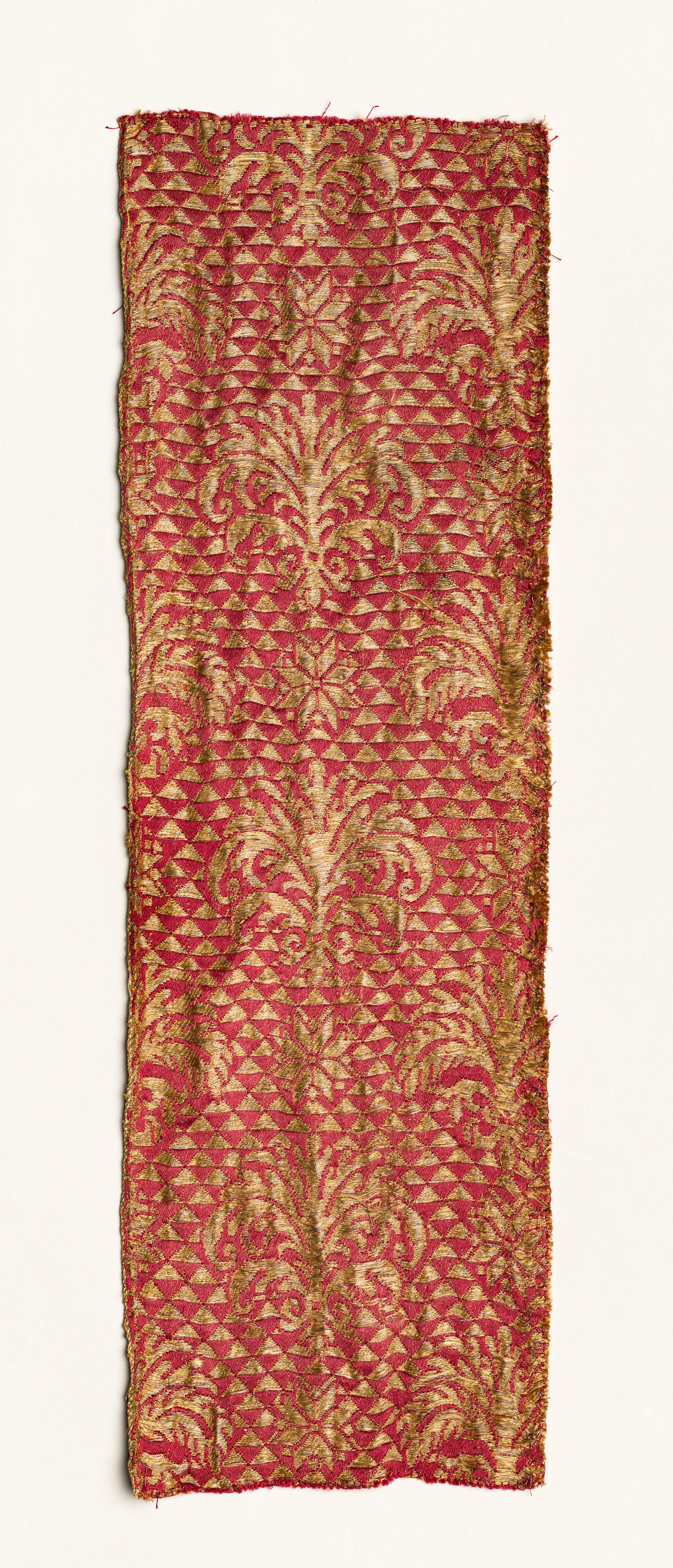
At Zoey Fashion Lab, our mandate extends beyond the mere replication of historical textiles. We engage in a process of fabric deconstruction, extracting the intrinsic logic, material grammar, and cultural memory embedded within a single artifact to generate entirely new design paradigms. This analysis focuses on a remarkable fragment—a piece of silk and gold-wrapped thread from the Mamluk Sultanate of Egypt (1250–1517). This is not simply a relic; it is a New DNA Strand, a genetic code that, when re-sequenced through an avant-garde lens, yields a collection of radical, wearable architecture.
I. Material Phylogeny: The Silk-Gold Nexus
The physical composition of the fragment—warp-faced silk with discontinuous wefts of gilded parchment or leather—represents a sophisticated technological plateau. The Mamluk weaver’s mastery lay in the tension between supple silk and rigid metal. The silk base provides drape and fluidity, while the gold thread introduces structural interruption, creating a surface that is simultaneously soft and armored. For Zoey Fashion Lab, this is not a historical curiosity but a blueprint for material innovation.
Deconstructive Translation
Our avant-garde methodology begins by severing the traditional hierarchy between these fibers. Instead of gold as an accent, we propose gold as a structural exoskeleton. We will develop a new composite yarn—a bio-engineered silk filament coated with a micro-thin layer of recycled gold via physical vapor deposition. This creates a fiber that is 80% silk, 20% metal, yet behaves as a single entity. The resulting fabric will not merely shimmer; it will conduct light and heat, allowing garments to respond dynamically to the wearer’s environment. The Mamluk’s gold was a symbol of imperial power; our gold becomes a tool for thermal regulation and interactive luminosity.
Furthermore, we will isolate the discontinuous weft technique. In the original, gold threads are floated across the surface only where needed, creating a pattern of dense metallic islands against a silk sea. Our deconstruction inverts this: we will weave a continuous gold grid, with silk as the intermittent float. This produces a fabric that is transparent, rigid in one axis, and fluid in another—a metamorphic textile that can shift from a sculptural, corseted silhouette to a liquid, cascading drape through the simple application of tension.
II. Structural Semiotics: The Geometry of Power
The Mamluk fragment’s visual language—often featuring interlacing arabesques, geometric star patterns, and pseudo-Kufic inscriptions—was not decorative. It was a cartography of authority, encoding the Sultanate’s claim to spiritual and temporal dominion. The patterns are mathematically precise, yet they create an optical illusion of infinite expansion. For our avant-garde collection, we treat these geometries as a generative algorithm, not a motif to be copied.
Algorithmic Pattern Disruption
We will feed the fragment’s geometric coordinates into a custom parametric design software. However, instead of reproducing the perfect symmetry, we introduce a controlled mutation—a digital glitch that breaks the pattern’s grid every 17th repetition. This creates a new visual rhythm: the eye perceives the historical order, but is constantly interrupted by a disruptive, organic error. This deconstructed arabesque will be laser-cut into full-grain leather and then bonded to the silk-gold composite. The result is a garment that references the Mamluk’s obsession with order, yet embodies the avant-garde’s celebration of rupture and imperfection.
We also isolate the pseudo-Kufic script. Originally, these were illegible imitations of Arabic calligraphy, used as a decorative border to evoke piety without literal meaning. Our deconstruction takes this concept of semantic emptiness and pushes it further. We will embroider the same pseudo-Kufic forms using a thread that is photochromic—shifting from black to gold when exposed to UV light. The text is present but unreadable; it appears and disappears based on environment. This transforms the garment from a static object into a performative text, commenting on the fluidity of meaning in the digital age.
III. Silhouette and Drape: From Tunic to Exoskeleton
The original Mamluk garment was likely a tunic or a ceremonial robe—a voluminous, rectangular construction that relied on the fabric’s weight for its fall. The avant-garde imperative demands a radical rethinking of this silhouette. We propose a deconstruction of the body’s relationship to the fabric.
Modular Tension Systems
Instead of a single continuous garment, we will create a modular system of panels derived from the fragment’s weave structure. Each panel is a complete textile unit, but they are connected via a series of tension cables—thin, high-tensile steel wires coated in the gold-silk composite. The wearer can adjust the tension at specific points, pulling the fabric into a rigid, architectural form around the shoulders, or releasing it to create a flowing, trailing train. This is a direct translation of the Mamluk weaver’s control over the warp and weft, but now the wearer is the weaver, actively constructing and deconstructing the silhouette in real-time.
Furthermore, we will introduce negative space as a primary design element. The original fragment is dense, almost claustrophobic in its ornamentation. Our avant-garde response is to cut away the fabric, leaving only the gold structural grid exposed. This creates a garment that is more absence than presence—a skeleton of the original. This is not a loss of material, but a reduction to essential form. The skin becomes the silk; the body becomes the gold. This approach challenges the very notion of what constitutes a garment, aligning with the avant-garde tradition of questioning the boundary between object and wearer.
IV. Conceptual Resonance: The New DNA Strand
The term “New DNA Strand” is not metaphorical. We are extracting the genetic information of this fragment—its material properties, its structural logic, its cultural coding—and splicing it with contemporary biotech and digital fabrication. The result is a hybrid organism, a garment that is part historical artifact, part futuristic interface.
Wearable Memory and Future Archaeology
We envision a collection that functions as wearable memory. Each piece carries the visual echo of the Mamluk Sultanate, but it is expressed through the language of tomorrow. The gold is no longer a sign of wealth; it is a conductor for a micro-LED system that displays a slow, pulsing light pattern derived from the fragment’s original interlacing. The silk is no longer a luxury fiber; it is a biodegradable substrate that has been digitally printed with a QR code of the fragment’s provenance, invisible to the naked eye but scannable by a smartphone. This allows the garment to carry its own metadata, its own history, embedded within its fibers.
In conclusion, the Mamluk fragment is not a dead object. It is a living code, a set of instructions for creating beauty, power, and structure. At Zoey Fashion Lab, our deconstruction is an act of reverence through rebellion. We do not preserve the fragment in a glass case; we re-sequence its DNA to birth a new species of avant-garde fashion—one that is at once ancient and alien, rigid and fluid, silent and luminous. This is the future of fashion: not a break from history, but a radical, generative reinterpretation of its deepest structures.