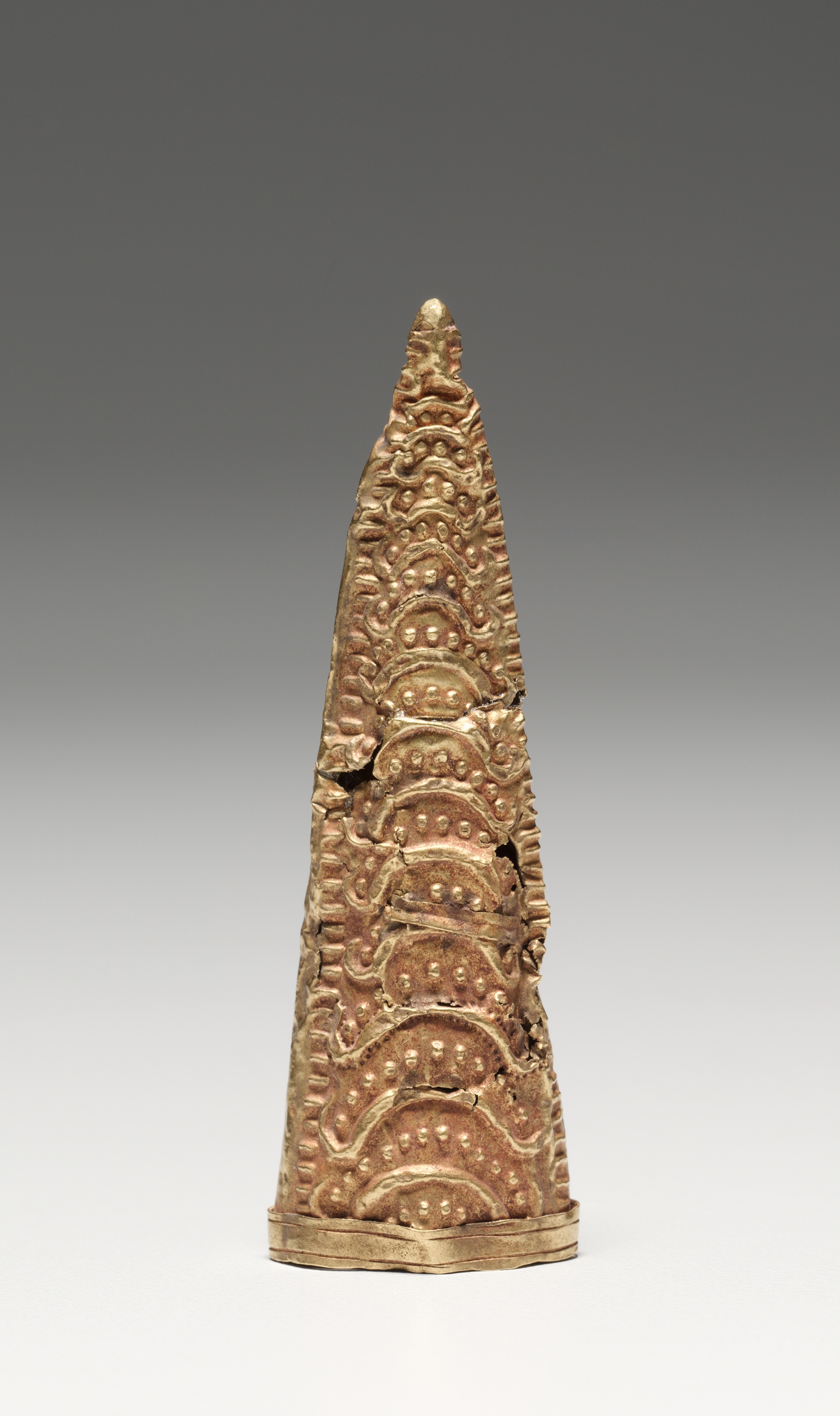
Deconstructing the Sika Boha: An Avant-Garde Analysis of Asante Goldsmithing
In the hallowed archives of material culture, certain objects transcend their utilitarian origins to become potent symbols of power, artistry, and cosmological belief. The knife-sheath tip, or sika boha, from the Asante Empire of Ghana is one such artifact. Hailing from Kumasi, the spiritual and political heart of the Asante Kingdom, and crafted by a master member of the goldsmiths' guild, this object is not merely a decorative finial. It is a condensed thesis on status, spiritual protection, and the alchemical transformation of base metal into divine authority. For Zoey Fashion Lab, this relic offers a profound blueprint for an avant-garde aesthetic—one that merges ancestral weight with radical, futuristic form.
The Alchemy of Gold: More Than a Metal
To the Asante, gold (sika) was not a mere commodity; it was the embodiment of the sun’s life-giving force and the physical manifestation of the soul (sunsum) of the kingdom. The sika boha, literally translating to "gold sheath tip," was the terminal ornament on the scabbard of a ceremonial sword or state knife. This was not a weapon of war but an instrument of statecraft, oath-taking, and diplomatic negotiation. The goldsmiths' guild in Kumasi, operating under royal patronage, were the high priests of this metallurgy. They practiced the lost-wax casting technique (cire perdue), a process of extraordinary precision and risk, where a wax model is invested in clay, melted away, and replaced by molten gold. This process itself is a metaphor for avant-garde creation: destruction of the initial form to birth a permanent, more precious one.
In the context of the Asante court, the sika boha was a visual marker of rank. The size, weight, and intricacy of the gold ornament directly correlated with the owner's proximity to the Golden Stool (Sika 'dwa), the mythical throne believed to house the soul of the Asante nation. To wear a knife adorned with such a tip was to carry a piece of the kingdom’s sacred essence. The gold was not worn for vanity; it was worn as a heavy, tangible burden of responsibility, a constant reminder of the ancestral contract between the living ruler and the departed spirits.
Technical Mastery and Symbolic Geometry
Our reference, described as a "Mirror with Split-Leaf" motif, immediately draws a parallel to the intricate patterns found on Asante goldwork. The sika boha is often characterized by complex filigree, braided wire, and geometric patterns that mimic organic forms like the split-leaf palm or the fern. These motifs are not arbitrary. The split-leaf, or funtunfunefu, often symbolizes the duality of existence—life and death, growth and decay, the physical and the spiritual. The goldsmith’s ability to render these delicate patterns in a dense, heavy metal like gold is a testament to their technical genius.
The avant-garde interpretation of this technical feat lies in the juxtaposition of weight and fragility. The sika boha appears as a solid, heavy mass, yet upon closer inspection, it is a lattice of air and light, with negative space as important as the gold itself. This principle of structured void is a cornerstone of contemporary fashion deconstruction. It challenges the viewer's perception of materiality, suggesting that strength can be found in perforation and that luxury can be expressed through intricate absence rather than opaque presence. The goldsmith’s guild was, in essence, practicing a form of three-dimensional sketching, where the metal becomes a line drawing in space.
Avant-Garde Resonance: From Regalia to Runway
For Zoey Fashion Lab, the sika boha is not a historical curiosity but a live source code for avant-garde design. The first point of translation is the silhouette. The knife-sheath tip, typically an elongated, tapered cone or a flared, leaf-like shape, can be abstracted into architectural shoulder pads, exaggerated collar points, or sculptural headpieces that mimic the regal bearing of Asante court officials. The design language moves beyond simple adornment into the realm of wearable sculpture, where the garment’s form is dictated by the tension between a sharp, aggressive apex and a curved, protective base.
Secondly, the surface treatment is paramount. The "florid palm-leaf patterns" on the reference mirror and the sika boha suggest a textural language of embossed relief. In fabric, this translates to high-density jacquards, metallic thread embroidery, or thermoformed leathers that create a bas-relief effect. The fabric itself must mimic the lost-wax process—starting as a flat, two-dimensional canvas and being forced into a three-dimensional, tactile topography. This is achieved through techniques like smocking, pleating, and quilting that are then gilded or coated with metallic finishes to capture the reflective, sun-like quality of the original gold.
Finally, the color palette is one of extreme contrast. Gold is not used as a simple shimmer; it is used as a narrative device. The avant-garde approach would pair the blinding brilliance of polished gold with the matte, blackened texture of oxidized silver or the cold, stark grey of stone, echoing the "cold sarcophagus" mentioned in our reference. This is not a gilded age aesthetic; it is a post-modern, deconstructed luxury where the gold is presented as a fragment, a relic, or a scar on a darker, more complex surface. The garment tells a story of power gained through loss, of light emerging from darkness.
Conclusion: The Future is Forged in the Past
The sika boha is a masterclass in the fusion of craft, symbolism, and power. Its relevance to Zoey Fashion Lab lies not in replication, but in conceptual extraction. We extract the goldsmith’s obsession with precision, the Asante’s understanding of metal as a vessel for spirit, and the visual tension between the sharp and the ornate. By re-contextualizing this African royal regalia within the framework of avant-garde fashion, we create pieces that are not merely worn but inhabited. They carry the weight of history while pointing to a future where fashion is a form of cultural archaeology, digging deep to find the gold that still glows beneath the surface of time. The knife-sheath tip is thus transformed from a relic of the past into a weapon for the future—a sharp, golden statement of identity, power, and unyielding artistry.